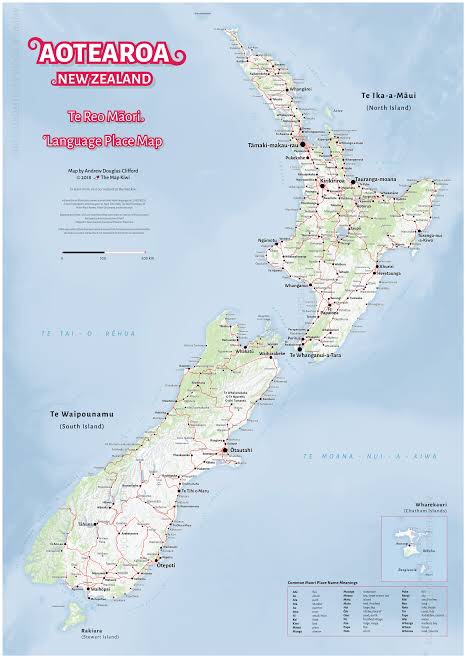
Well, it’s been grand. We started in Auckland three months ago, and we are returning to Auckland tomorrow. In between, we rolled down the middle and the east coast of the North Island, then crossed the Cook Strait to the South Island. There, we rolled down the east coast and up the west coast. We returned to the North Island, and we spent our last five days in New Plymouth.
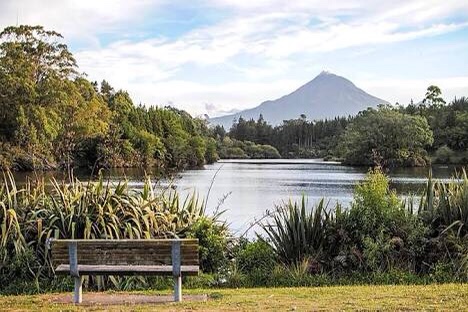
New Plymouth is the westernmost town on the North Island. It is an ocean town, a deep water port, with a mountain hovering over it. It is set on a volcanic peninsula, of which Mount Taranaki is the main volcano. It is 8500 feet in elevation, just a half-hour drive from the ocean. The ocean here is the wild west coast, sparsely populated, with big surf and secluded beaches. South and north of New Plymouth are some of the best surfing beaches in the country.
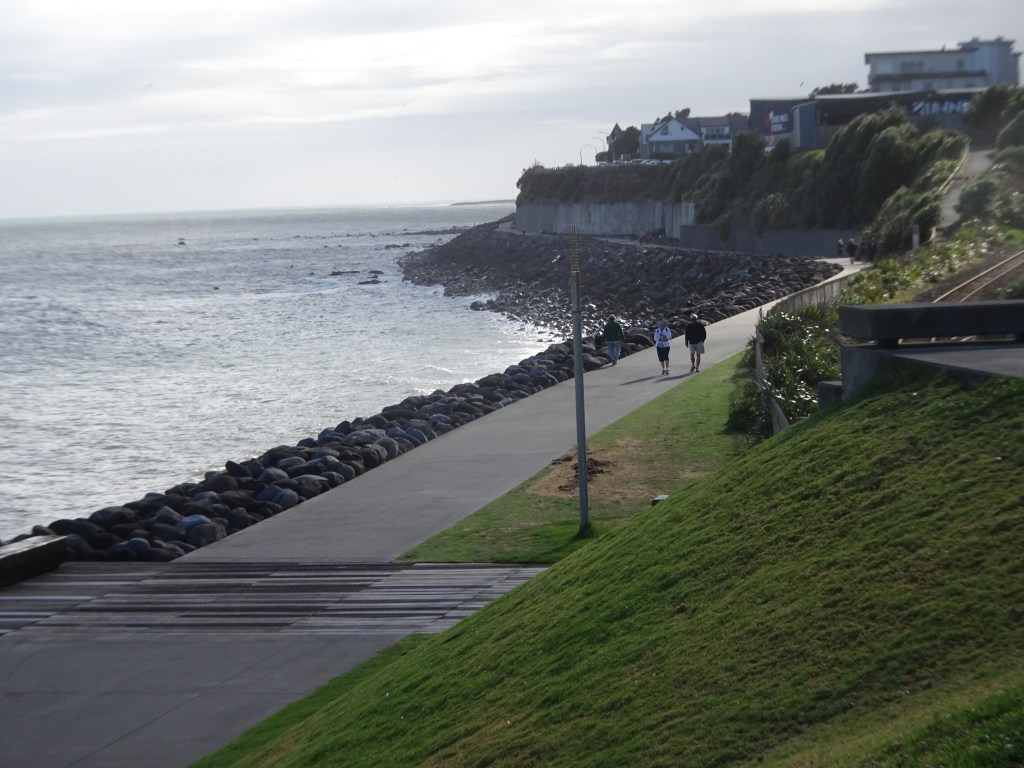
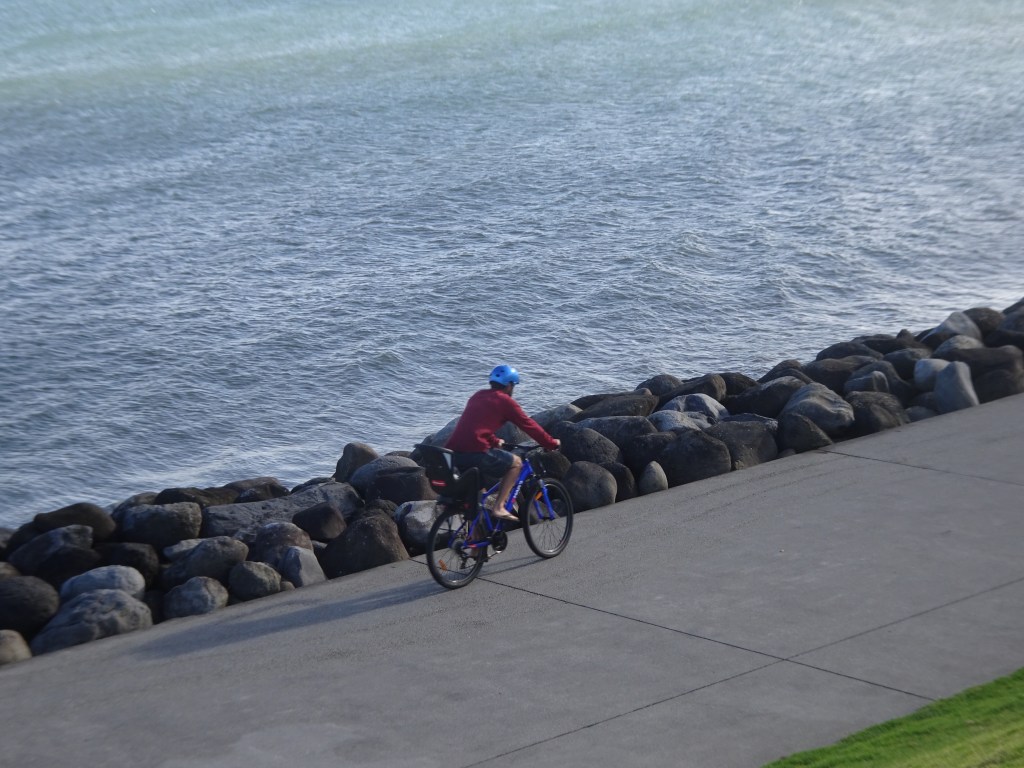
We spent one day exploring the coast to the south, and another day hiking in the mountain forest, and we we also spent time in New Plymouth itself. This is not a touristy part of New Zealand. The town is friendly and quiet, and it has a beautiful ocean walkway. It is uncrowded, with lots of good restaurants and art galleries and museums.
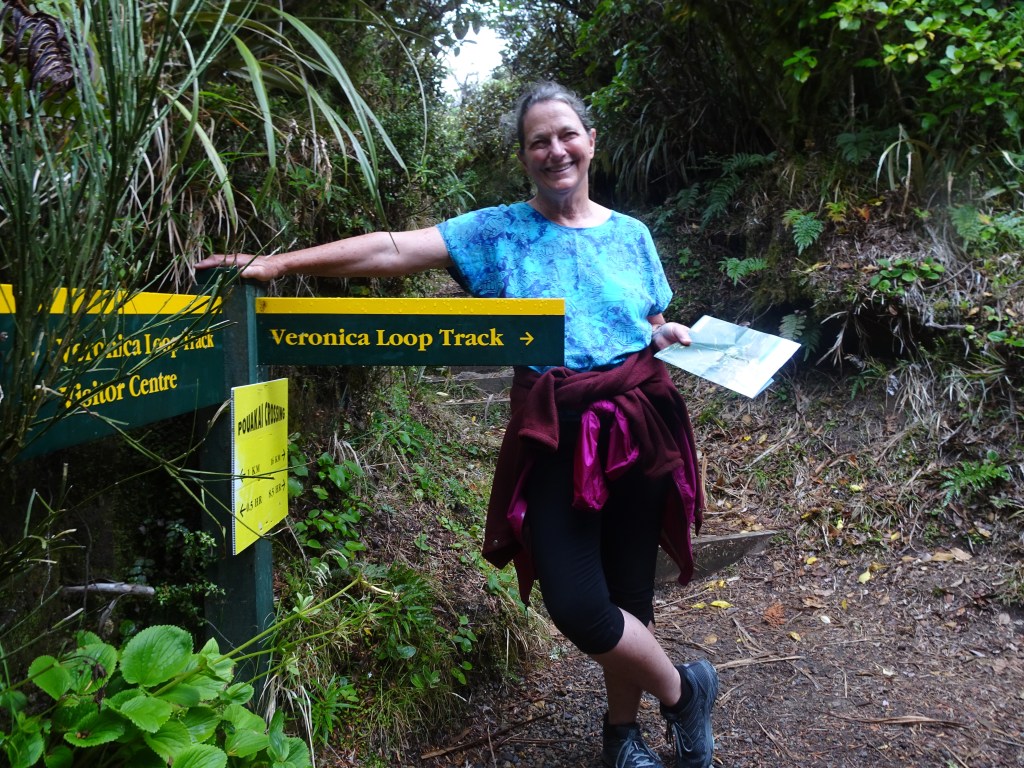
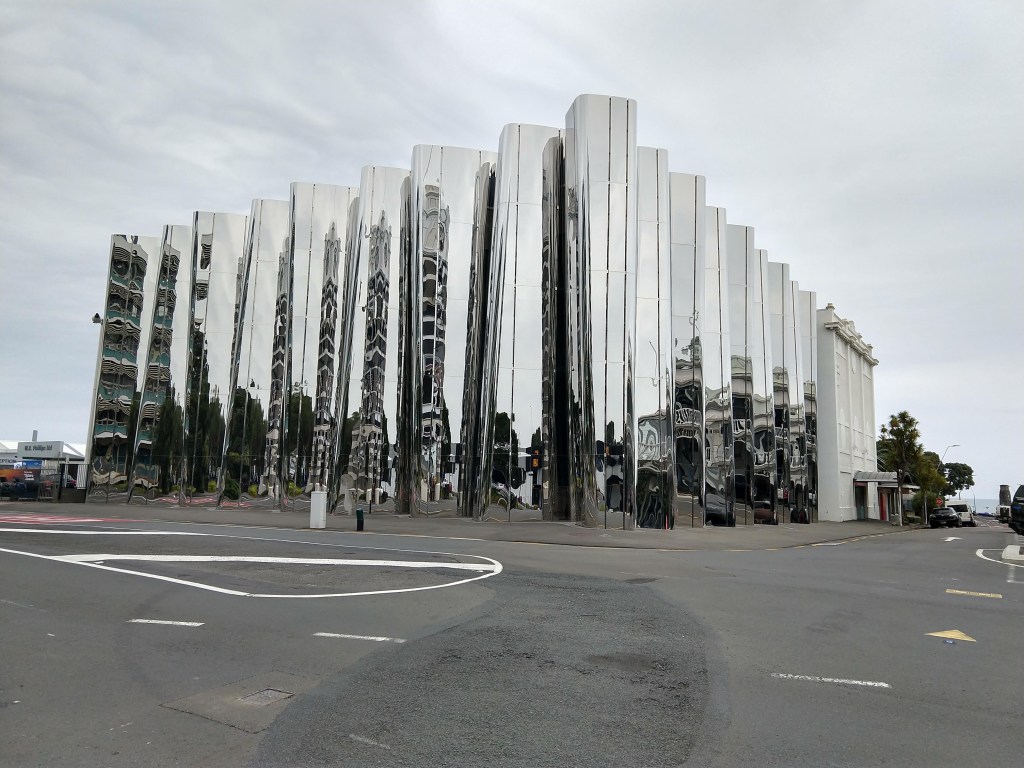
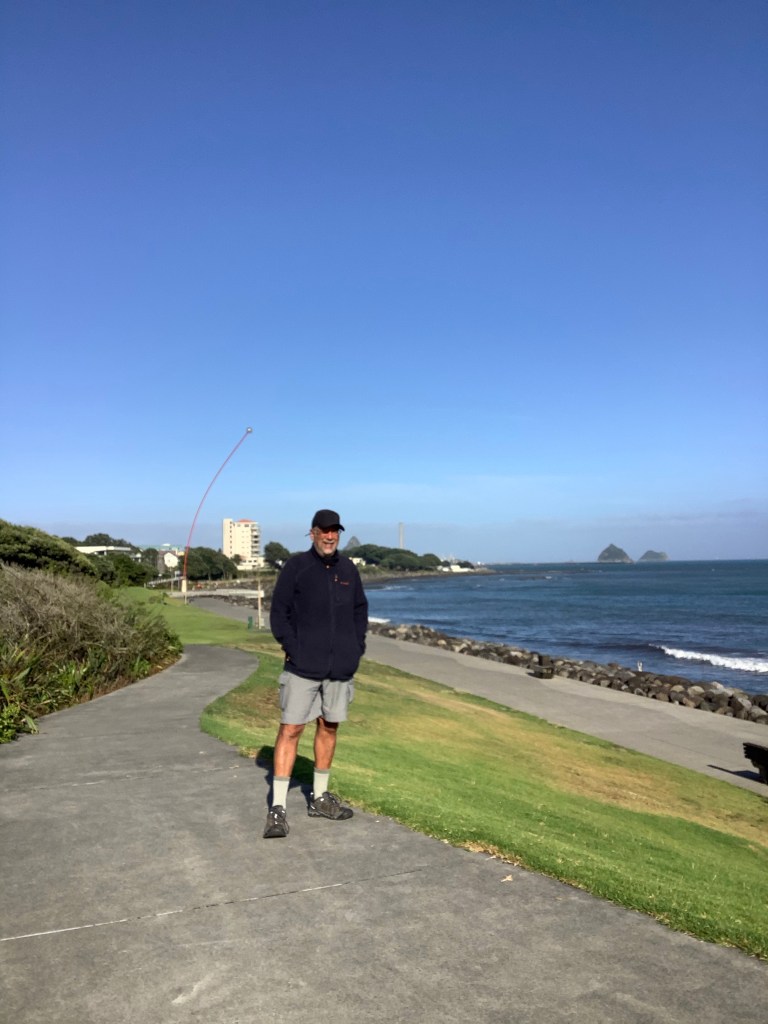
In the forest on the flanks of Mount Taranaki. We had a cool cloudy day up there. We couldn’t see the mountain, but the forest was lush.Len Lye Center and Govett-Brewster Modern Art Museum are world renown.The seafront walkway goes for twelve kilometers. Red pole in background is the Wind Wand, mobile sculpture by Len Lye, artist/filmmaker and one of New Plymouth’s native sons.
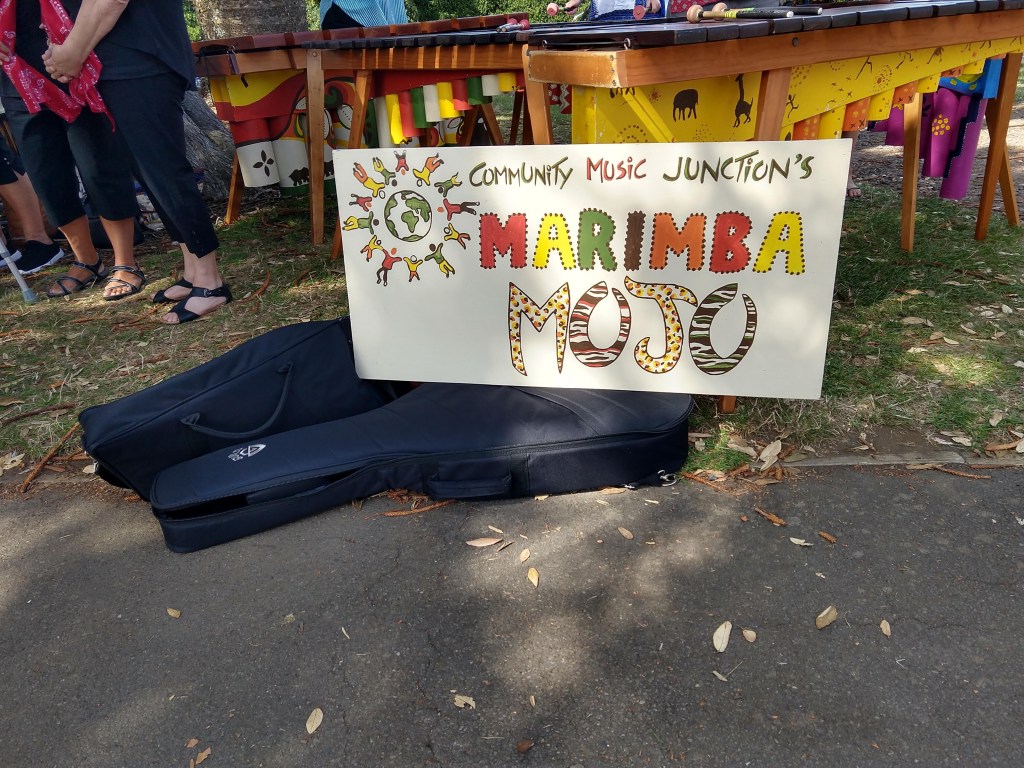
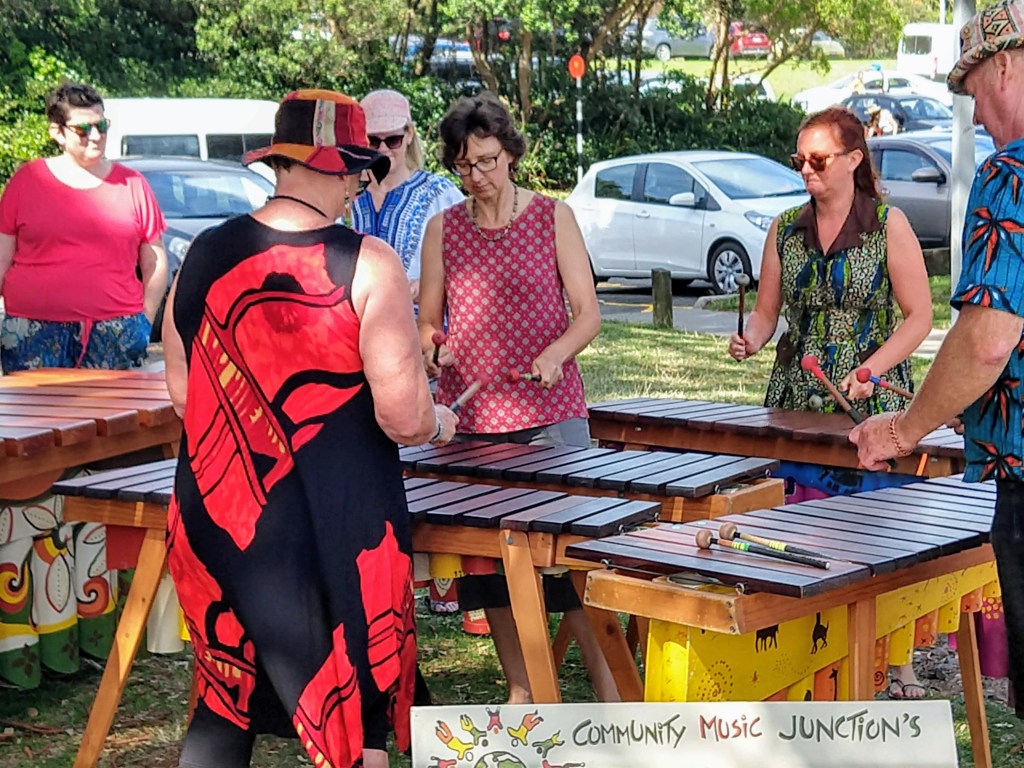
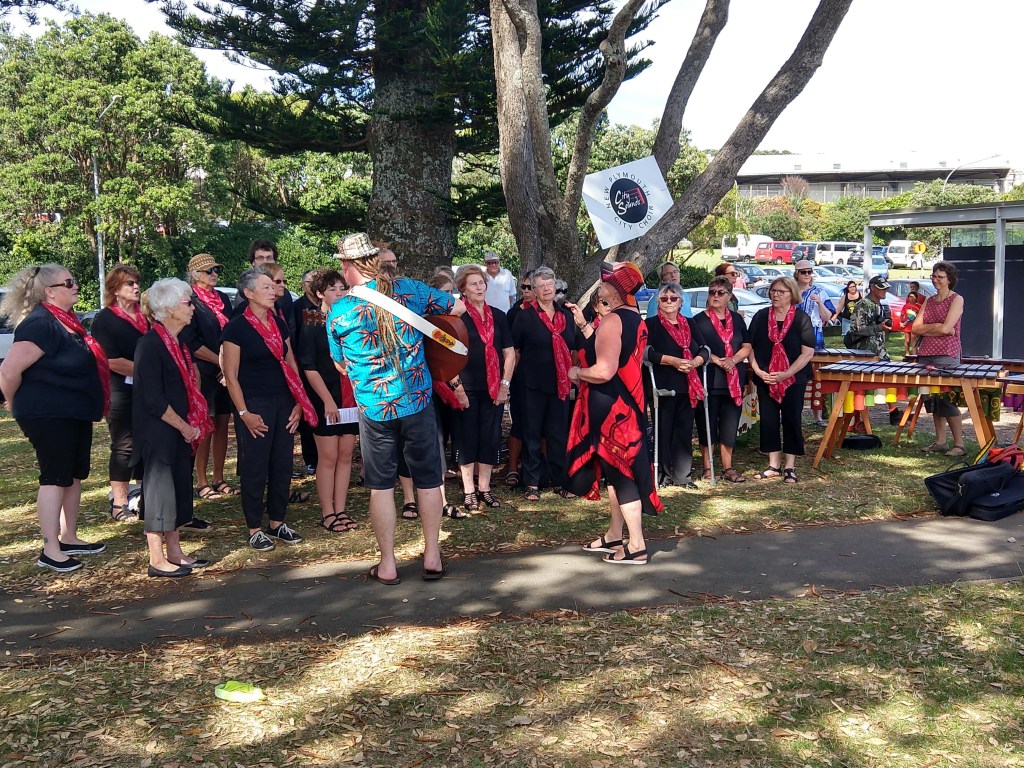
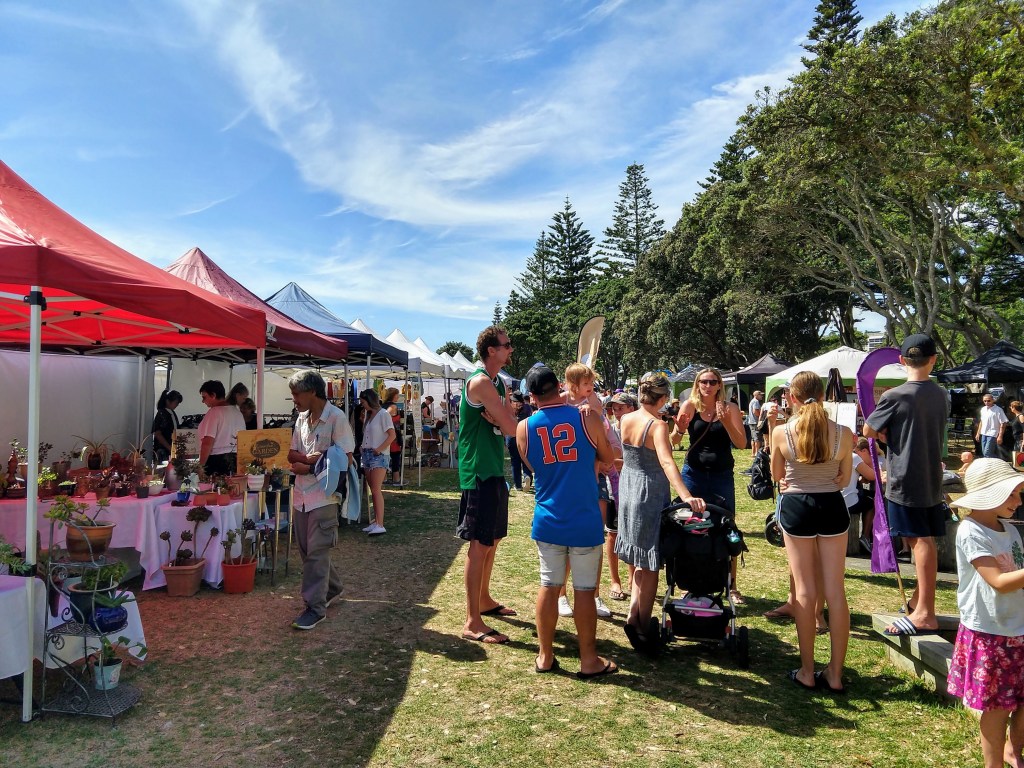
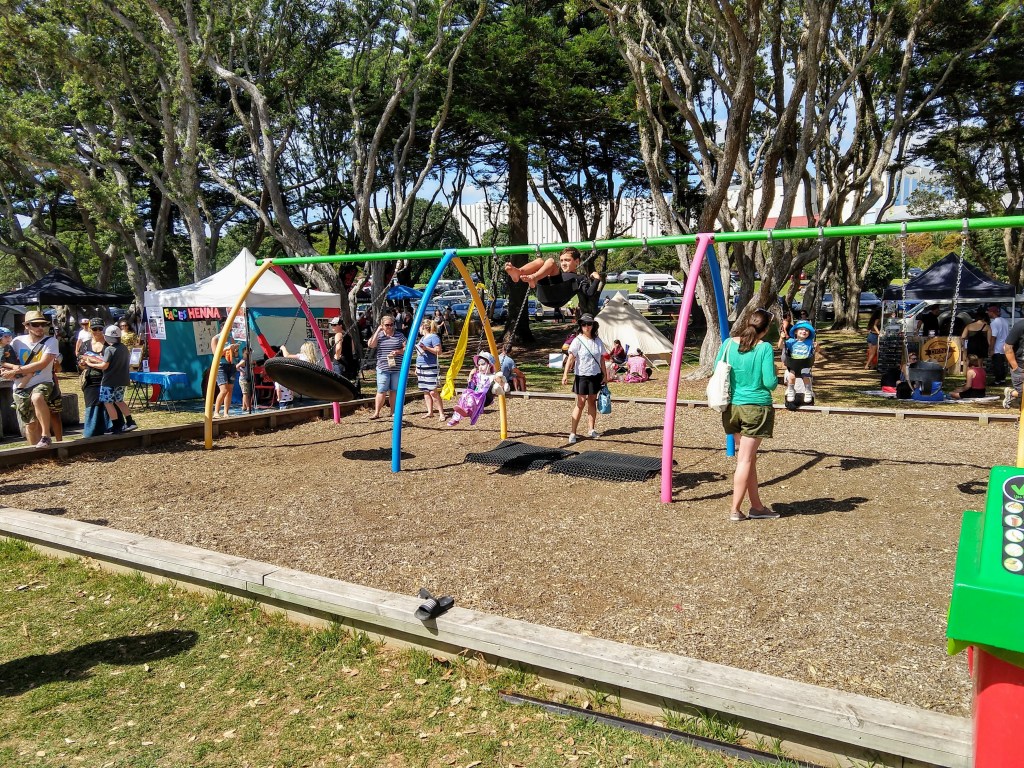
Every other Sunday, there is a Seaside Market. When we were there, it was a gorgeous sunny day. Lots of food booths, crafts, and a marimba band performing with the community choir. New Plymouth has lots going on, just not too many people. A good combination.
I bought a jar of hot sauce from these folks. He is hoping to quit his job as a cheese-maker to go full time into the hot sauce business.
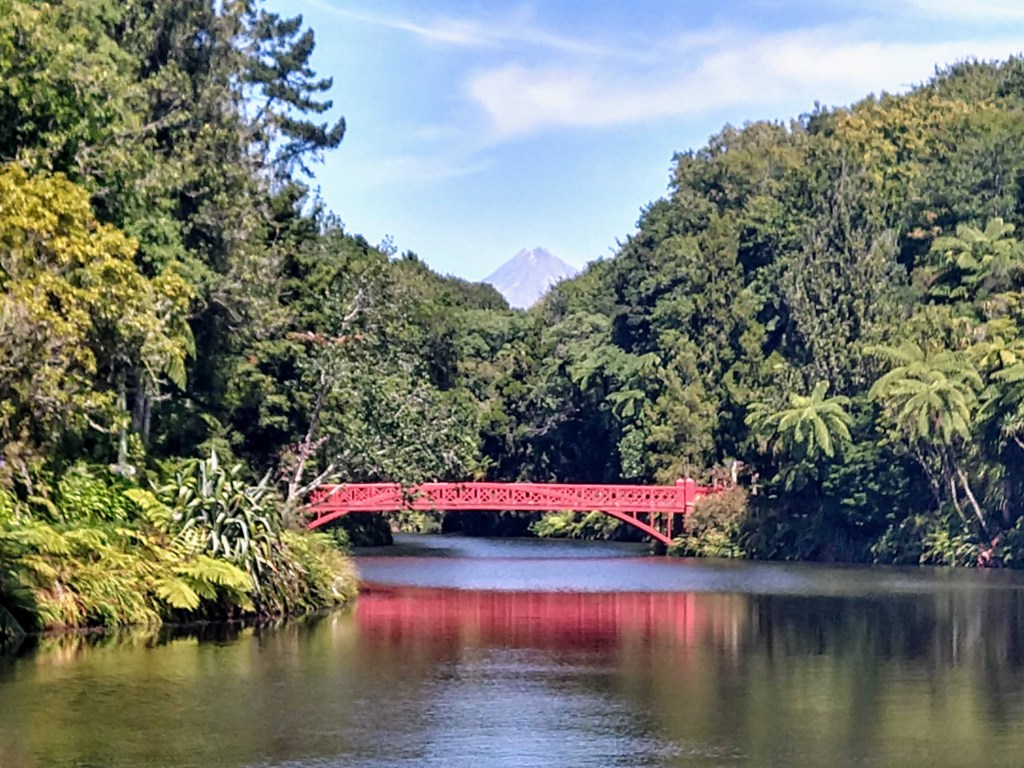
Pukekura Park
Pukekura Park is the heart of the city. We spent an afternoon there, wandering through green spaces. There are events here year-round, including the WOMAD Festival (World of Music, Arts, and Dance). This is a three-day international festival held every March. People stream into little New Plymouth from around the country and around the world.
Mount Taranaki in the background.
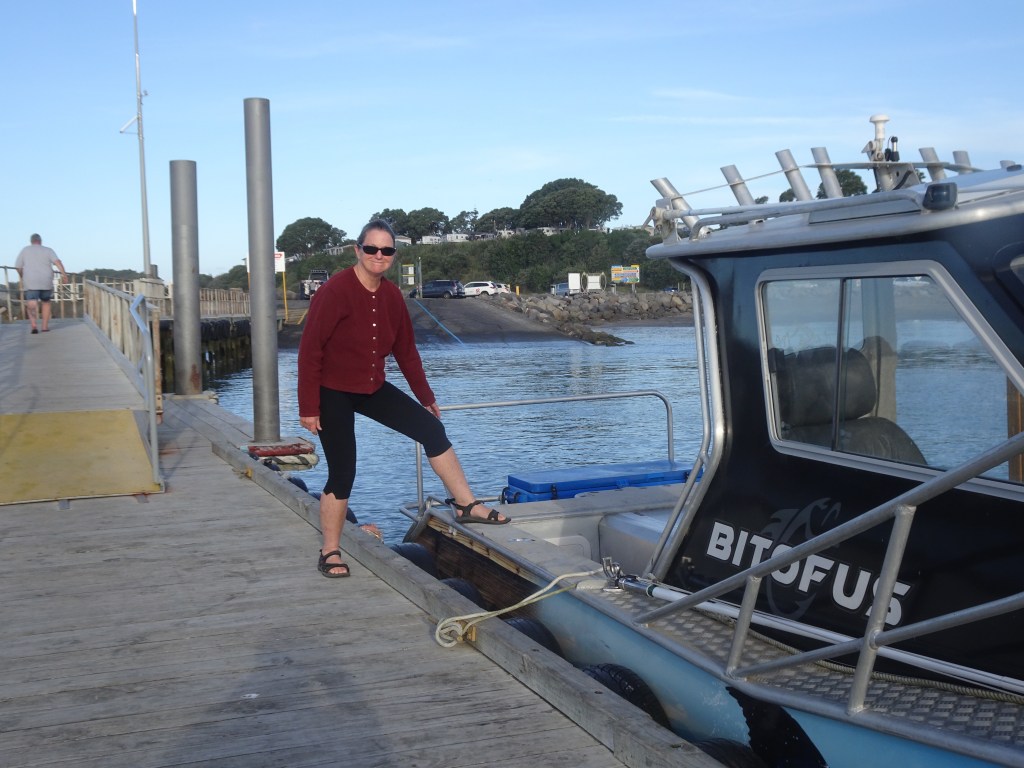
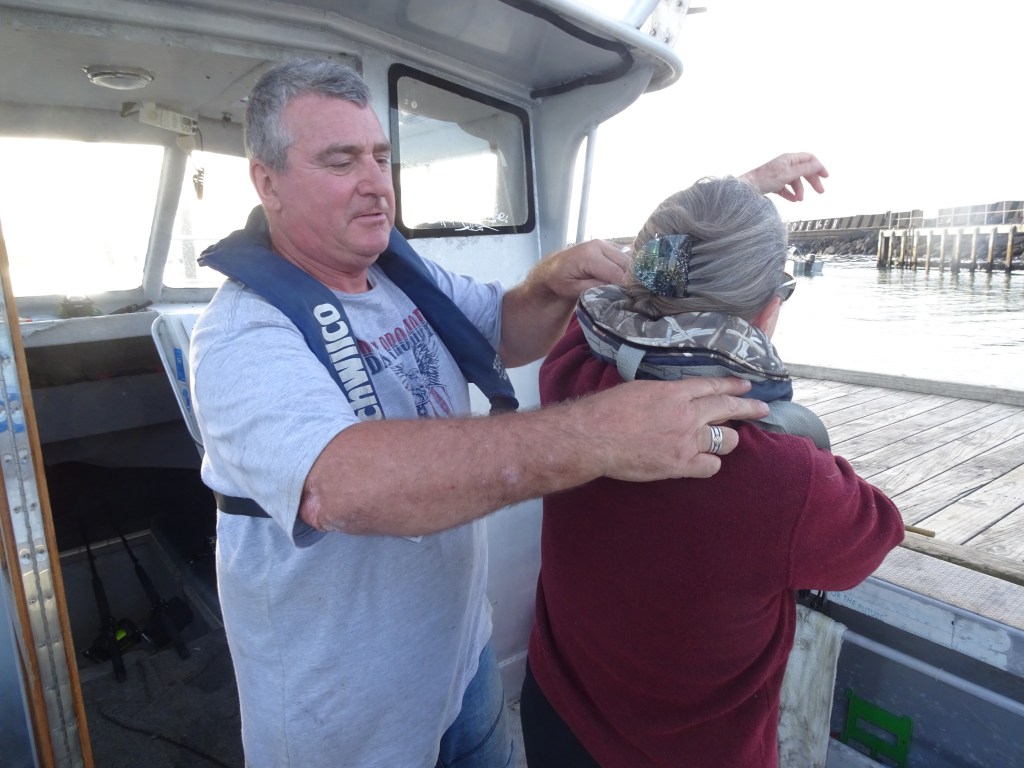
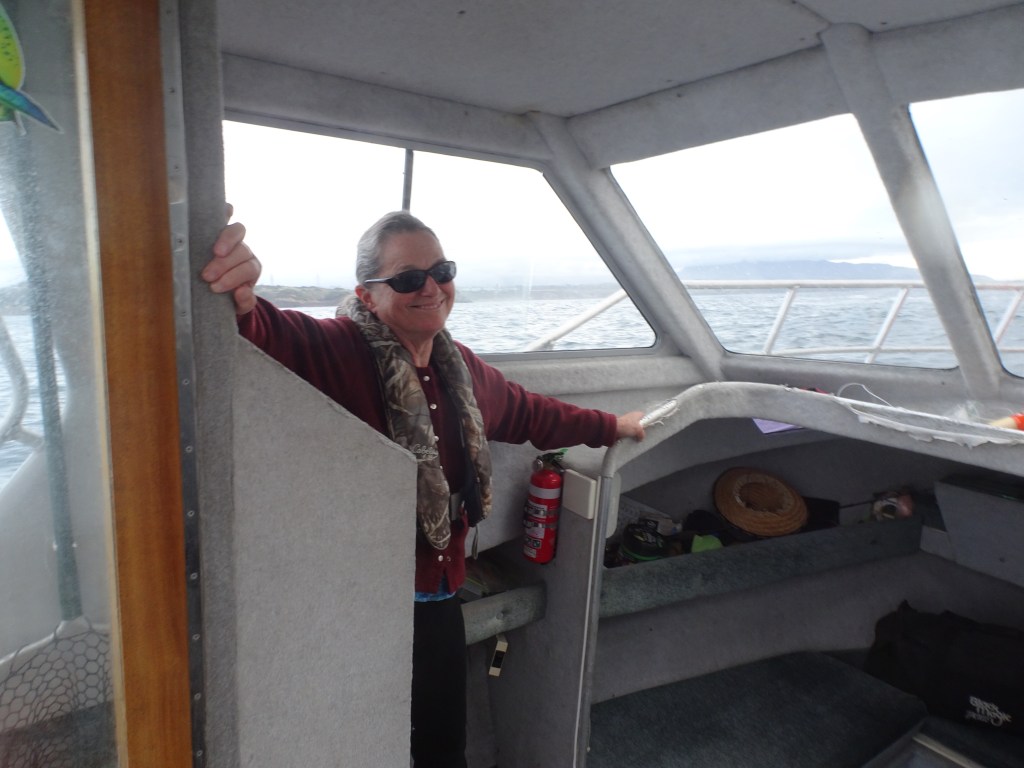
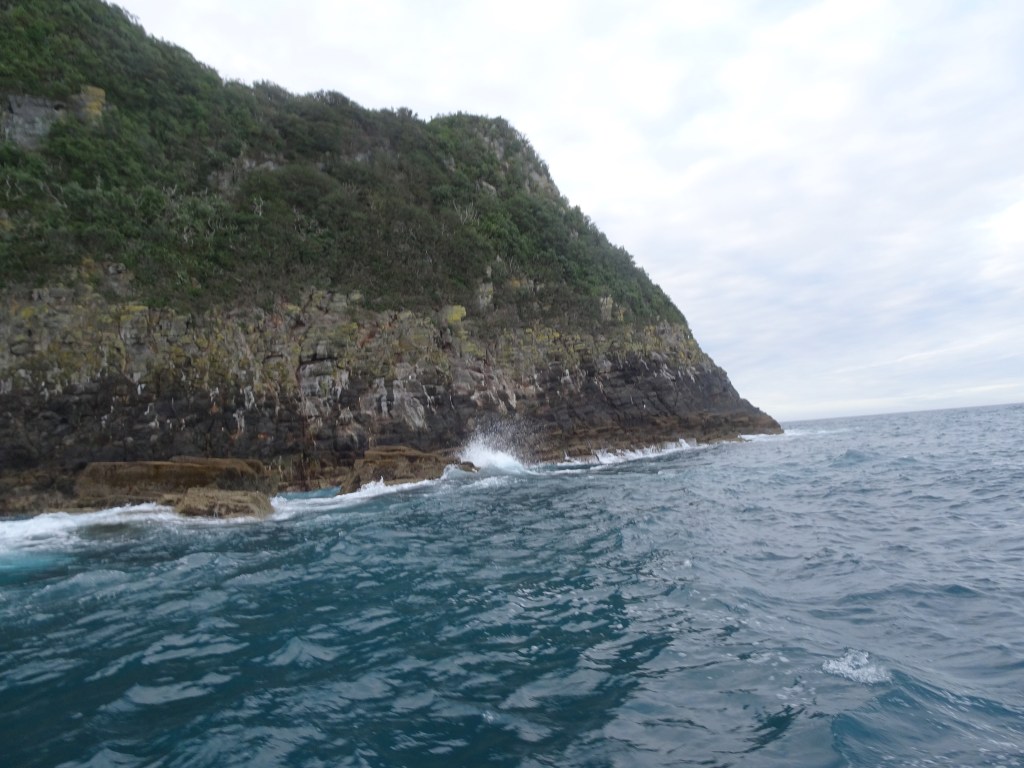
Our airbnb hosts were Donna and Wayne. Wayne took us out in his boat one late afternoon. He had just had some mechanical work done on it and he wanted to check it out before really taking it out to fish for marlin. We were in the “lumpy” sea for about a half-hour. Mike got to take the wheel, but the camera stopped cooperating in Mo’s hands.
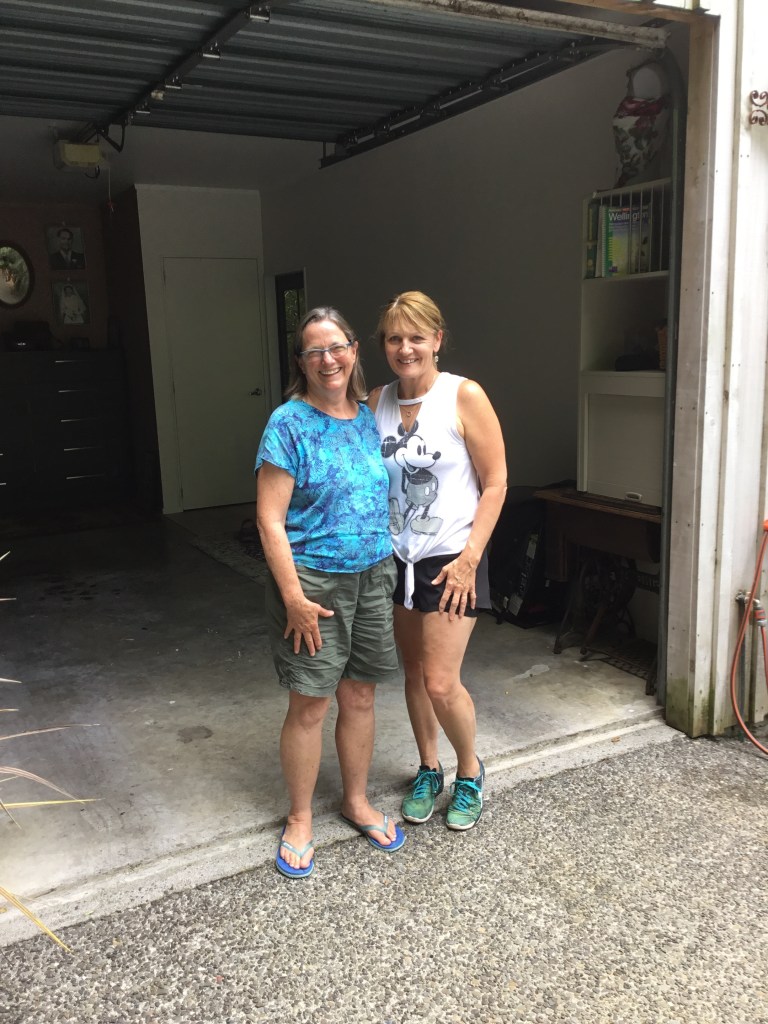
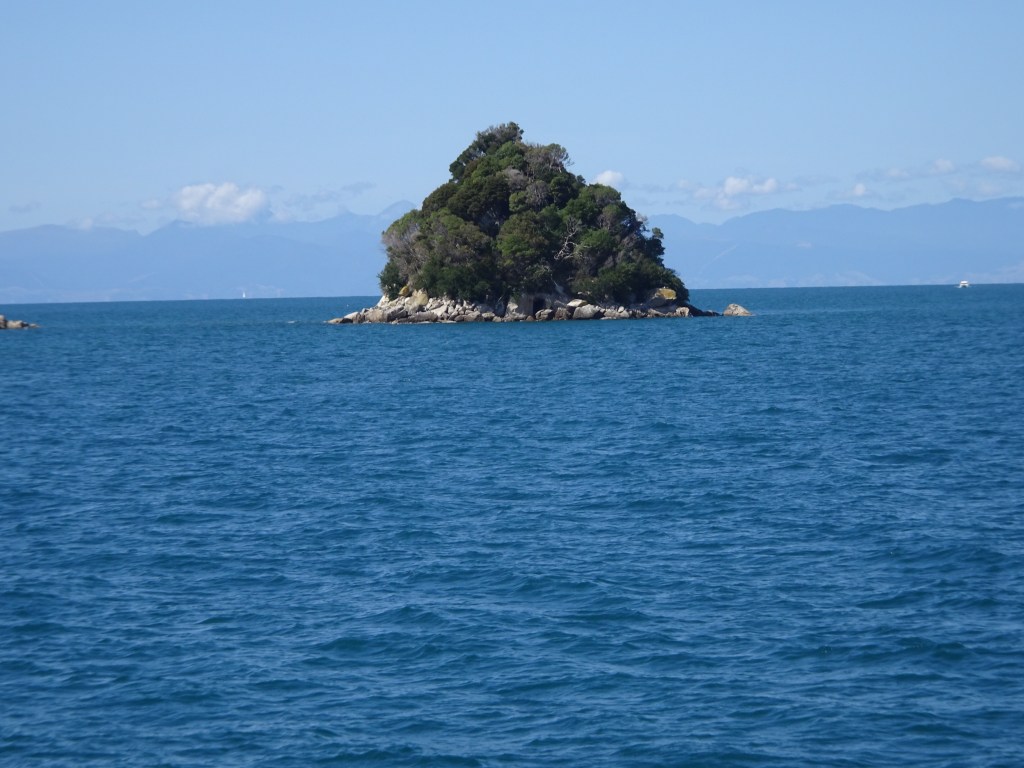
If we looked close, seal pups were resting on this rock island.Monica and Donna
New Zealand has treated us wonderfully every step of the way. We didn’t get everywhere, notably missing the north of the North Island and the south of the South Island, but we had the opportunity to see a lot of the country and to meet a lot of people. It’s great to know that these calm islands are here, a speck of land in the Southern Ocean.
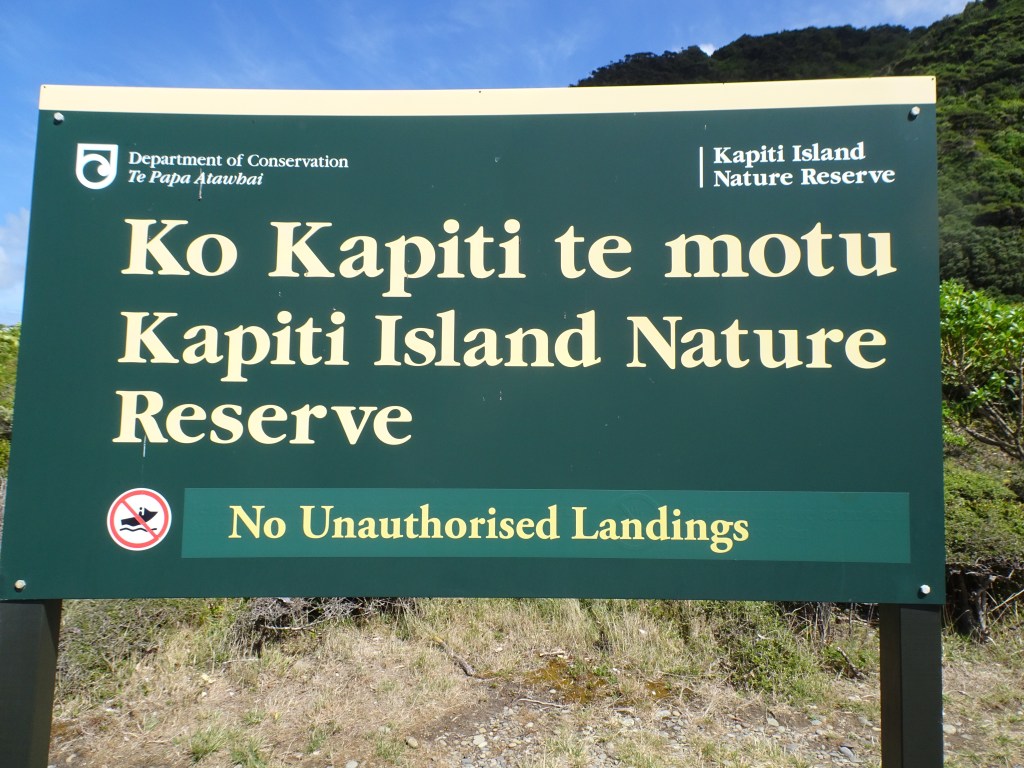
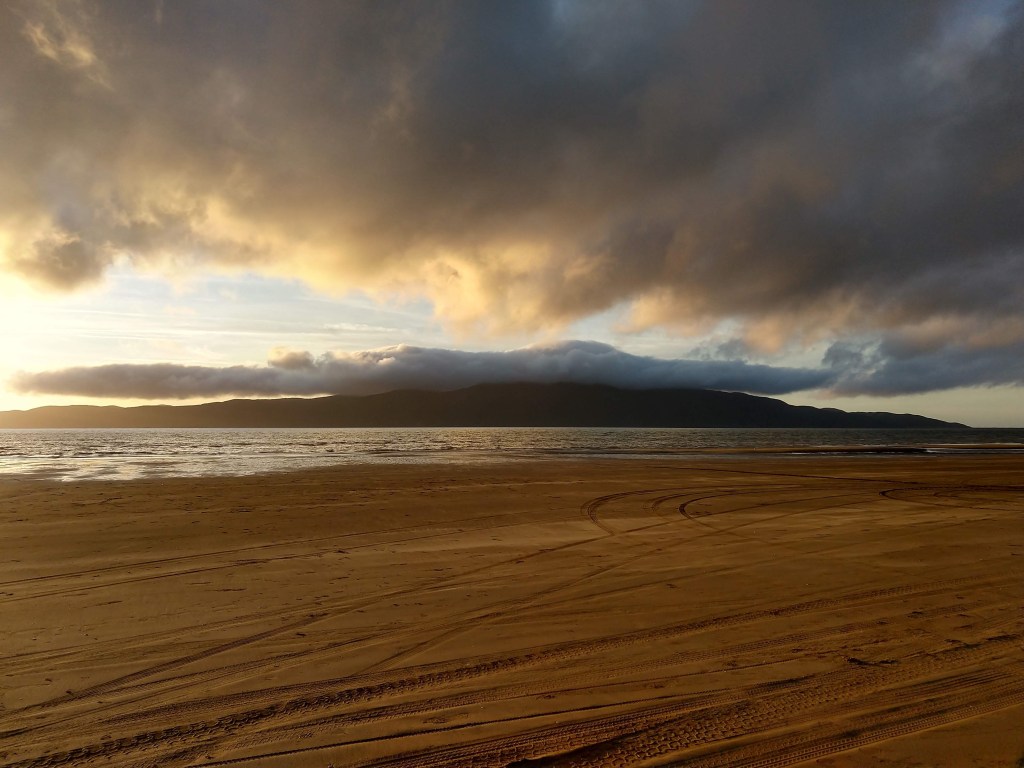
Kapiti Island, capped with a Kapiti Cloud, seen from the mainland.
First of all, it is pronounced like yappity, or yoppity. And second of all, it is one of New Zealand’s sanctuary islands, a world with its own history, separated from the mainland, and an inspiration and hope for that separate world.
New Zealand has long been one of the world’s pioneers and leading thinkers in the conservation movement, and Kapiti Island was one of the first places in the world to prioritize preservation of nature over progress. It was declared a bird sanctuary in 1897. At the time, it had already been overrun and brutalized by an intense century of human activity. It was a whaling center for twenty years, from 1830-1850, until all the right whales were exterminated. Then its forests were burned for the benefit of farming and sheep. In 1897, the New Zealand government formally bought the island and began the process of ridding the island of all mammals (sheep, goats, cats, dogs, horses) and reintroducing native birds.
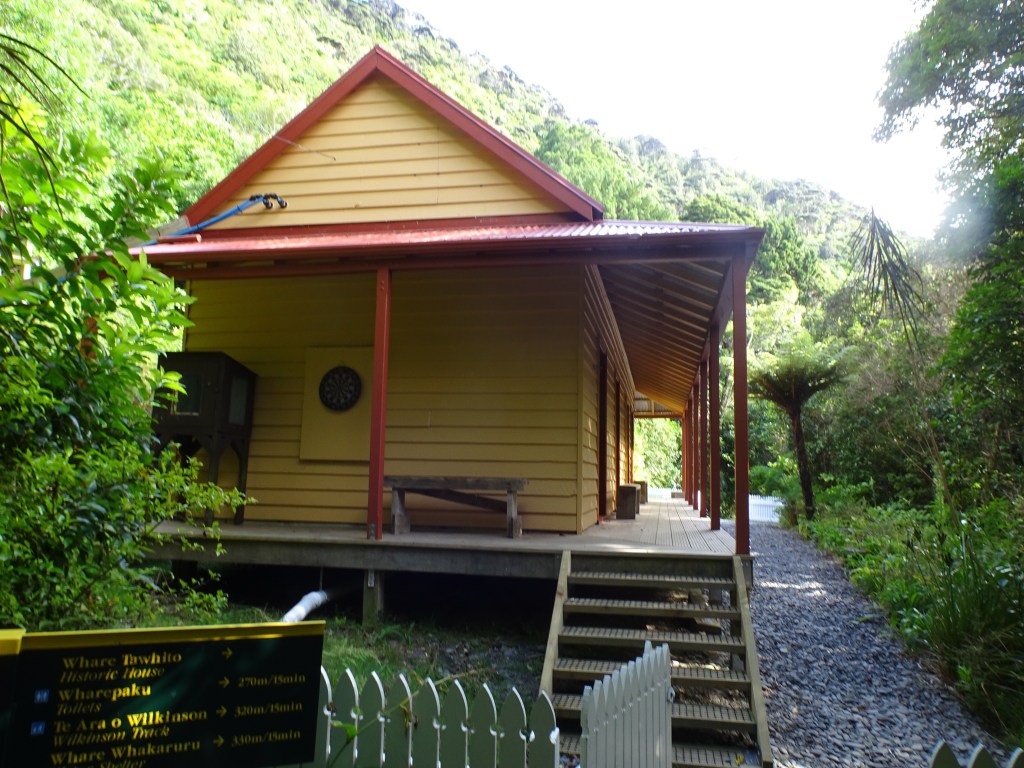
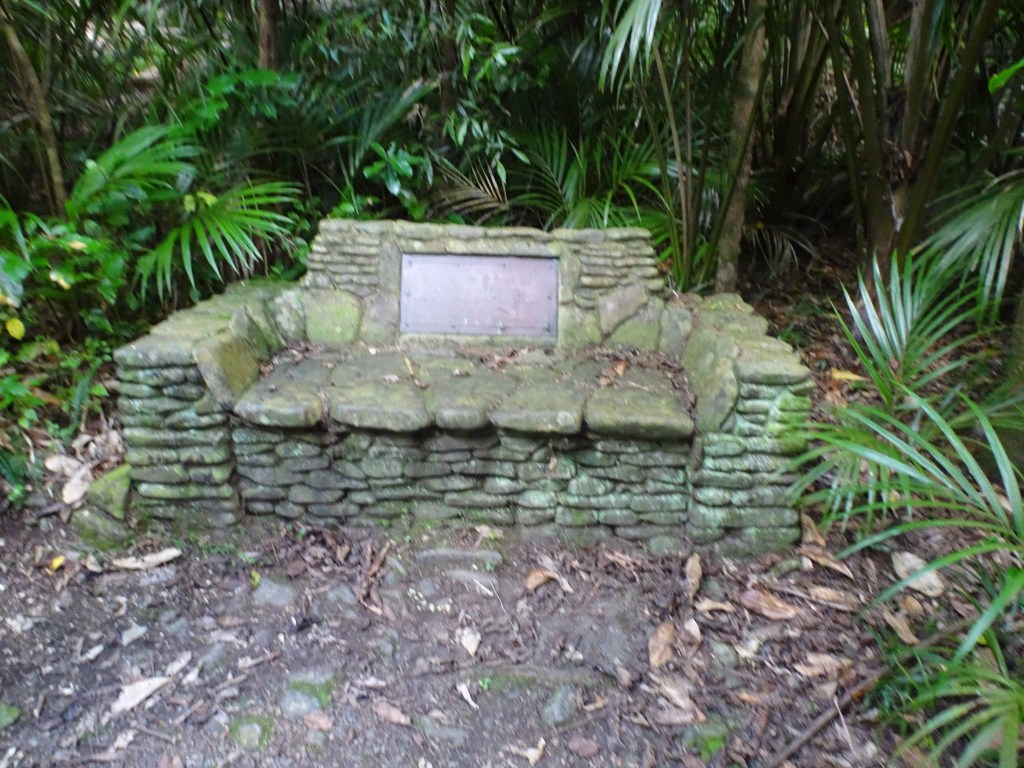
The first caretaker’s cabin, built in 1897. The idea of translocating birds to safe places originated here.
Trees were not planted, but everything was allowed to grow. During most of the twentieth century, the forests regrew and the birds barely survived. The problem was possums and rats. In the 1980’s, the government got serious about the predator problem. They started with the possums. 20,000 possums were trapped and killed between 1980 and 1986. There were only a few left. But the thing about making a sanctuary island safe is that you have to be ruthless and relentless and brutal. Every single predator must be eliminated. If you leave one pregnant female, they will repopulate. One single pregnant rat can theoretically produce over 10,000 rats in three years. It took the government two more years, of tracking and hunting with dogs, to eliminate 32 more possums. Rebekah White writes in the January 2020 issue of New Zealand Geographic,
“Something is going to die. It will either be possums, mustelids (weasels and ferrets) and three species of rat, or it will be most of New Zealand’s native birds and an unknown number of plants and invertebrates. You have to choose. Inaction is a choice.”
New Zealanders have chosen. There is a strong national will to bring back the birds.
A word about possums. New Zealand possums are not the same as North American possums. The ones in North America are actually “opossums,” and in Australia and New Zealand they are “possums.” Very different creatures. The ones in Australia and New Zealand are predators. They eat birds and their eggs. They can destroy forests. They are also cuter than the North American ones, and you can make lovely sweaters from their fur.
Rats are different that possums. You can’t trap them to extinction. The government took a more radical step. In 1996, after five years of study and trials, they used helicopters equipped with GPS to dose the entire island with poison, and then two weeks later, they did it again. The trials were to see whether birds would be tempted by the bait. Some were, and they were removed before the real thing. They meticulously monitored the island for two years. At the end of two years, in 1999, Kapiti Island was declared finally and totally predator free. The results have been amazing.
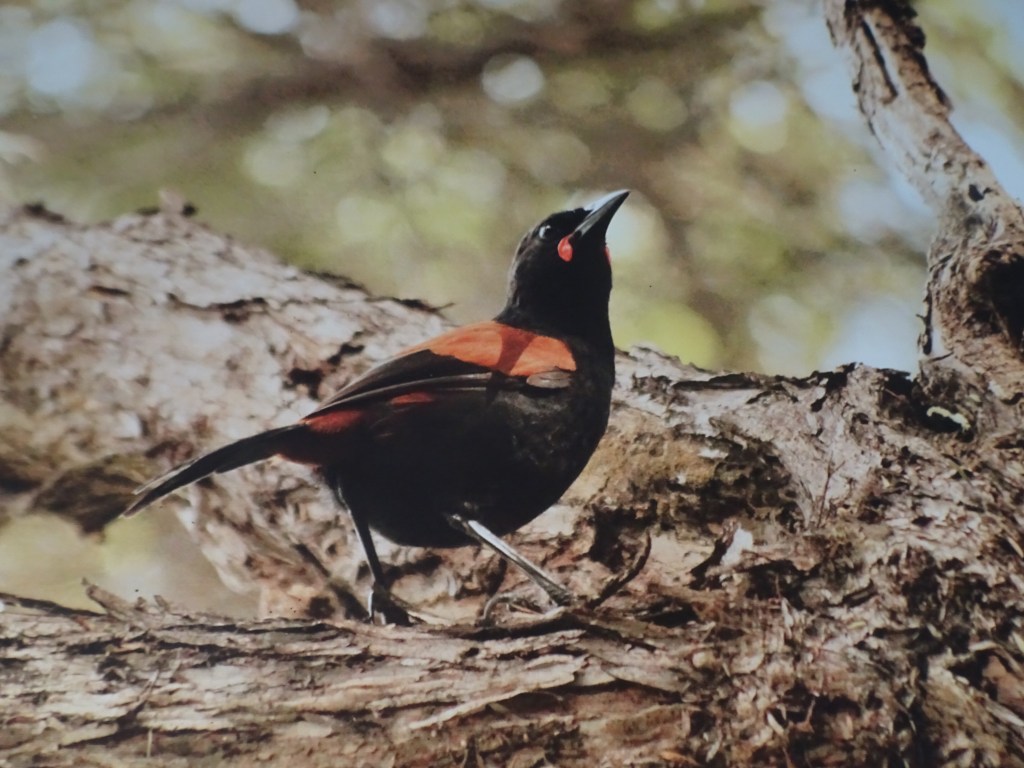
(New Zealand Birds Online)
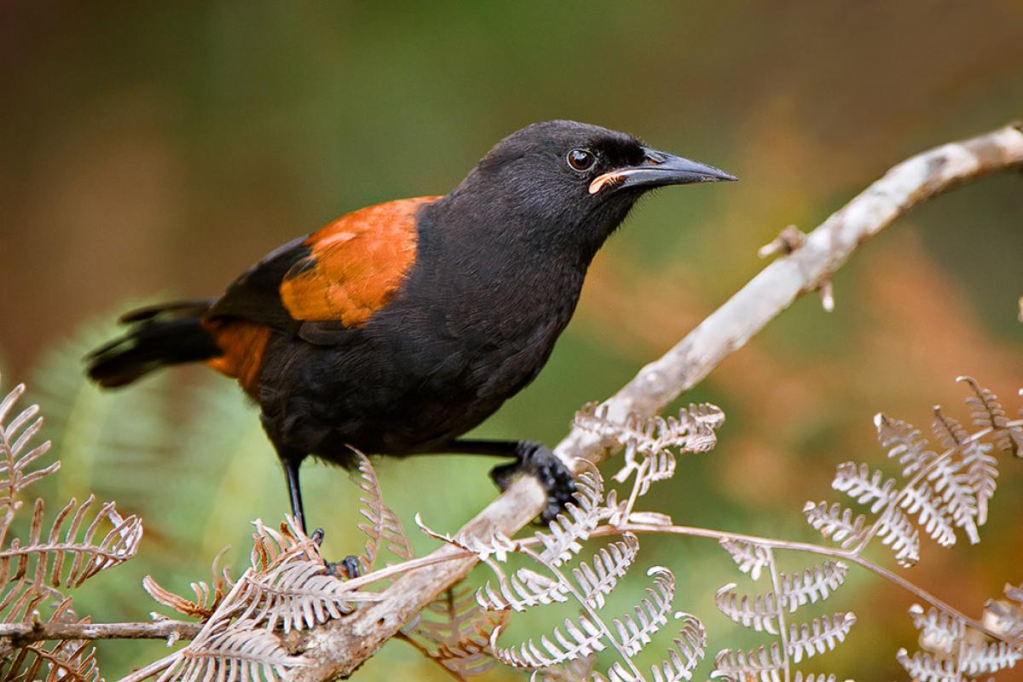
The North Island Saddleback was actually declared extinct in the 1920’s. New Zealand is the only place in the world it lives, and it was decimated by rats. It is mainly a ground-dweller, and it is a very weak flyer. It lives on the ground and hops around in the bushes. It had evolved for millions of years and was very successful, but it was no match for the rats who arrived in the 1800’s. Now there are hundreds on Kapiti, and they are being translocated (moved) to other sanctuary islands.
It’s not just the saddlebacks, although it was thrilling to see them while we were there. We probably saw twenty of them in our limited time.
Being on the Island
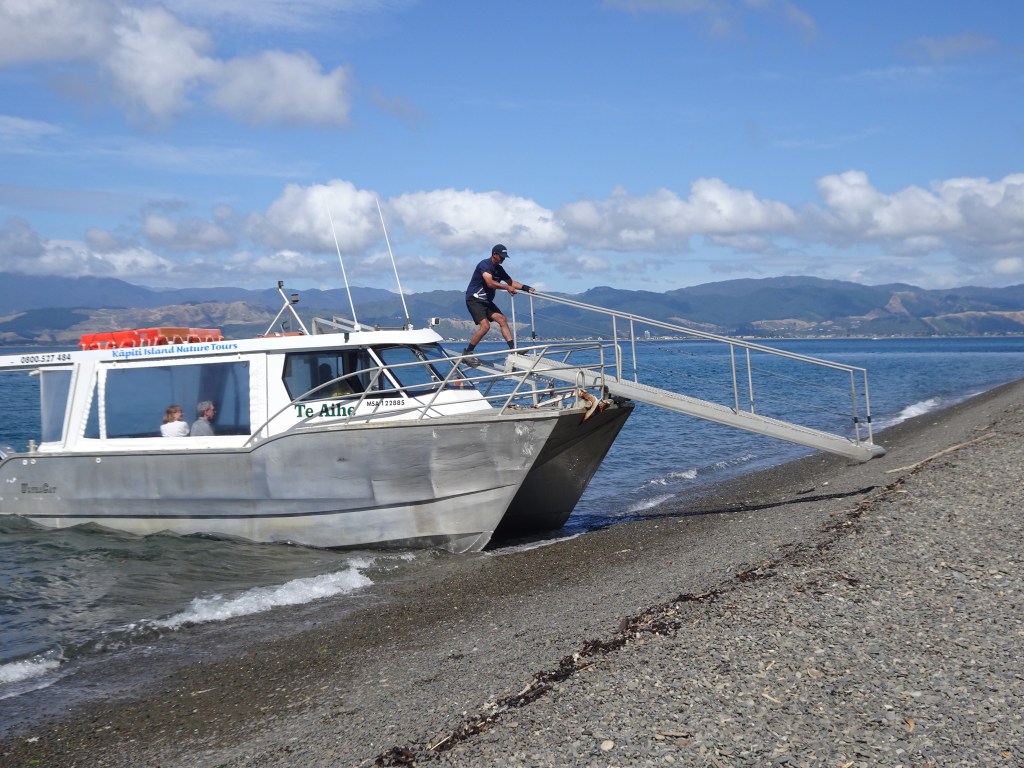
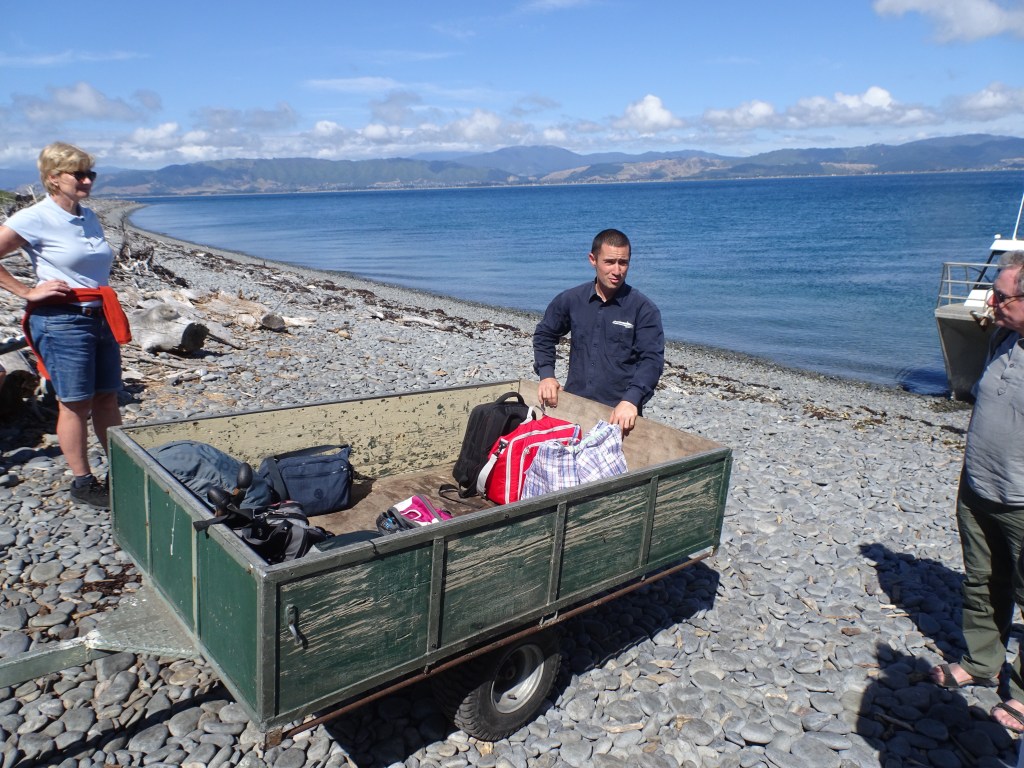
The island is five kilometers from the mainland. We were dropped off on the beach.Menaaki was our host and our guide. His great great great grandfather was the chief here, and his great great grandmother made sure the land stayed in the family’s hands.
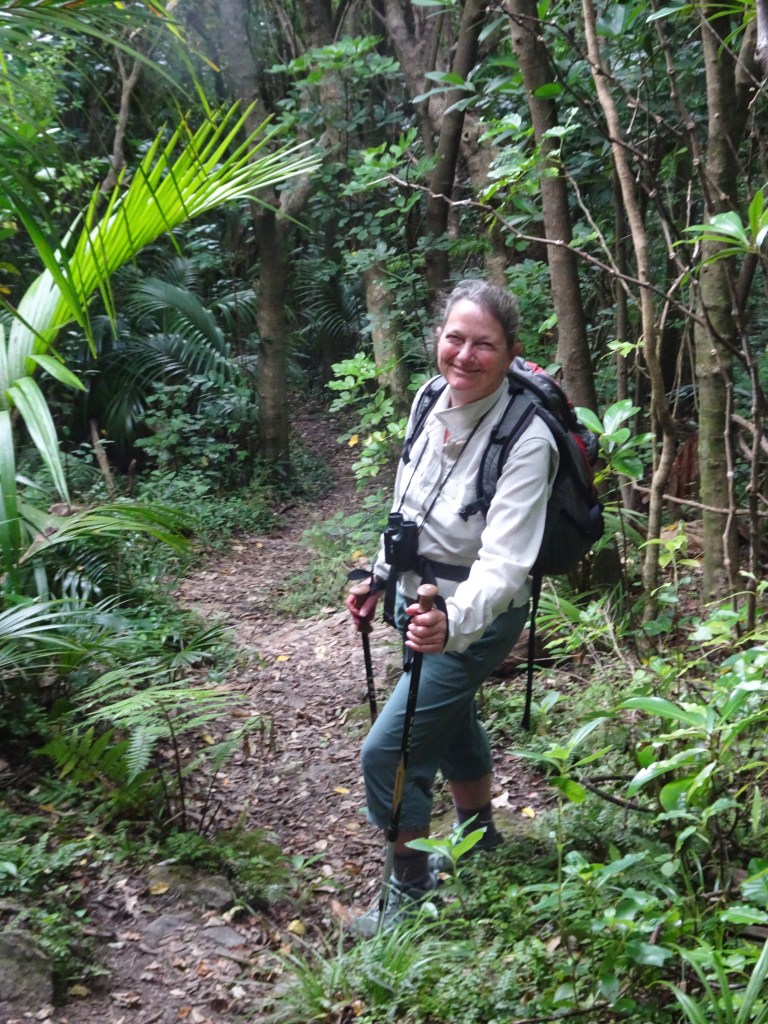
The island is ten kilometers long and two kilometers wide. Most of it is owned by the New Zealand Government (Department of Conservation, DOC) but the northernmost corner is owned by the Family Trust, of which Menaaki is one member. Every member is a descendent of his great great grandmother. We arrived at 9:00 in the morning and stayed overnight. We left at 3:00 in the afternoon the next day. There were 18 of us who spent the night. Six people from Holland, six people from USA, four people from New Zealand, and two from Isle of Man. All of us there for the birds. It was fun spending time with all these bird nerds and nature nuts, getting excited about saddlebacks and spoonbills. The first day, after receiving an orientation, we hiked up a couple of trails into the forest, and were serenaded by the birdsong. When we first arrived and went into the visitor shelter for the orientation, Monica and I both thought separately that they were playing a tape of birdsongs. It was loud and melodious. Chirping and singing. But it was no tape. The island is just full of birds. Even so, it is nothing like it was. Captain Cook wrote in his journal that his men could not sleep on the island because the bellbirds and tui were so numerous and so loud. They rowed back to the main ship to escape the noise.
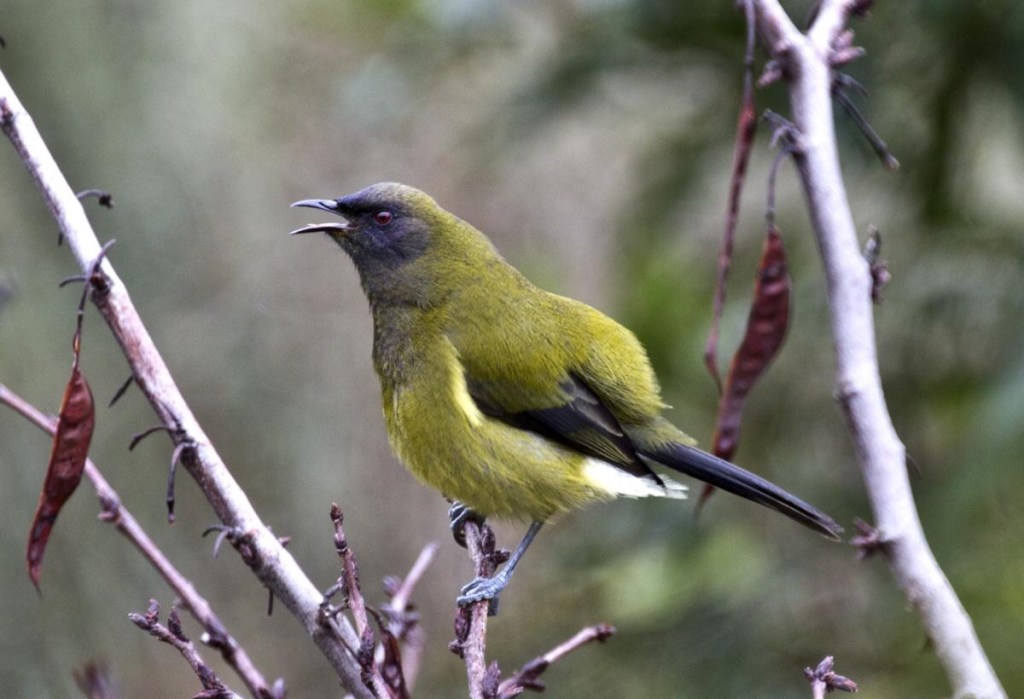
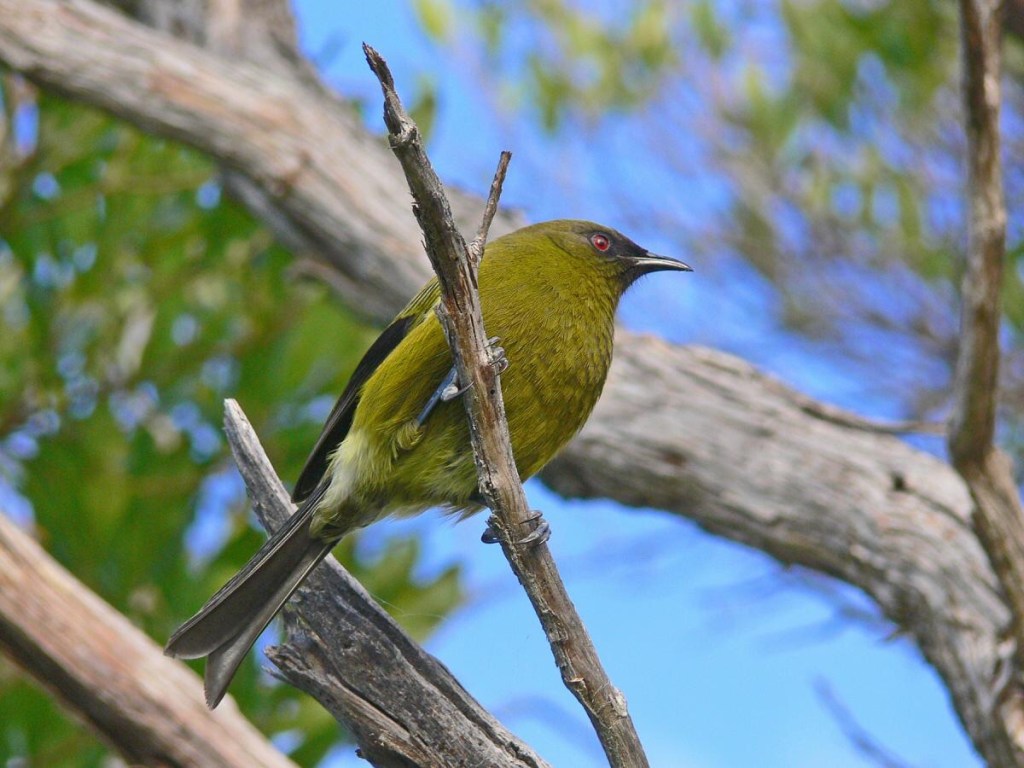
A perfect place to sit and wait. The birds will come. Bellbirds are all over the island. They sing out loud and proud. We saw them at Abel Tasman also.
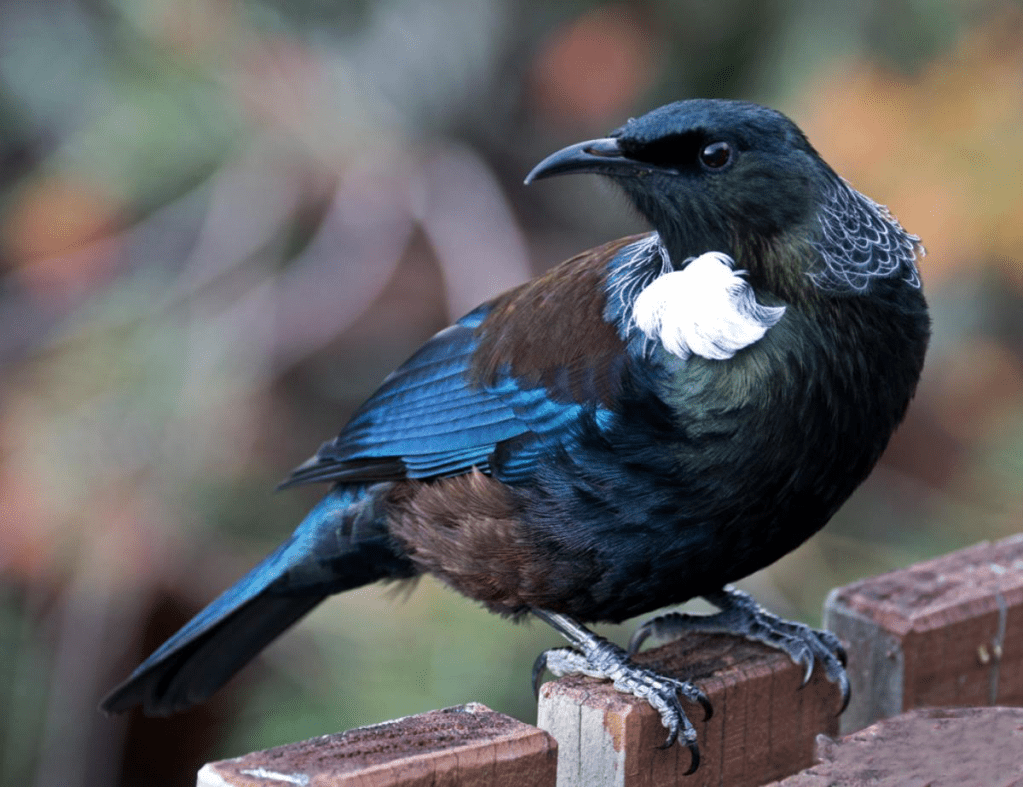
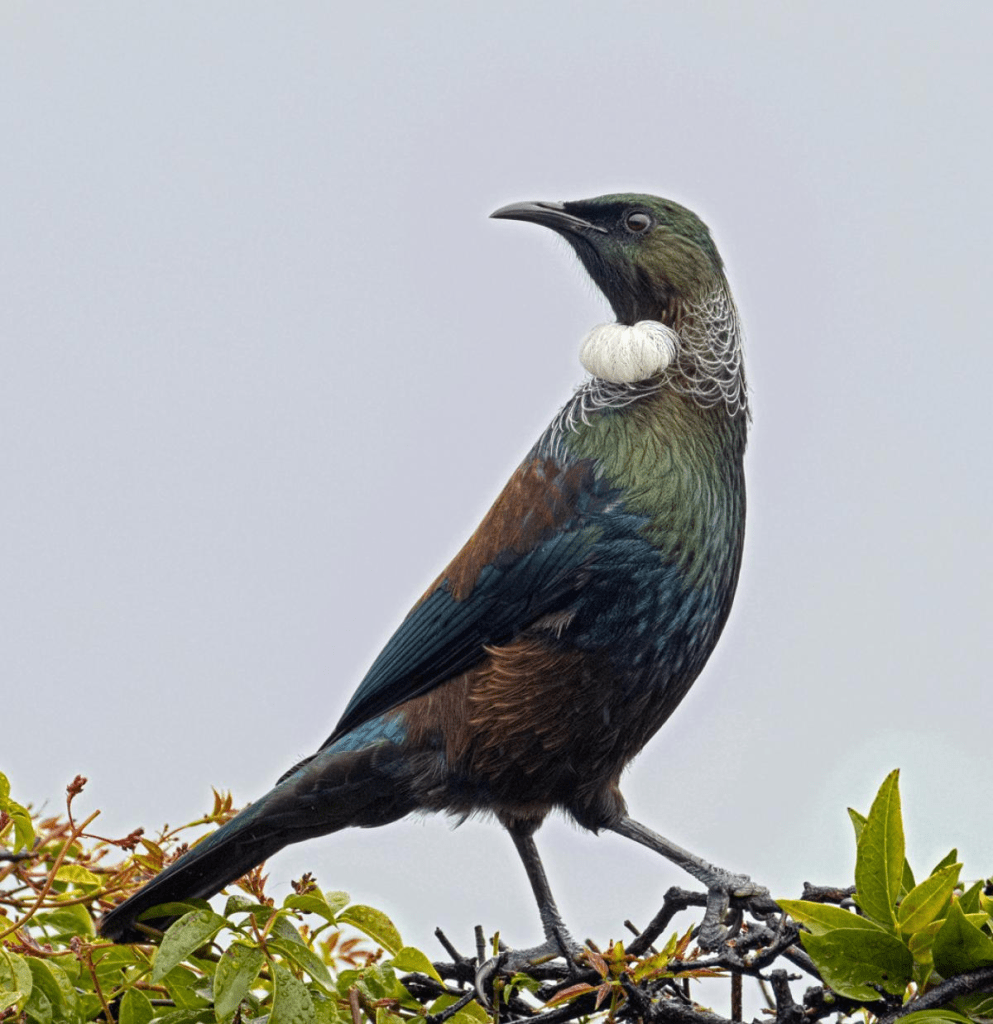
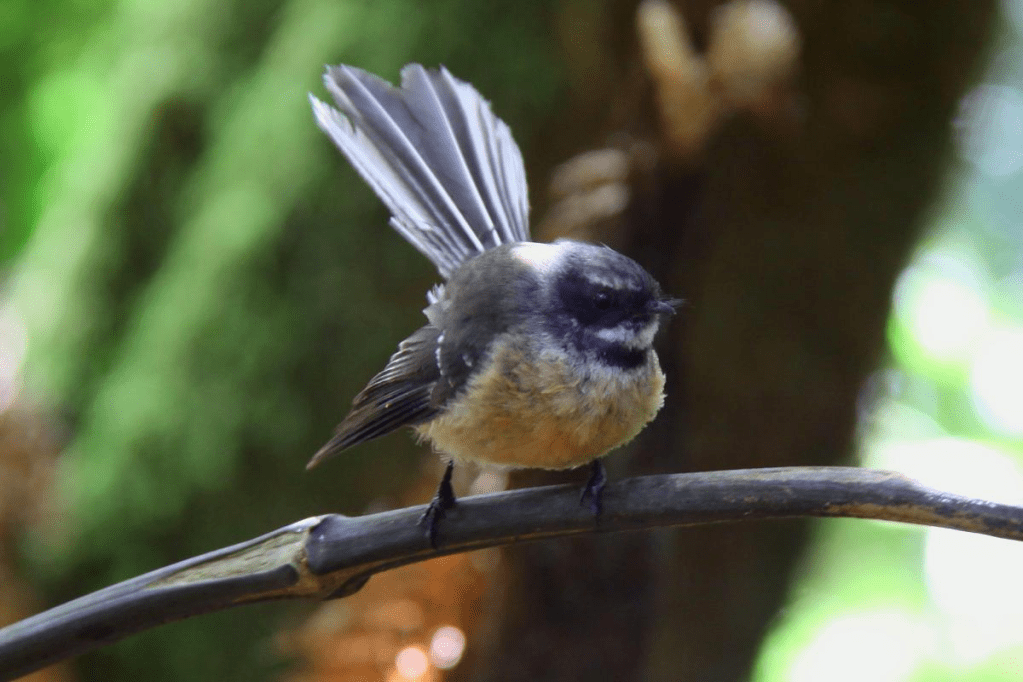
It’s almost impossible to differentiate the songs of the bellbirds and the tuis. The tuis are mimics, and they love mimicking the bellbirds. We have seen tuis everywhere in New Zealand. They are big and bold and very territorial. They fly noisily right over your heads. Usually they appear solid black, but when the light hits them just right, they explode into brilliant blues and greens and browns. The bellbirds, tuis, and fantails are all endemic here. Our three favorite birds.
NZ Birds Online
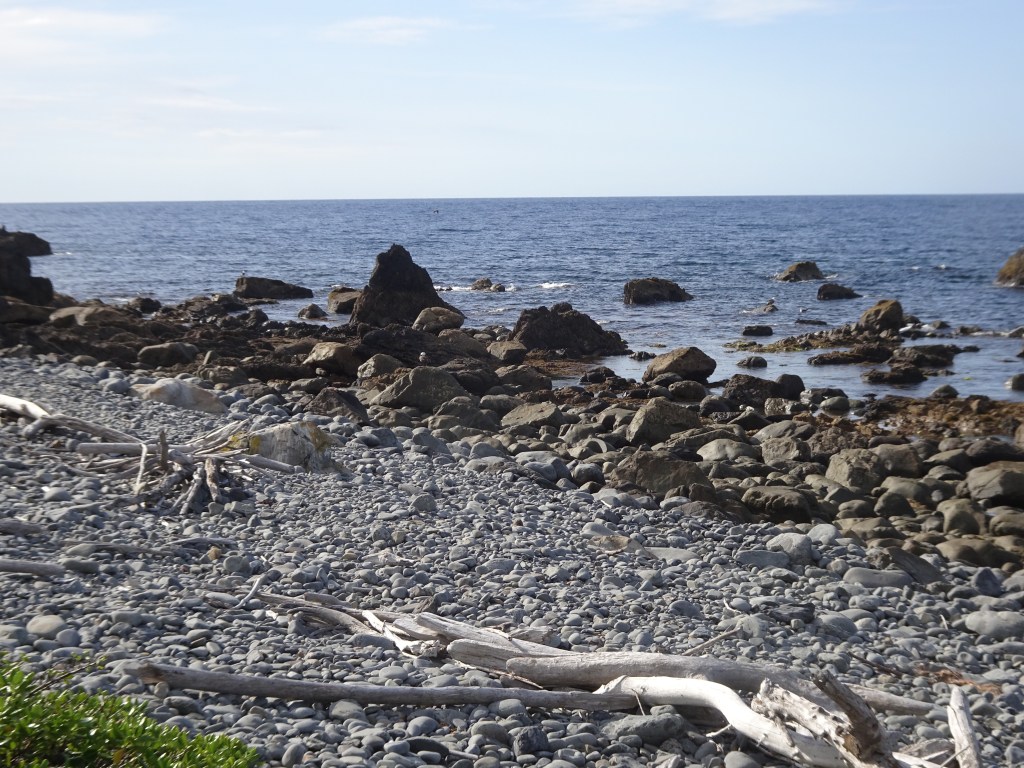
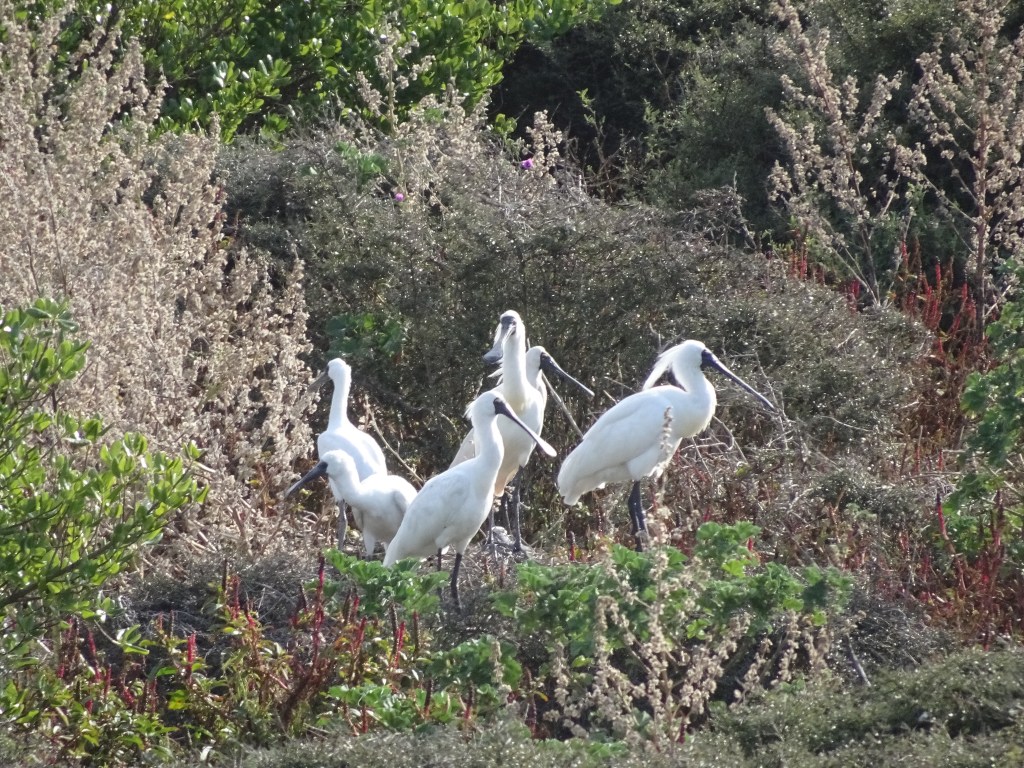
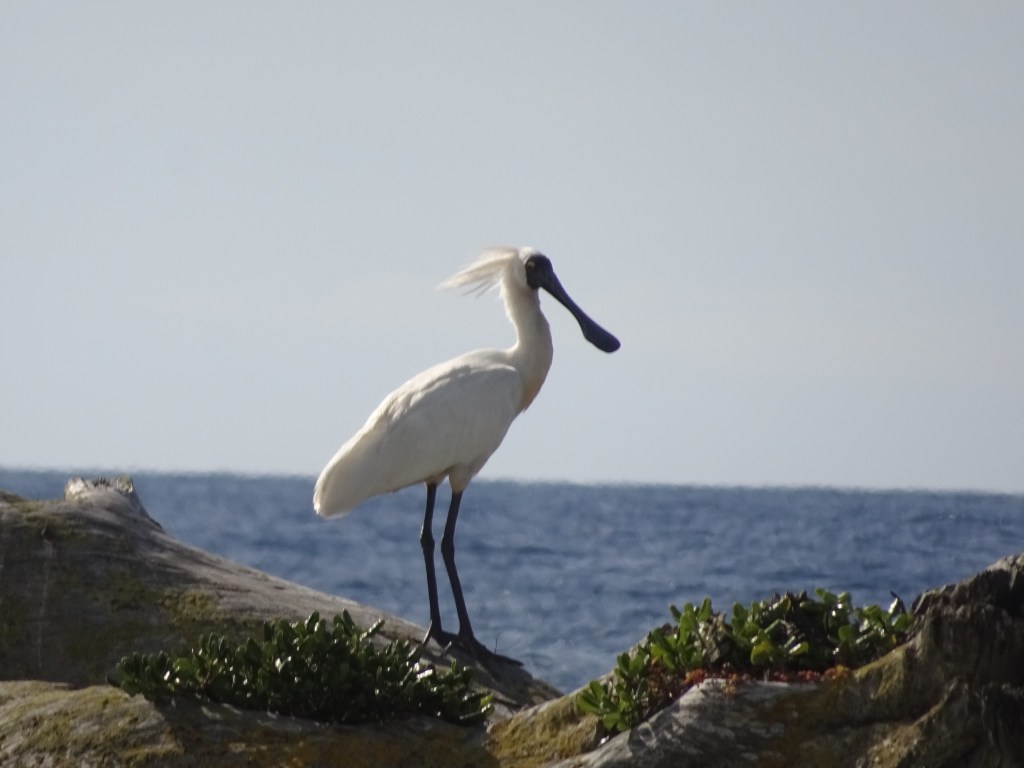
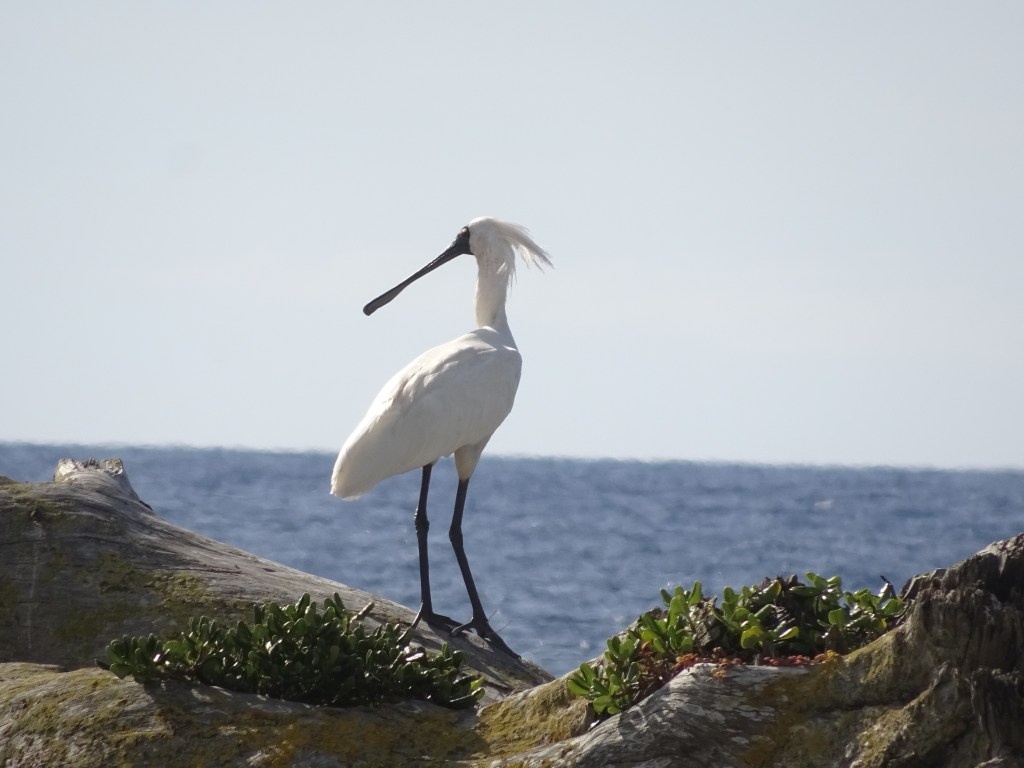
We also hiked around the northern coast of the island on a trail that leaves from the lodge, where we gathered for meals. The coast gets remote pretty quickly, and there is a colony of Royal Spoonbills living out there.
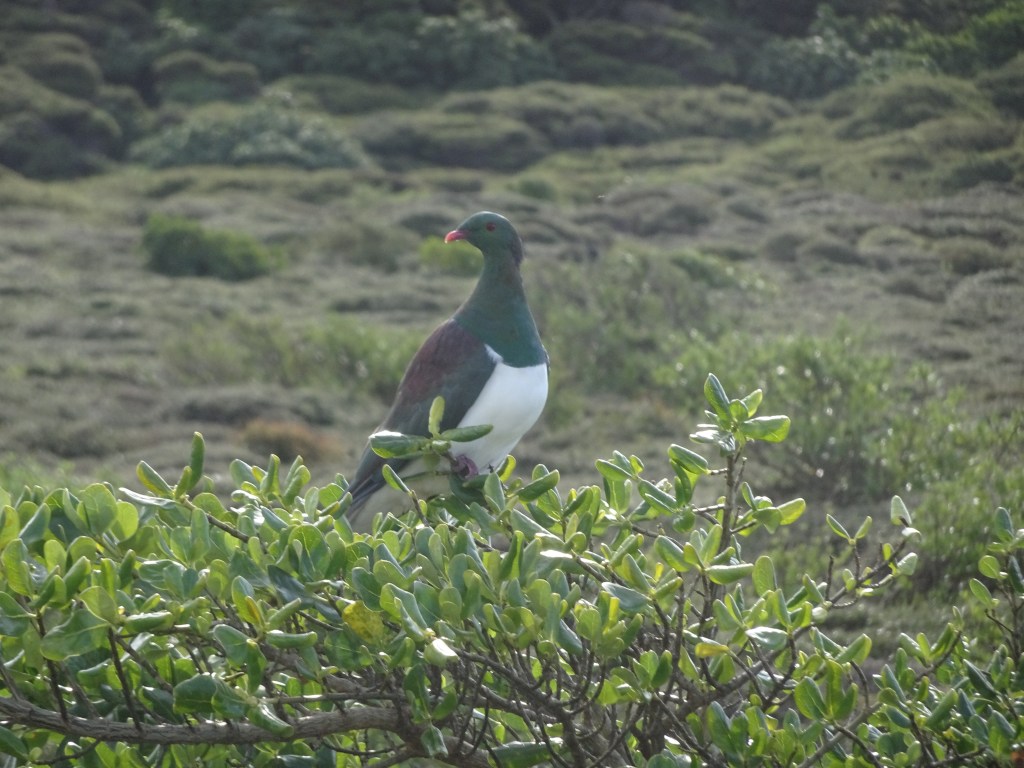
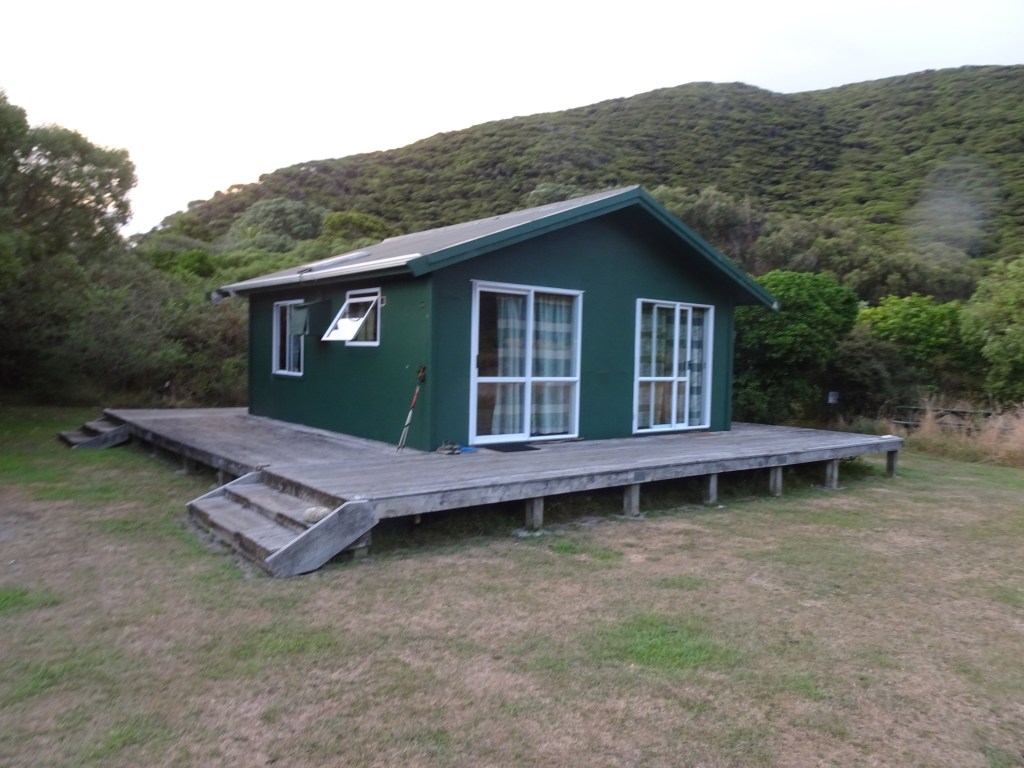
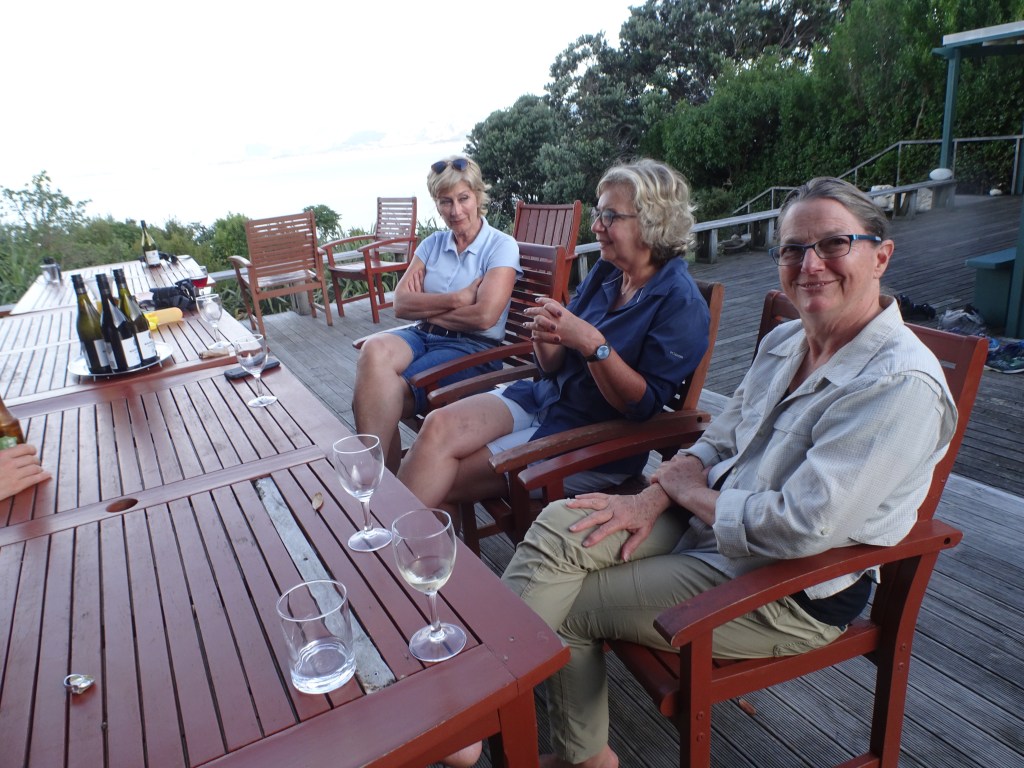
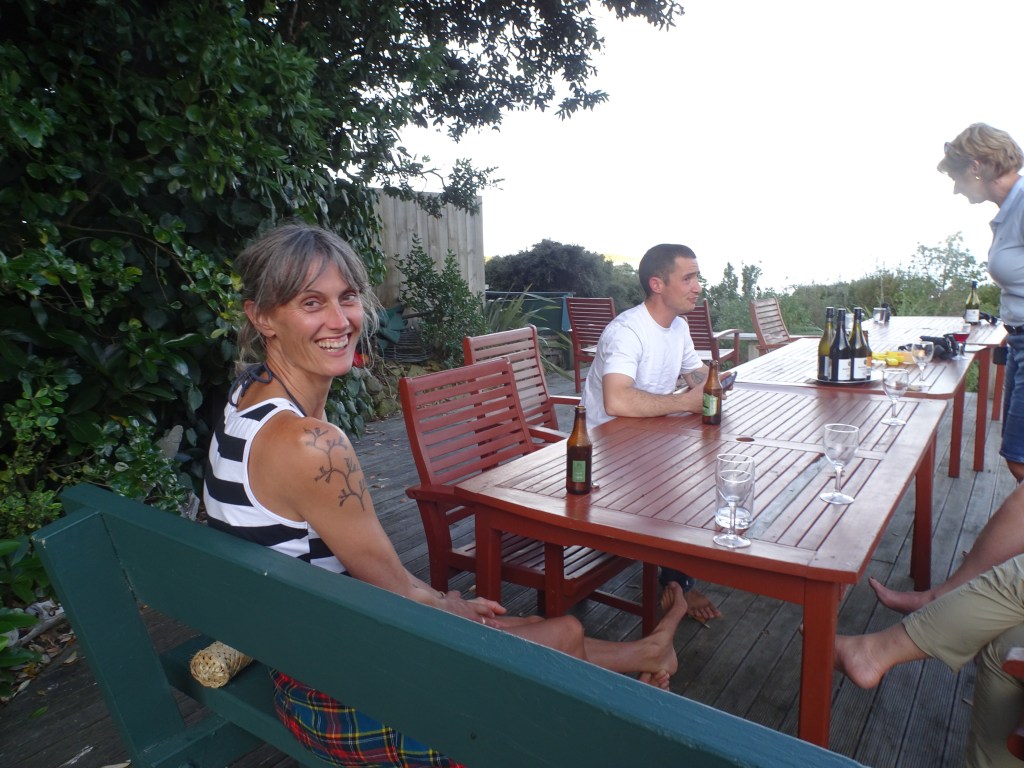
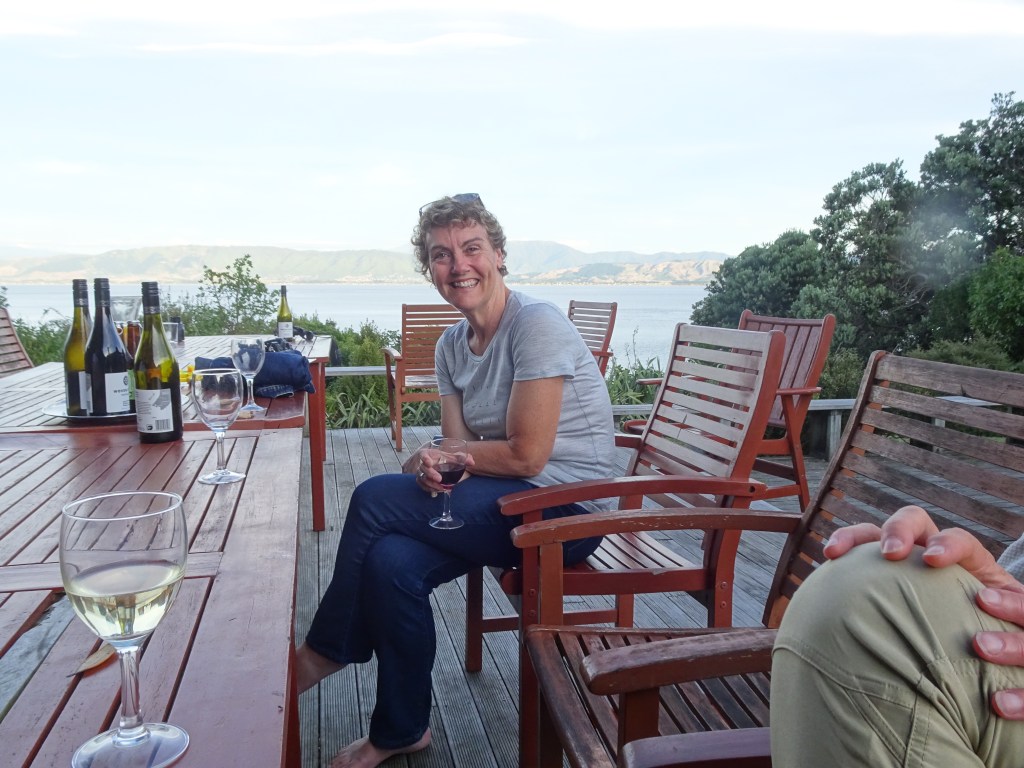
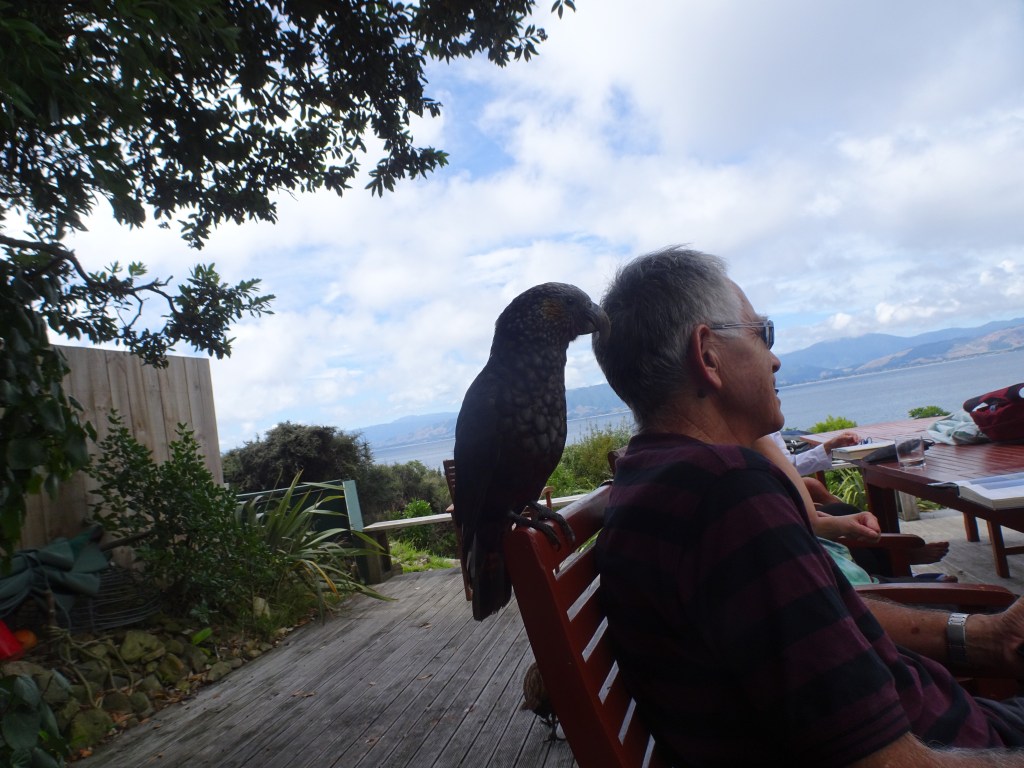
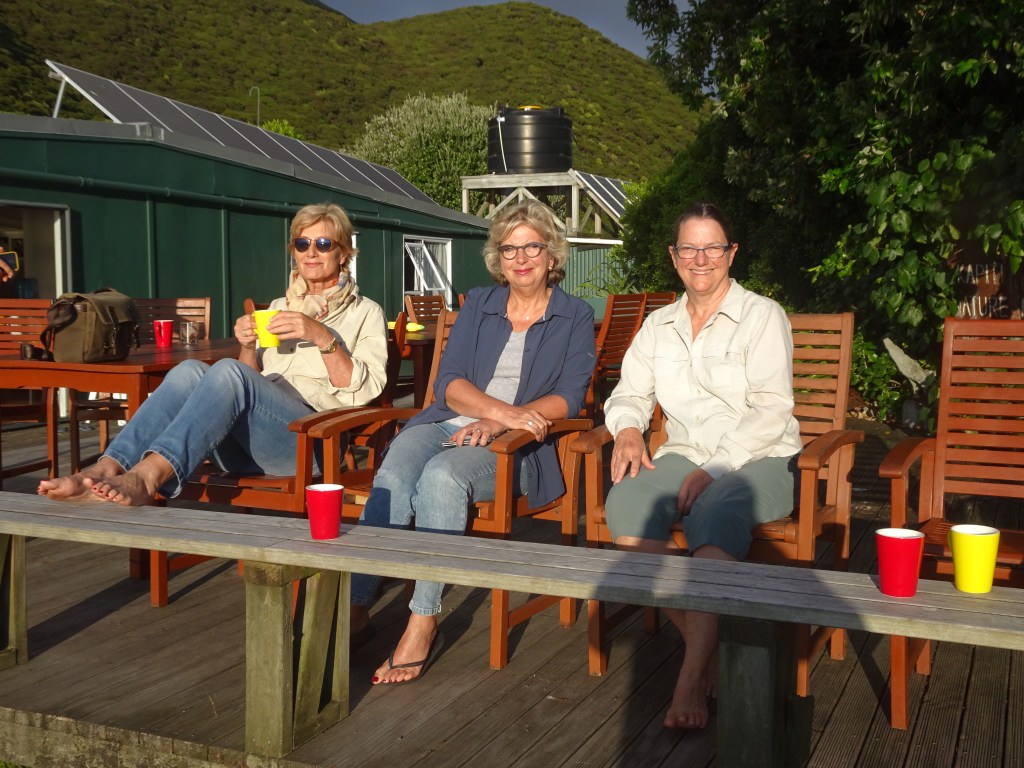
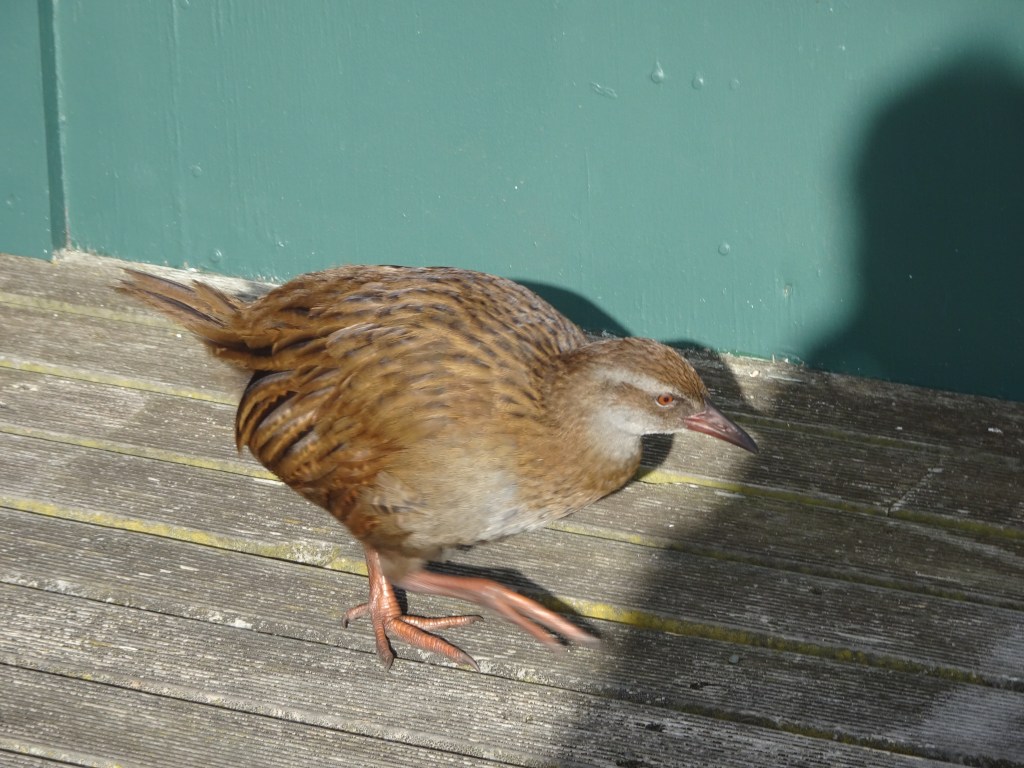
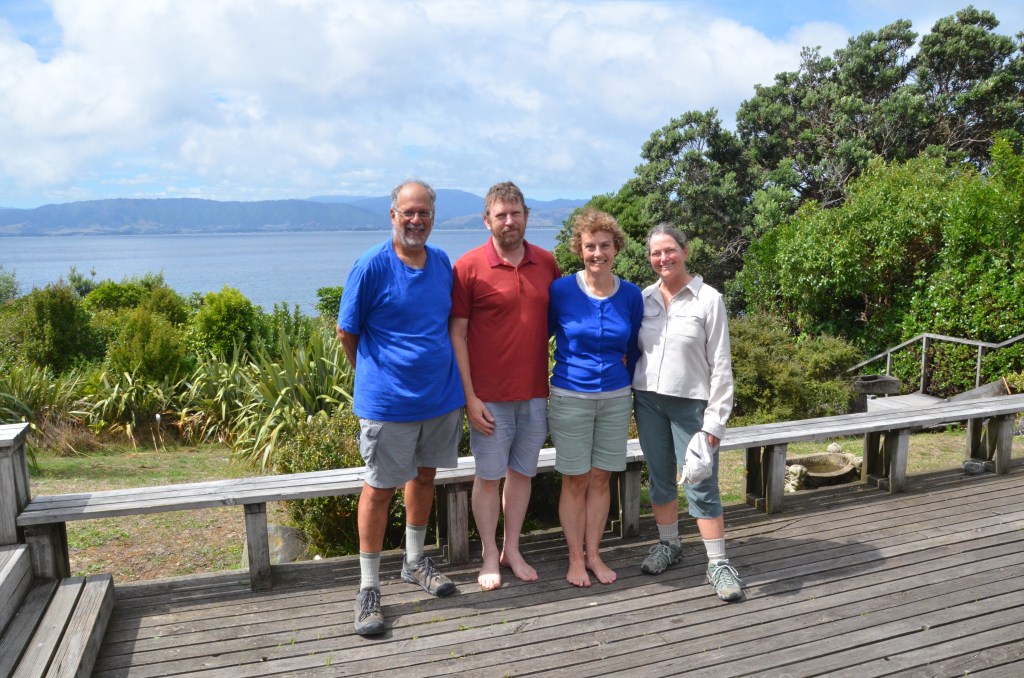
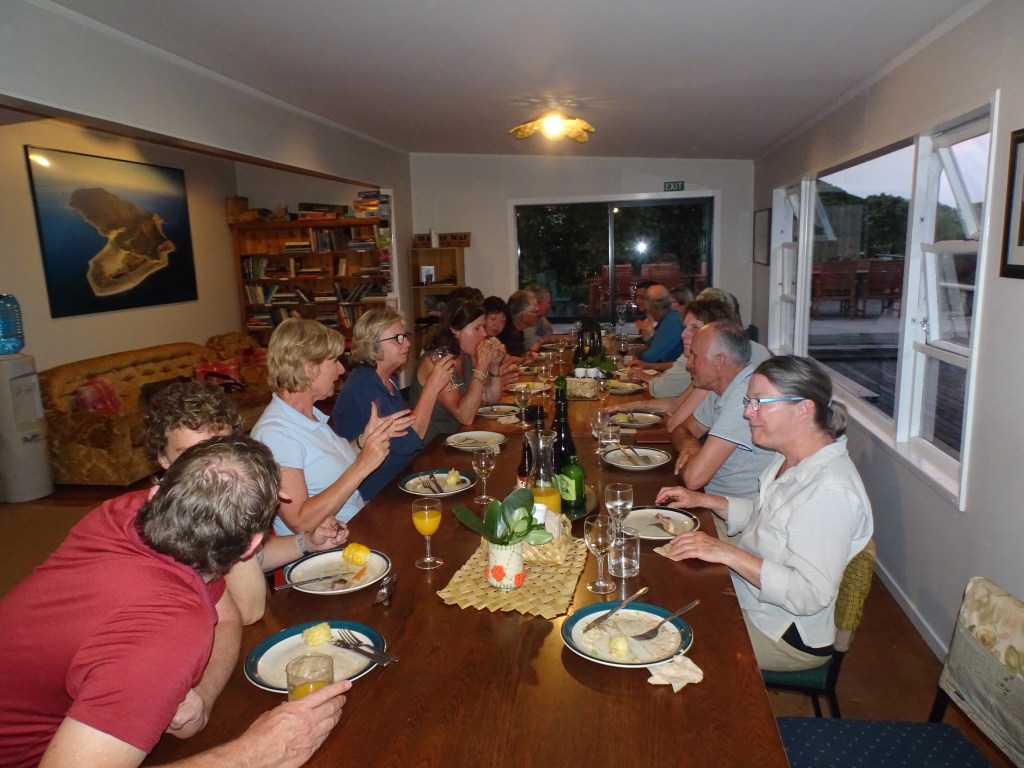
They filter water through their bills to trap food.The New Zealand Wood Pigeon also lives here. We stayed in this 4 unit cabin. The windows to the left opened to our little bunks. Monica with Maryan and Letitia. They are flight attendants for KLM. This is the lodge of the deck, after an afternoon of exploring. Menaaki freely and cheerfully shared his knowledge and wisdom.Bianca is a cook, dishwasher, organizer, housekeeper, answerer of questions, and leader of the kiwi hunt. Nicola is a keen birder and hiker. She is also executive director of “English Language Partners.” This is an organization that teaches English to immigrants. We had a lot in common. Thieving kaka, a NZ parrot. We could not bring or eat food on the deck. They would swoop from the trees and bite it out of your hand.Enjoying the early morning sun.Wekas are also endemic. Here, they are ubiquitous and affectionately tolerated. Mark and Nicola, from Wellington.An animated after-dinner discussion.
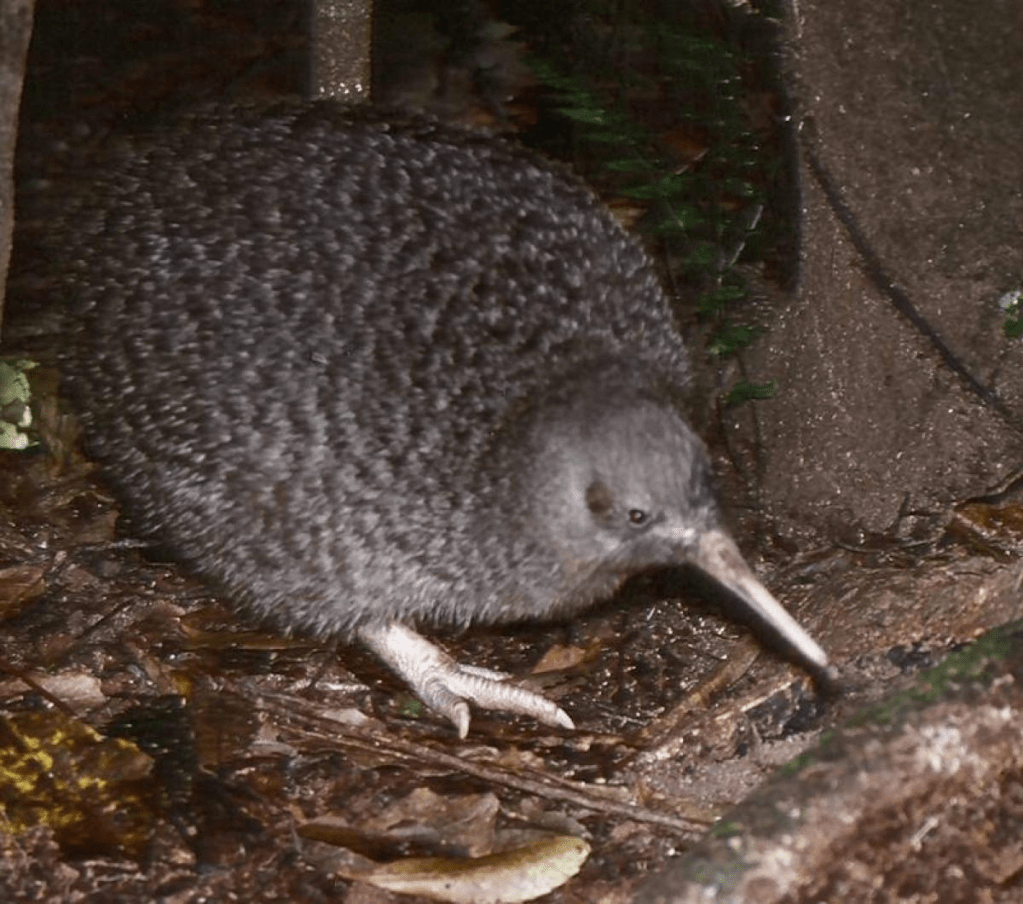
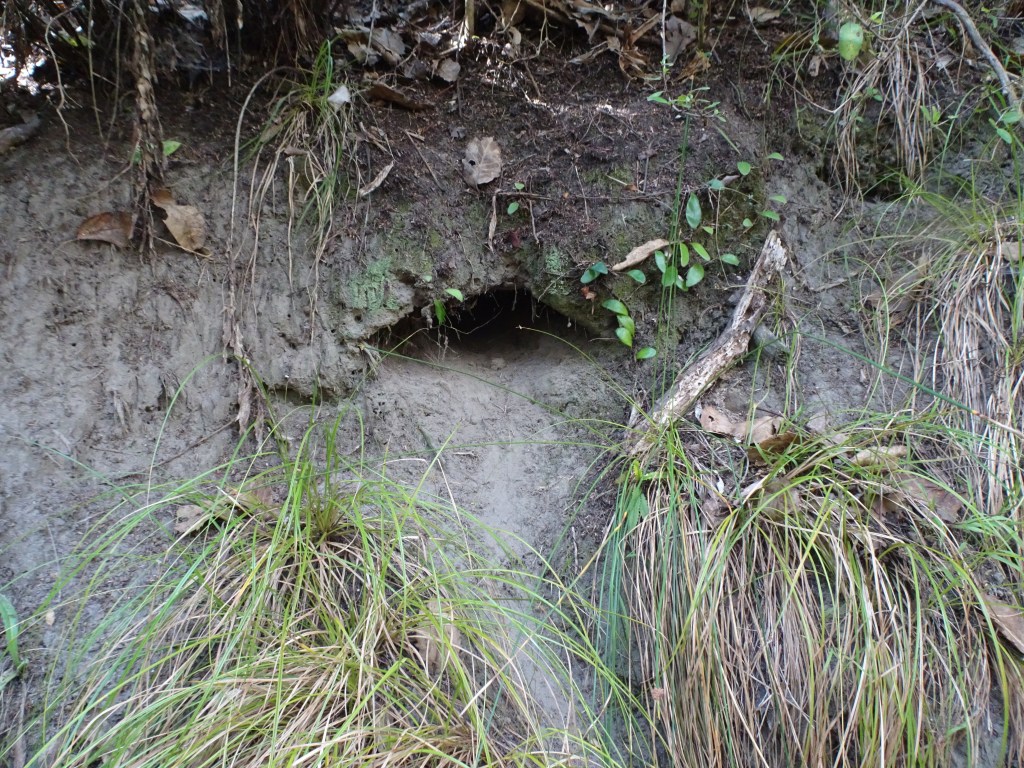
After dinner, Menaaki talked with us about the kiwi bird’s history and life, and then we gathered to go look for them. The birds are totally nocturnal, and they stay to the darkest spaces, poking their beak into the ground, feeling for and smelling for little bugs. During the day, they live in burrows that they dig out, under bushes or into the hillside. The way that you find kiwis is to go out into the dark of night, and be quiet and wait. We went into stealth mode, then followed Menaaki and his red light. After an hour, we saw one, snuffling around in the brush. We watched it for about a minute and then it disappeared. There are five distinct species of kiwi in New Zealand. The one who lives here is the Little Spotted Kiwi. There are about 1200 to 1400 of them on Kapiti, and that’s the limit, given their territory behavior. There used to be millions on the mainland, but they are extinct now. The government is trying to re-establish colonies elsewhere, because if something happened to this population, it would be disastrous.
NZ Birds OnlineA burrow on the northern coast.
We left Kapiti Island with a deeper understanding of the challenges and promises of making choices and commitment. The island is a treasure, but sanctuary islands are not enough. They are kind of like museums where we can go to see what life used to be like. The real challenge and promise lies ahead.
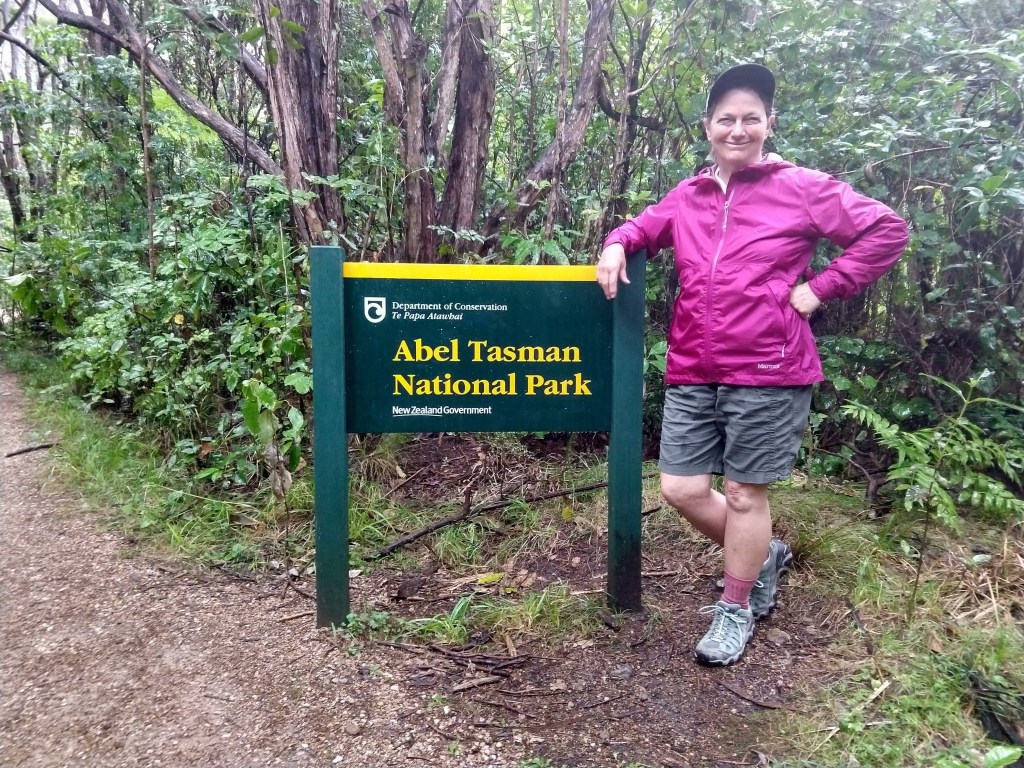
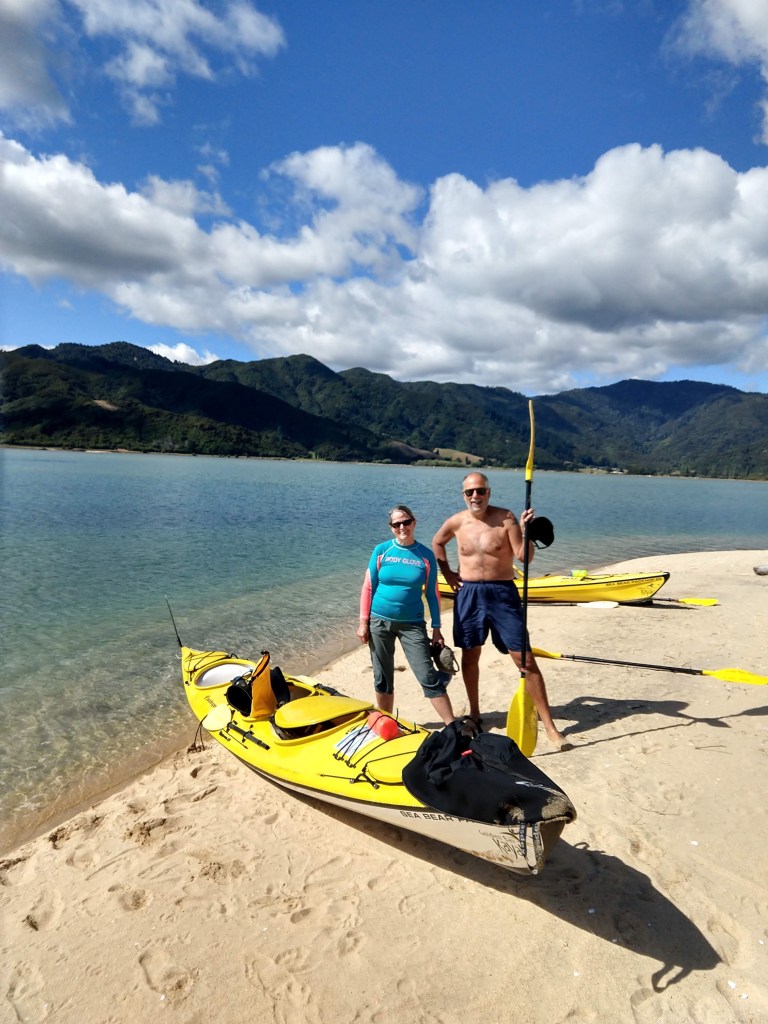
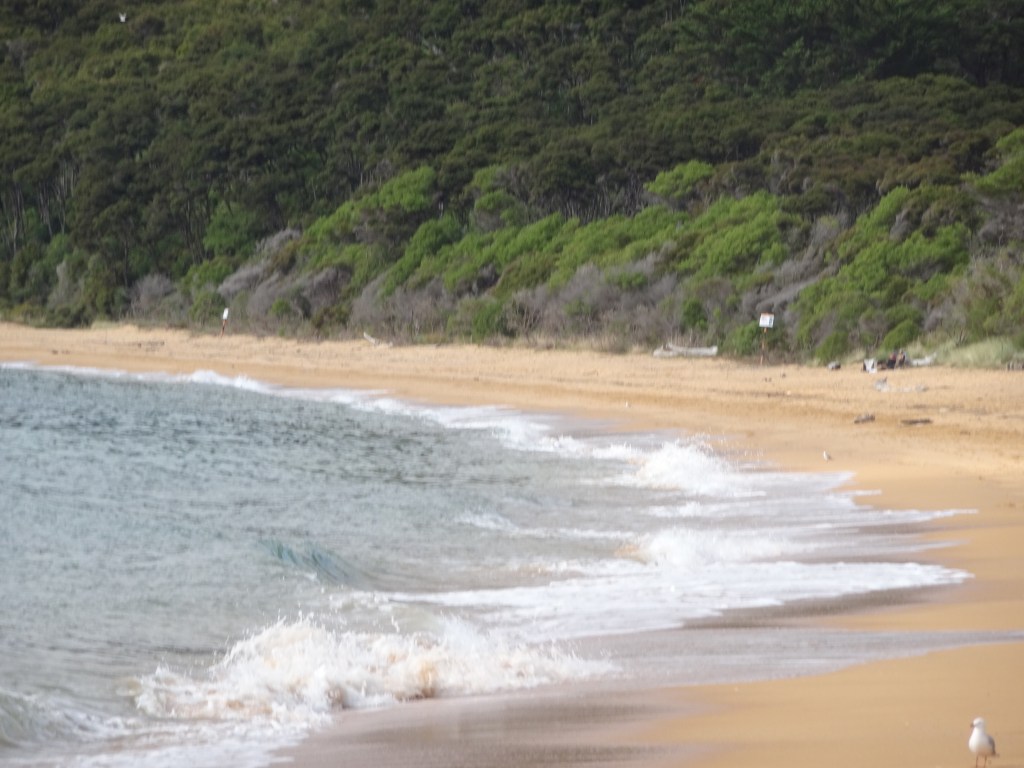
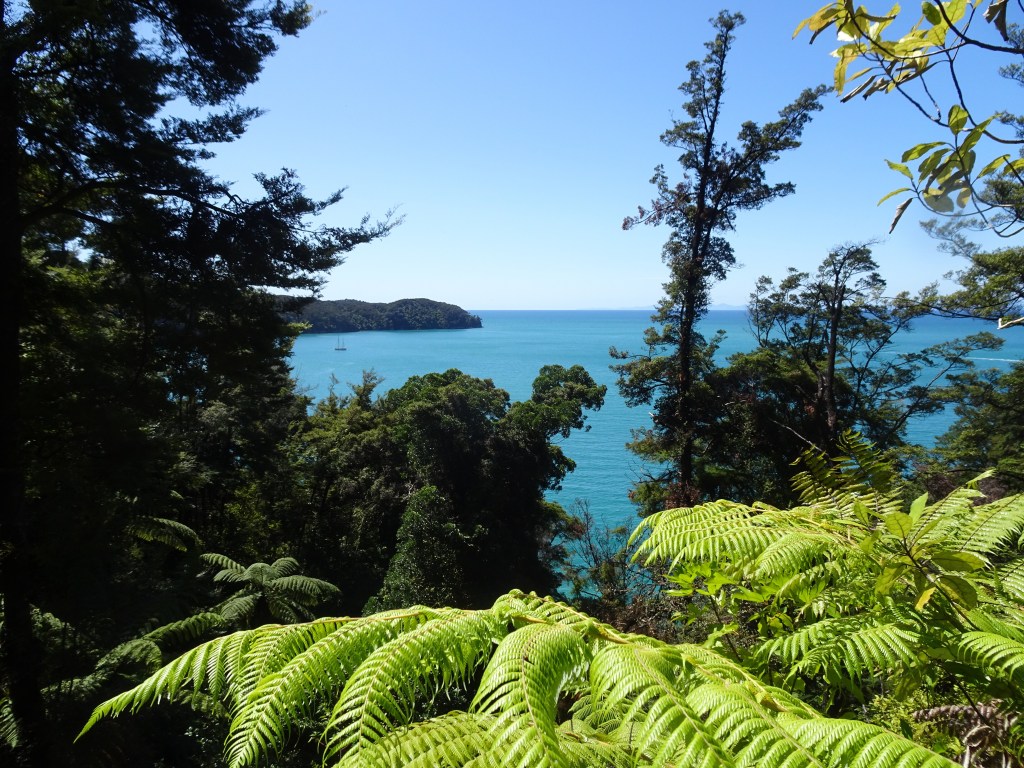
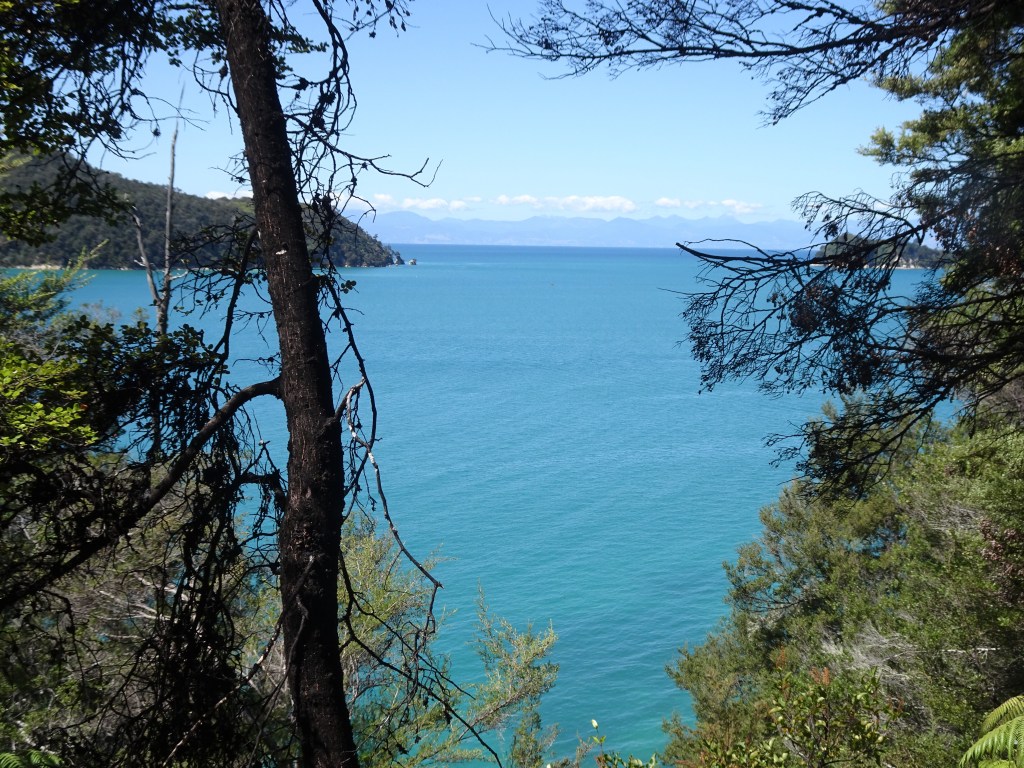
The biggest quandary we had during our five days at Pohara Beach was whether to stay home and walk and sit and watch the tide come in and go out on our beautiful beach, or to head out in the car and explore the region and see other places. We stayed in a little beach cabin right on Pohara Beach, just outside of Abel Tasman National Park. The park is the most visited park in New Zealand, even though it’s one of the smallest. It is a powerhouse of beauty and activity. The coast is a world wide magnet for kayakers. It is turquoise water up against forested headlands, bays, and beaches. We kayaked and hiked, on the coast and in the mountains, walked on tidal mudflats and on raging open beaches, and we still had time for sunset walks on our beach. We were sad to leave.
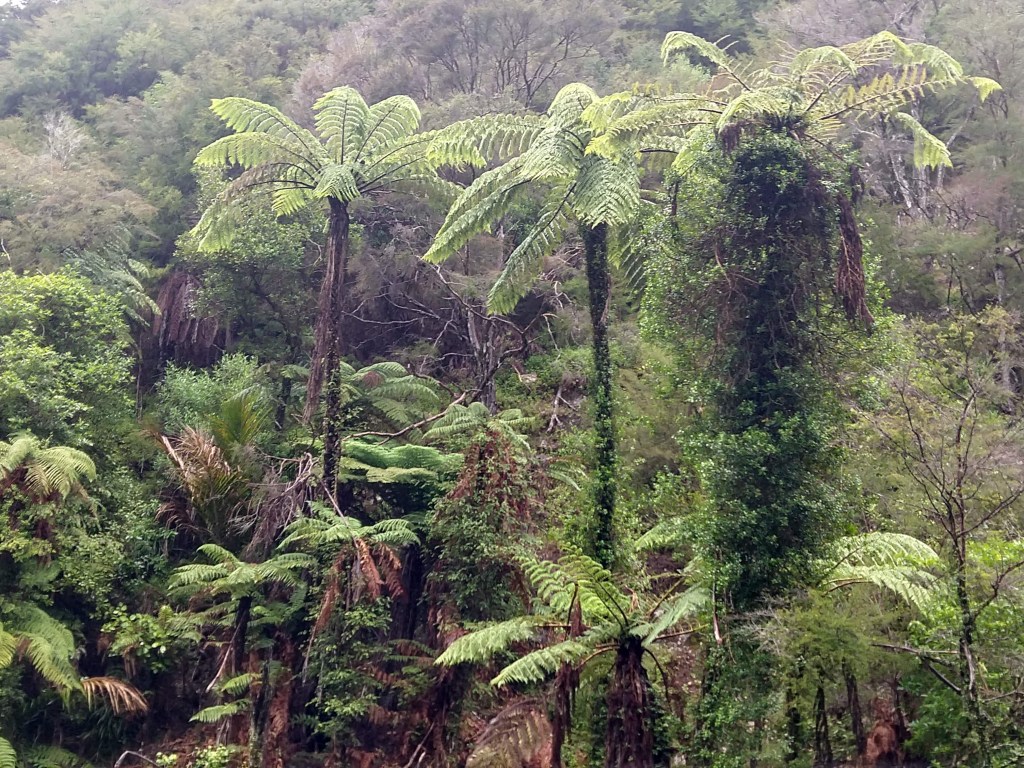
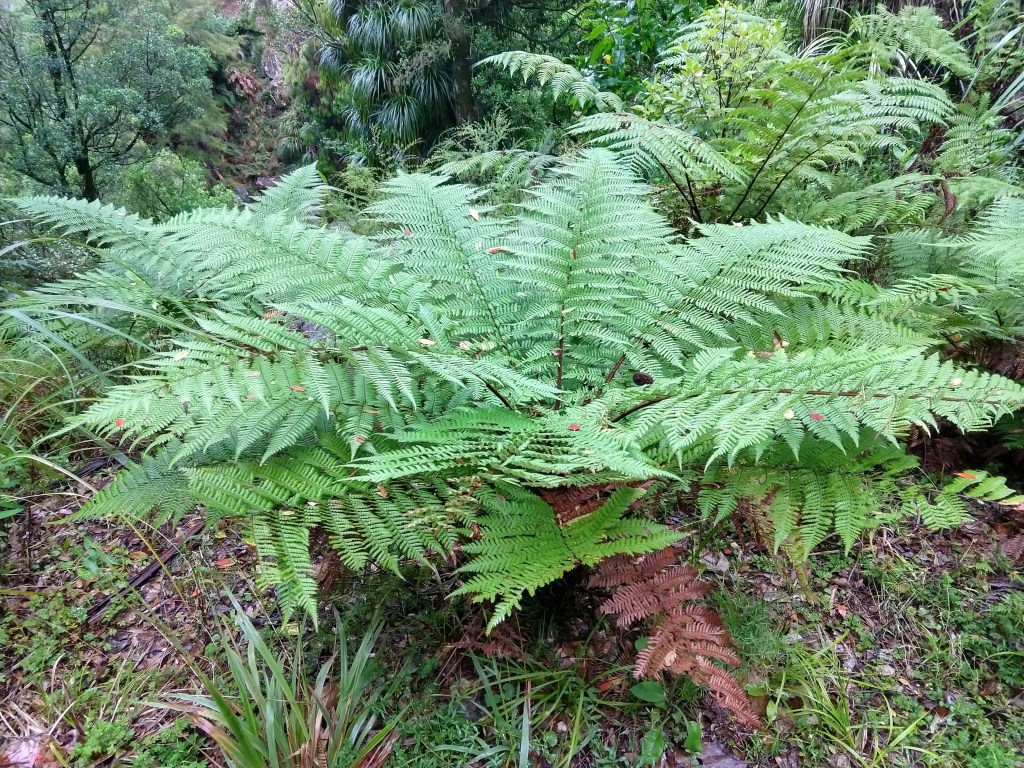
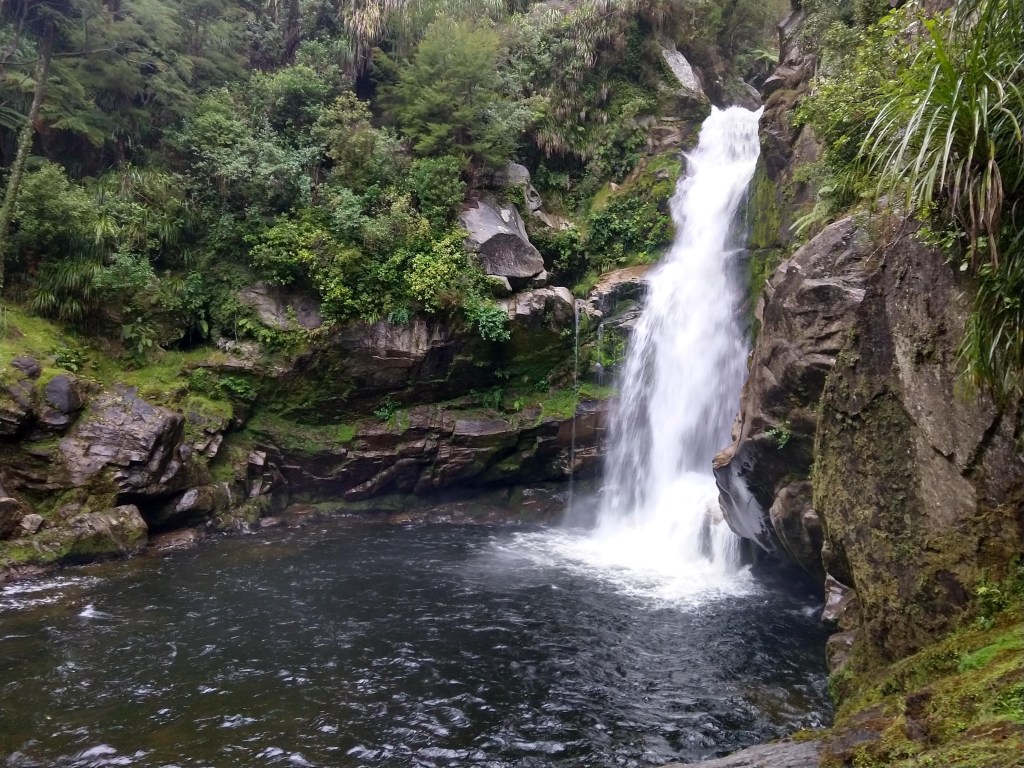
Wainui Falls is a waterfall in the park that you get to by a half-hour walk through the forest. The forest itself is very tropical and even prehistoric looking, with fern trees and silver ferns, and little fantails flitting through the trees. We took advantage of a rainy, windy day to go up there.
On a hot day—-this is a perfect swimming hole.
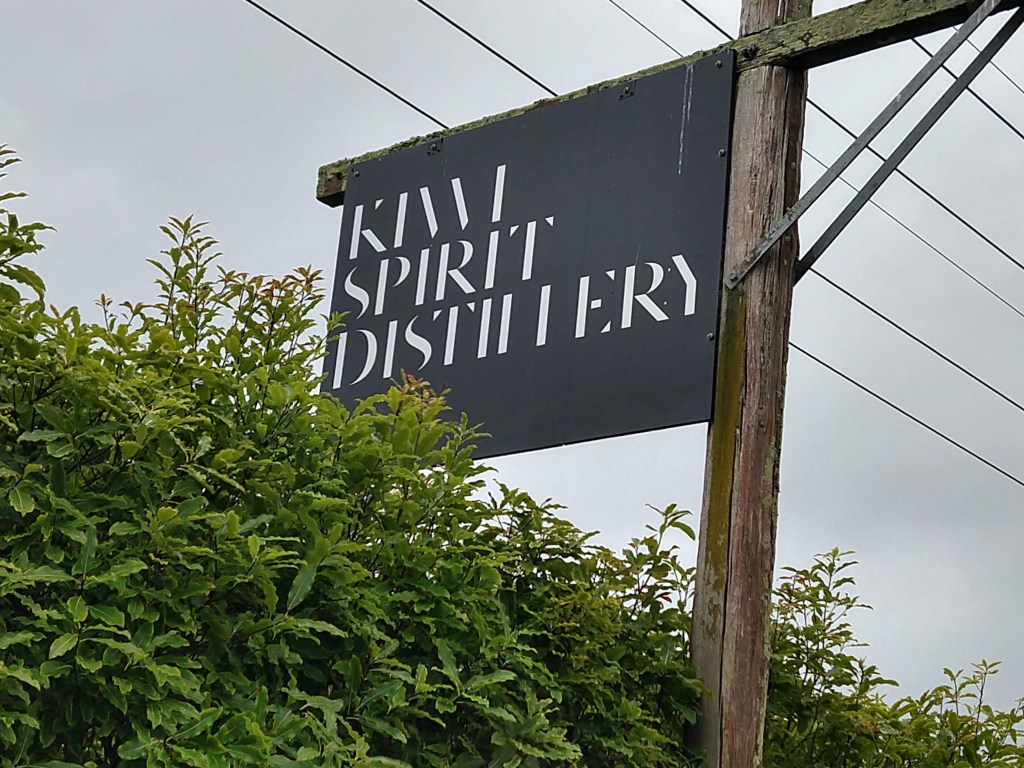
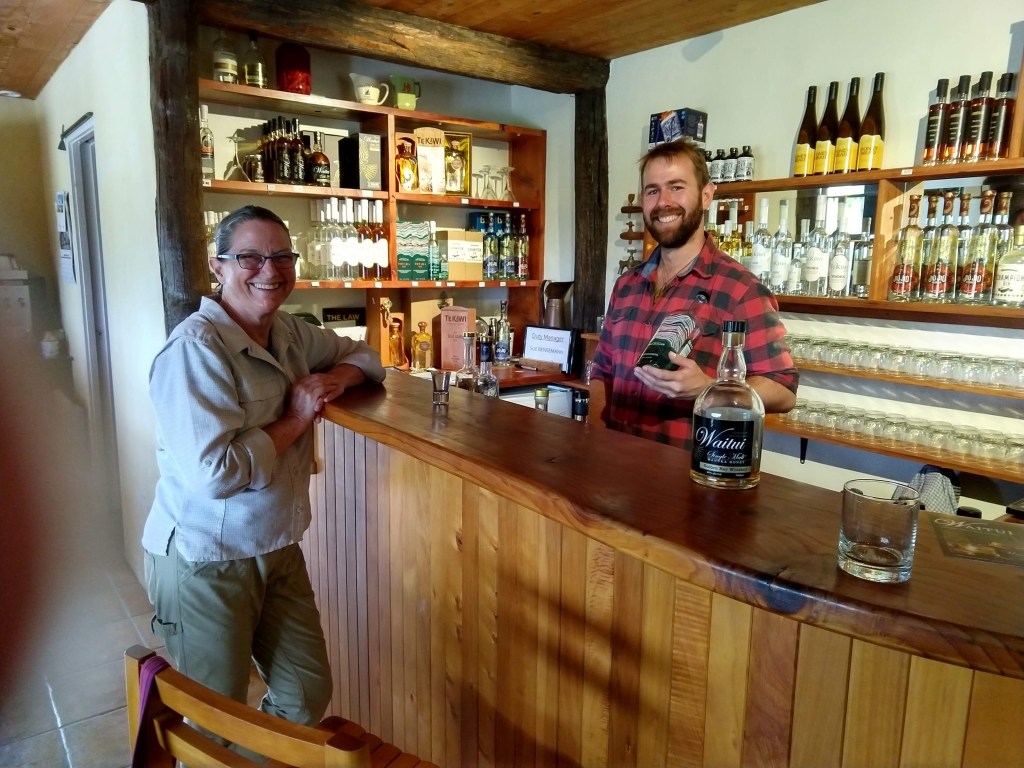
Another good rainy day activity is going to the local distillery. The town of Pohara doesn’t have much—a couple of coffee shops and restaurants, and that’s it. It is, however, also the home of Kiwi Spirit Distillery, which makes three kinds of gin, some vodka, and some great whisky. We stopped by and talked with Jeremy and tasted some of their products. Monica was impressed with the gin, I was impressed with the whisky.
In Search of Birds
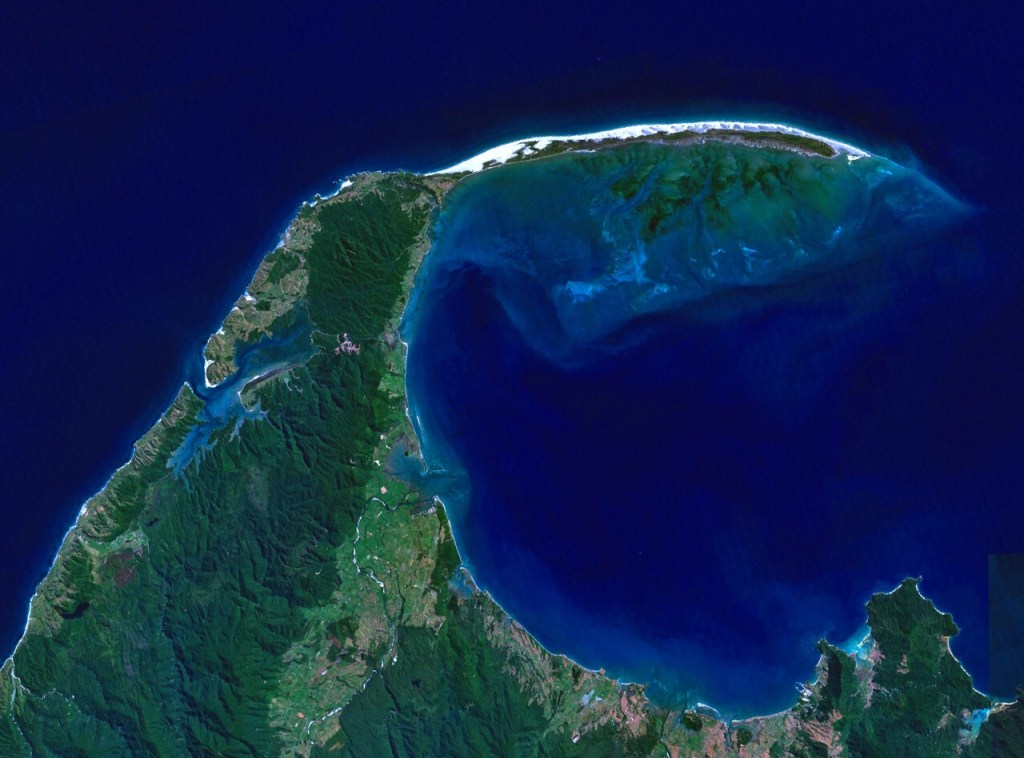
The northwest corner of the South Island is a spectacular haven for shorebirds. There is a lot of protected shallow water, with enormous tidal effect, which means in some cases, during low tide, there are kilometers of mud flat. Along the southern edge of Farewell Spit, which protects much of Golden Bay from the open ocean, the mudflats extend seven kilometers during low tide, then fill right back up with the incoming tide. The spit itself is 26 kilometers long above the ocean, and many more kilometers below the surface. We could see it from our beach, about thirty kilometers in the distance. The spit is dear to the hearts of New Zealanders, because it totally looks like a Kiwi. (The bird, that is.)
This is an image from a NASA satellite. The spit is the kiwi’s bill. South of the bill are the mudflats. Pohara Beach is the long beach, just about 5:30. Just to the right of center.
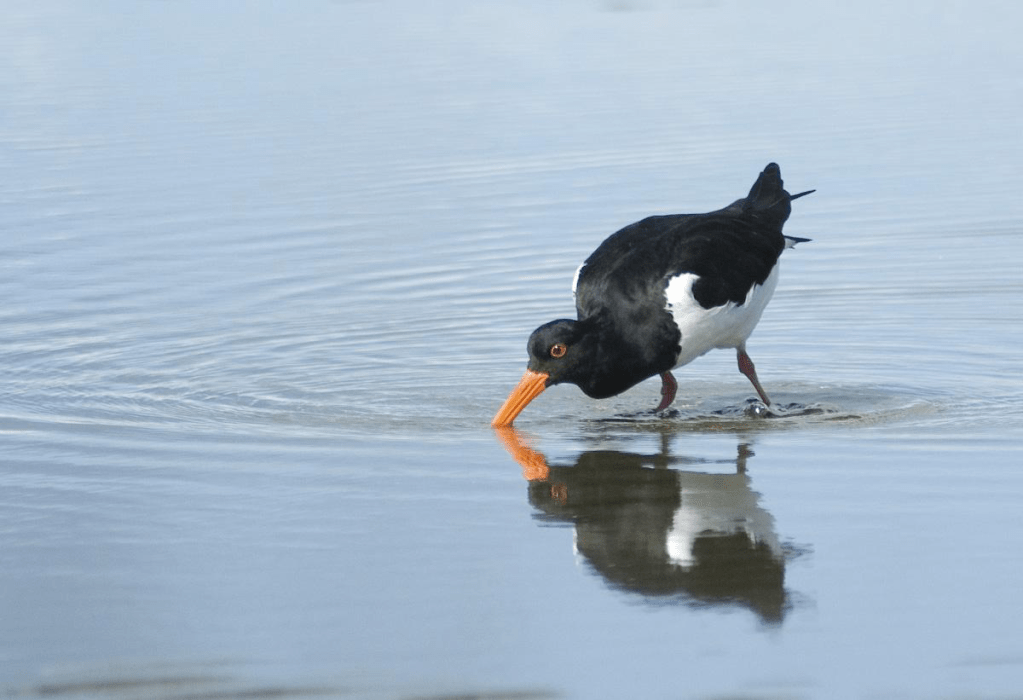
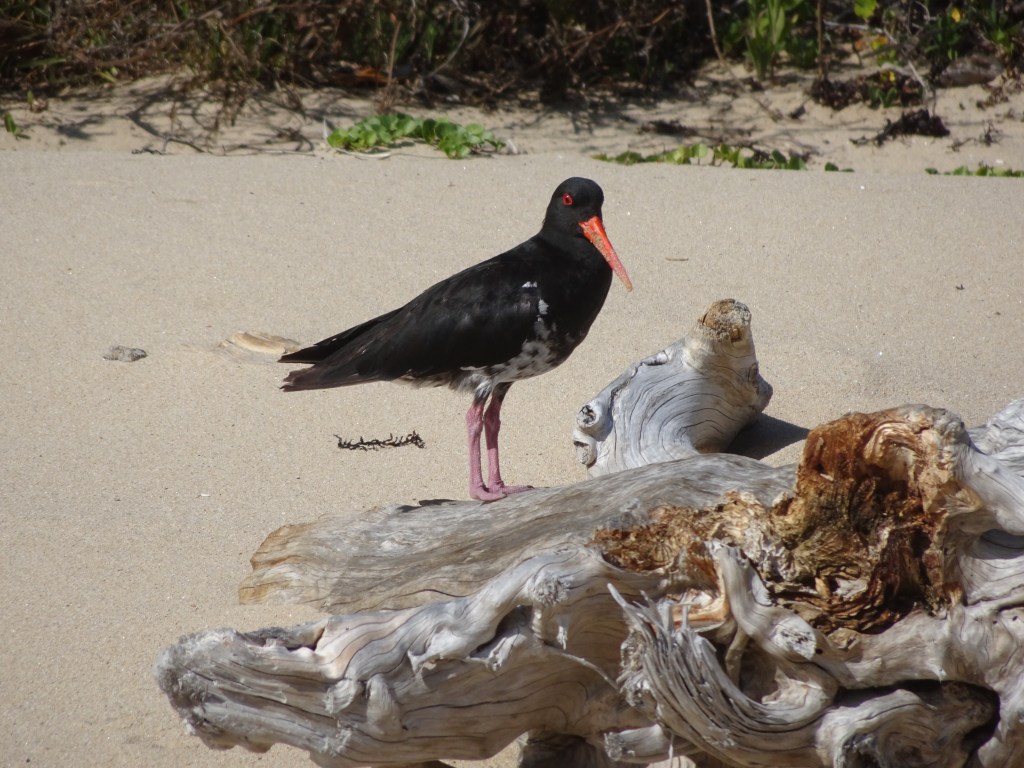
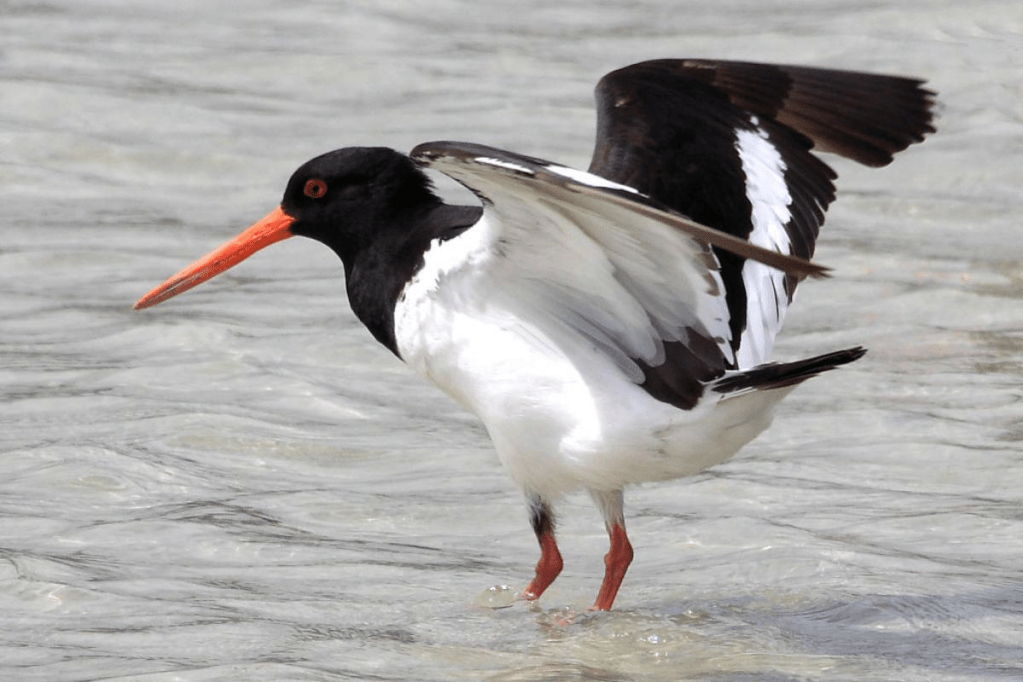
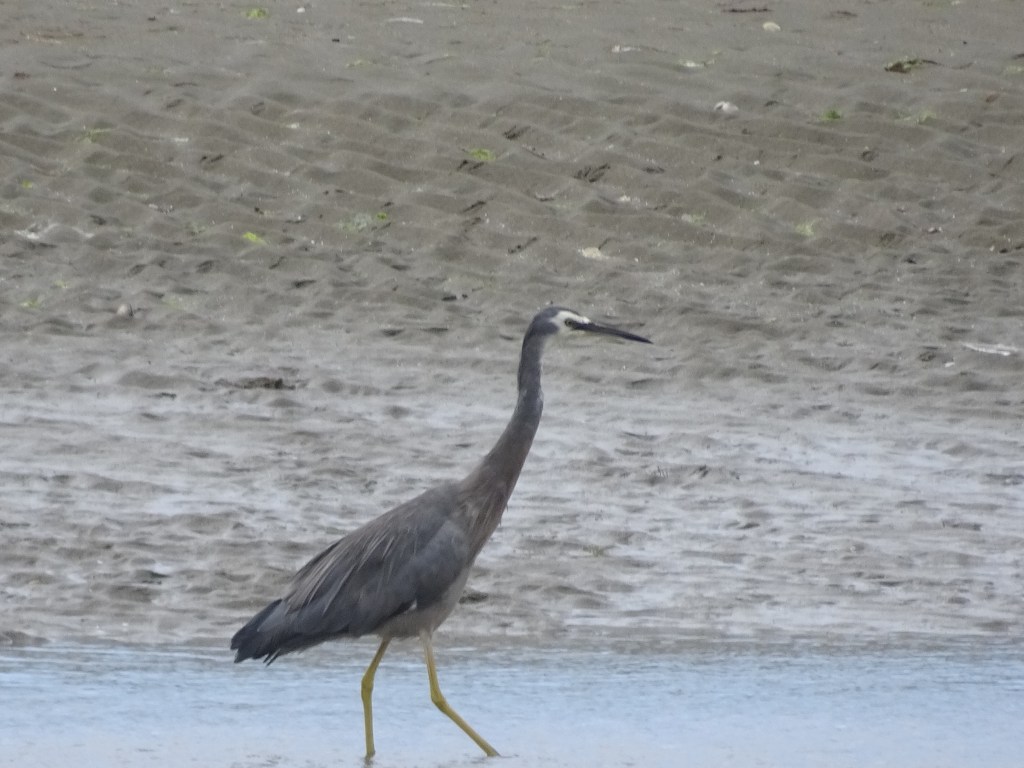
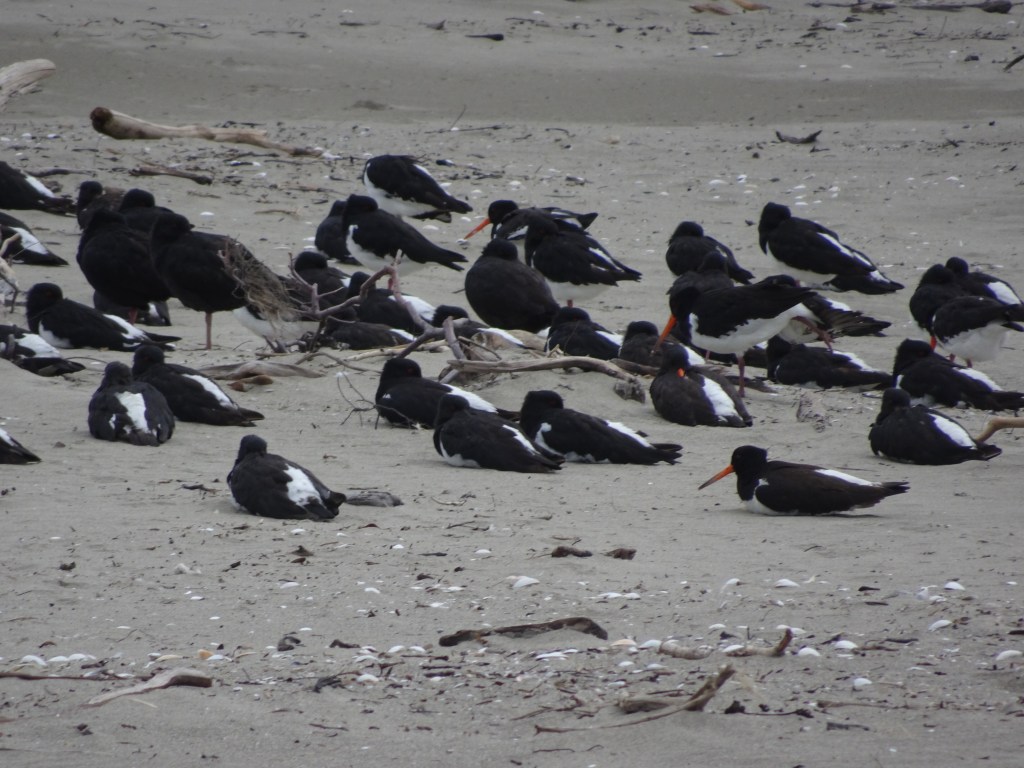
We went up to Farewell Spit, You aren’t allowed to walk very far out on the spit unless you are with one specific tour company called Farewell Spit Eco Tours. They will take you out on a four-wheel drive bus, and there are colonies of bar-tailed godwits and gannets out there. We considered it, but decided that six and a half hours on the bus was too long. Maybe next time. Colonies of godwits… Instead, we stopped at inlets and bays along the way, during low tide, and we spotted godwits, along with white-faced herons, pied stilts, and hundreds of oystercatchers. There are two kinds of oystercatchers in New Zealand—the variable oystercatcher and the South Island Pied Oystercatcher. The SIPO is the most abundant. They were on every beach. We see oystercatchers in Oregon, but they are all black. It is very striking to see the black and white.
This one is probably immature, more spotted than solid white.
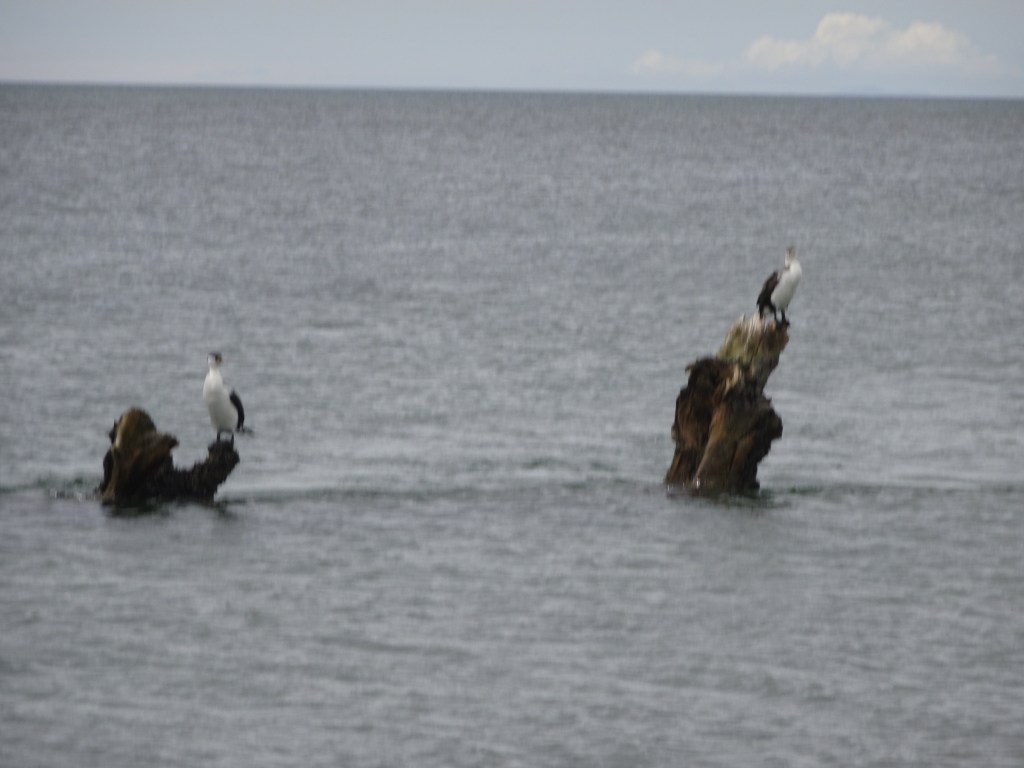
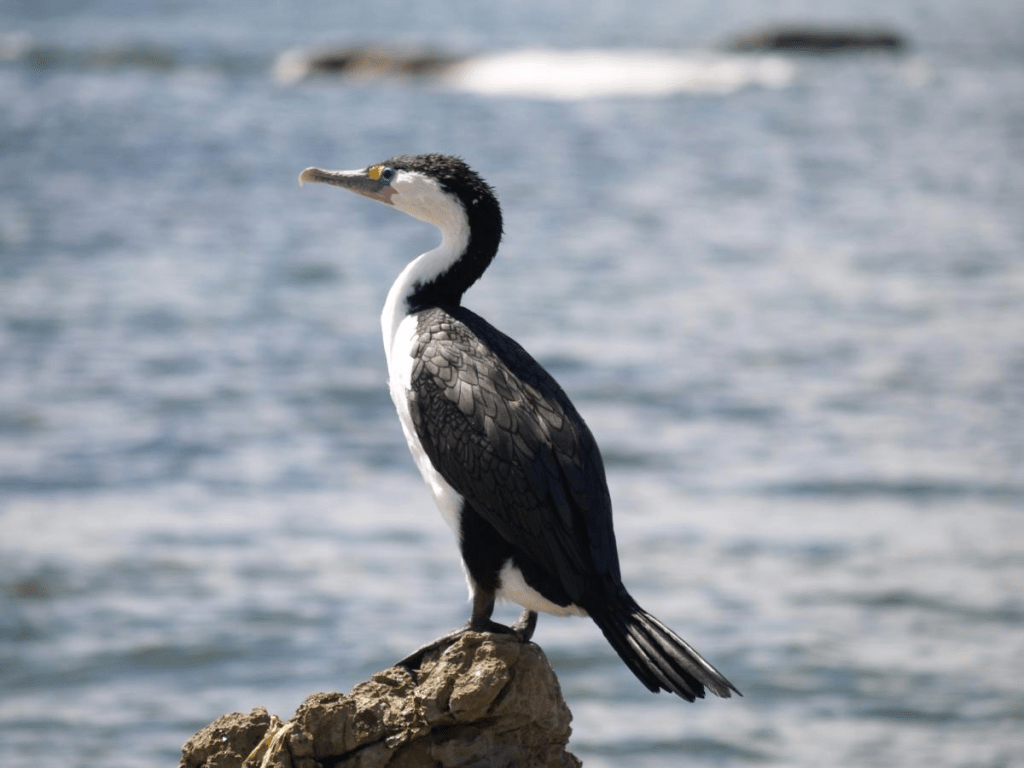
Pied shags are another example of familiar birds looking a bit different. In North America, we know cormorants as heavy sea and water birds. In New Zealand, the cormorants are just a bit different, they are called shags, like in Europe , and there are lots of different kinds. Pied shags are the most common, but there are black shags, little shags, little black shags, New Zealand King shags, and a couple more. We saw pied shags everywhere.
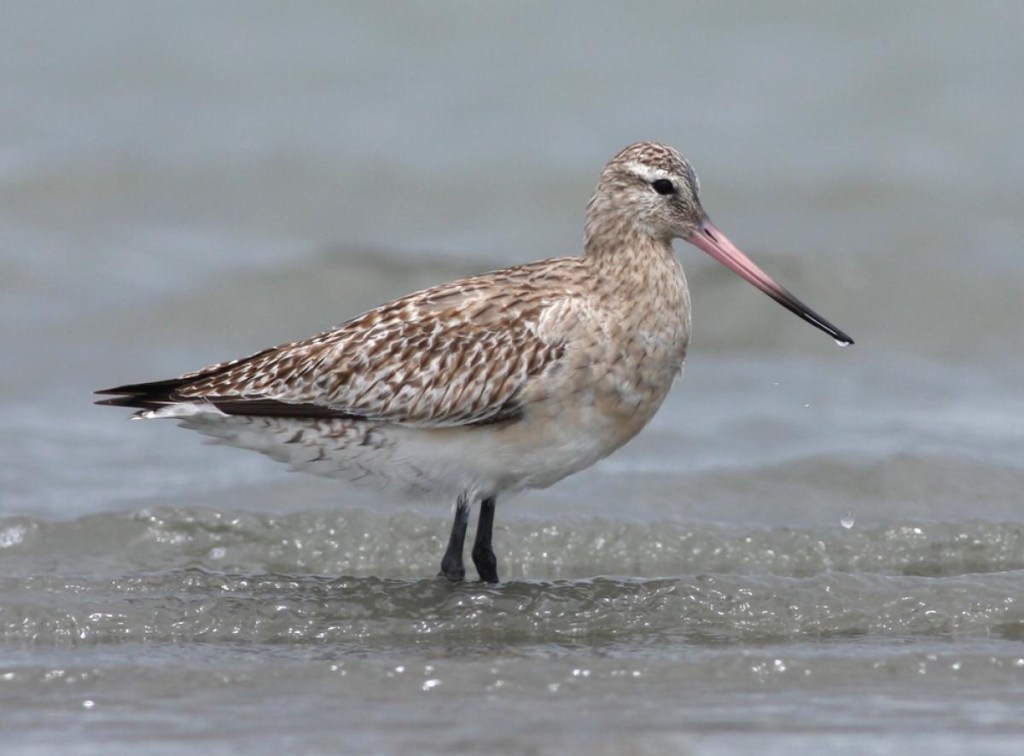
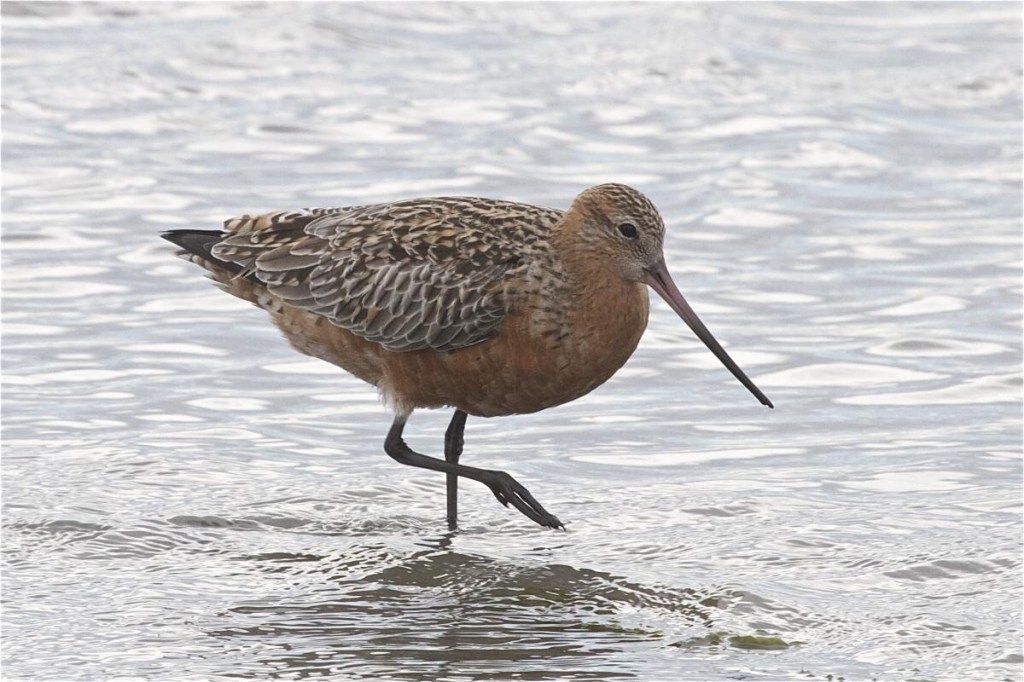
Bar-tailed godwits are super-birds. We saw them on our beach, Pohara, and on other beaches in Abel Tasman and on the way to Farewell Spit. They breed in Alaska in June, then they fly to New Zealand in September or October. They do not land or touch down on the water. It is the longest non-stop flight of any bird, around 8000 miles. They do it in seven to nine days. Then they live in New Zealand until March. In March, they fly to China. In June they fly to Alaska, breed and come back to NZ. On the past few years, it is estimated that 80,000 birds have made the trip. We saw them hanging around with the oystercatchers. Now it is mid to late February, and they are fattening themselves up for the flight north. Soon, they’ll gather into groups and take off.
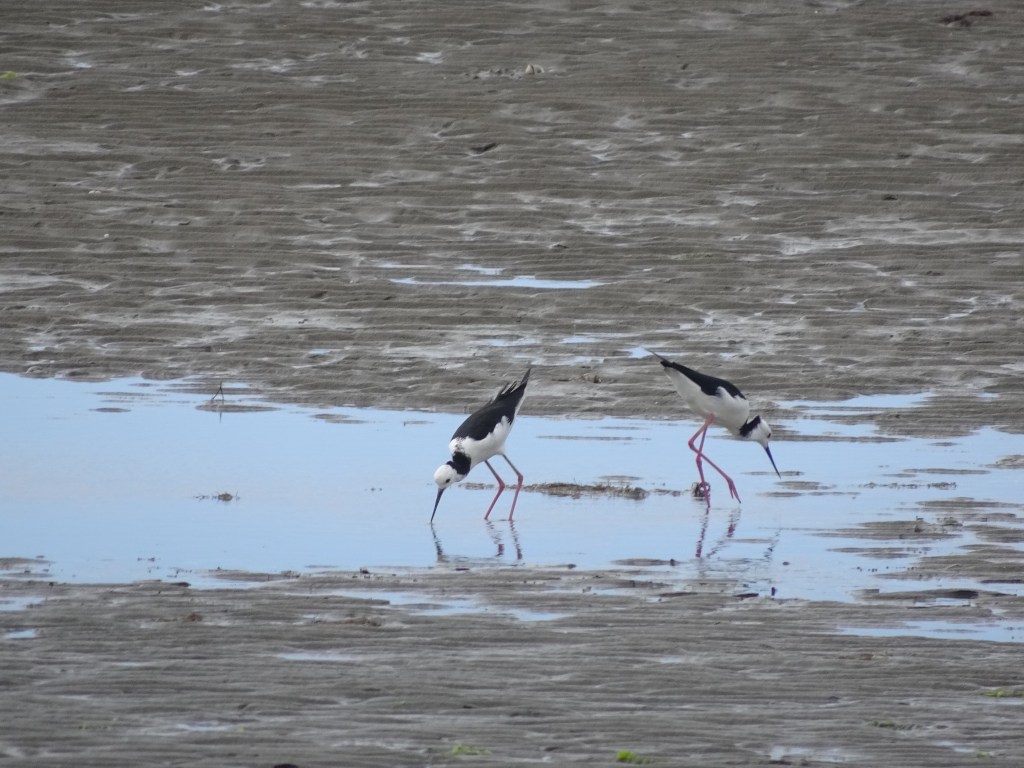
Very slightly upturned two-color beak. They blend into the sand.They don’t look like super flyers, because they beat their wings quickly instead of soaring. But they are marathoners. Pied stilt. In North America, they are called black necked stilts, or black winged stilts. White faced heron on Collingwood Beach. These are all over NZ. They’re like the great blue herons, but slightly smaller.
Wharariki Beach
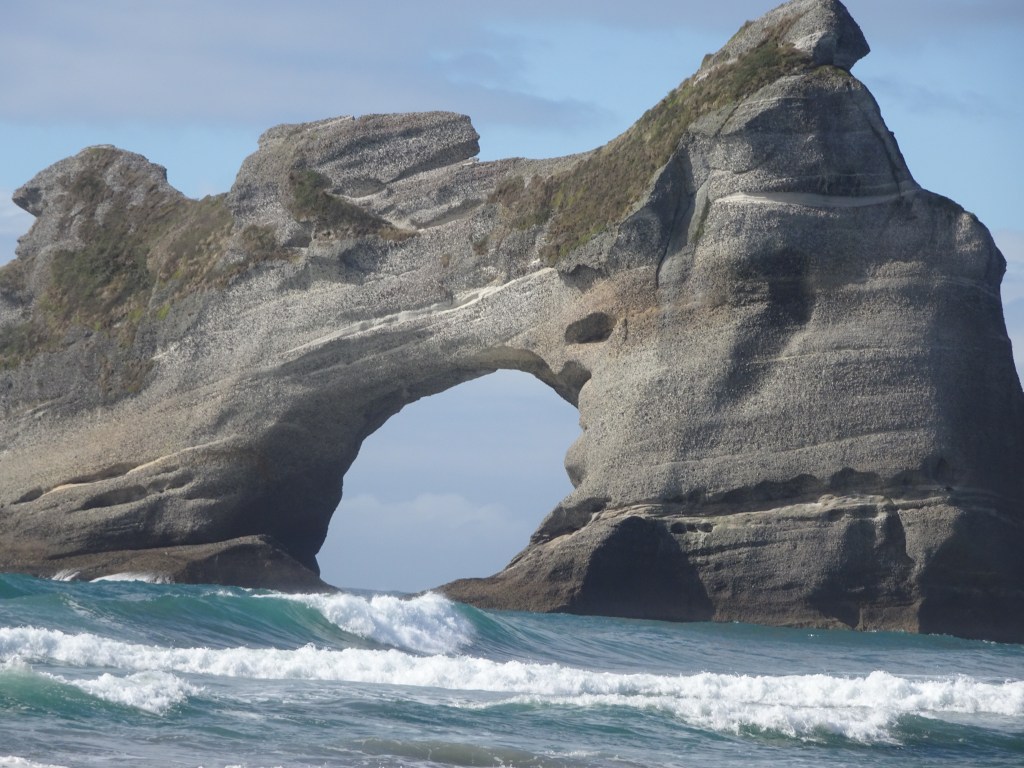
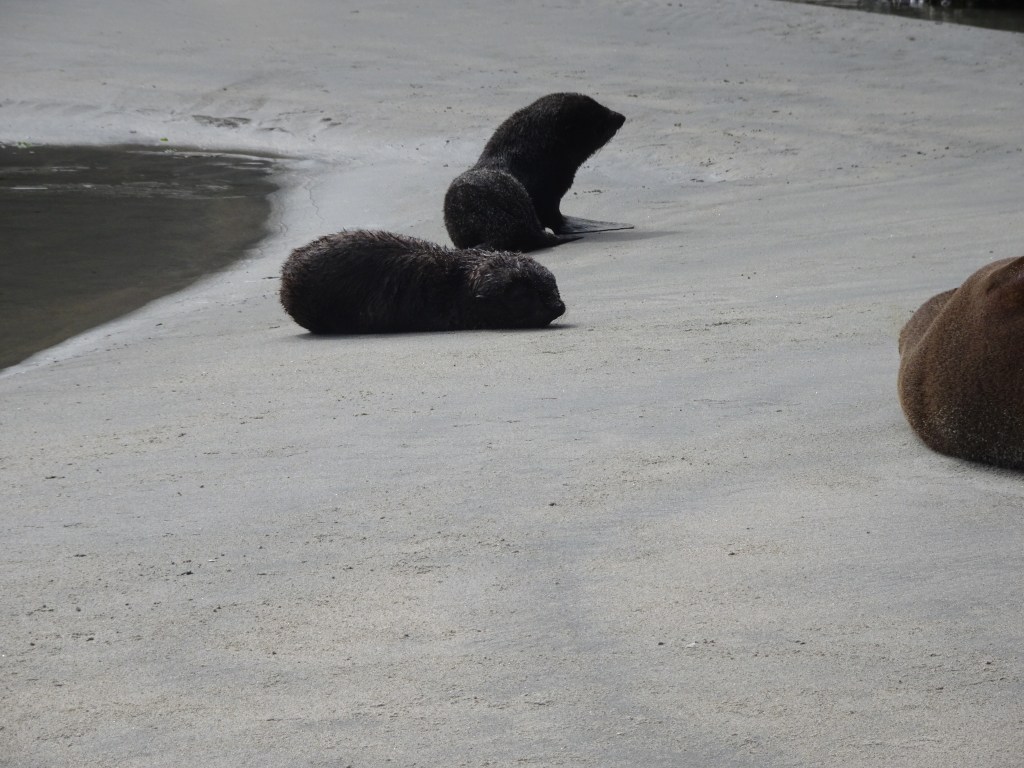
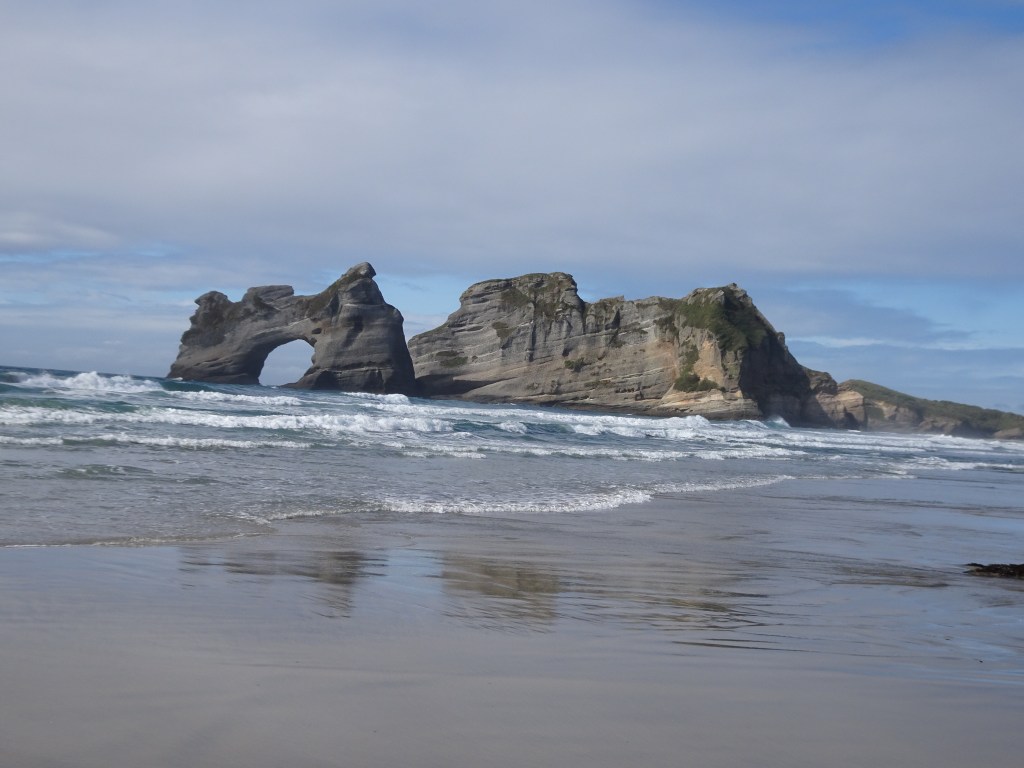
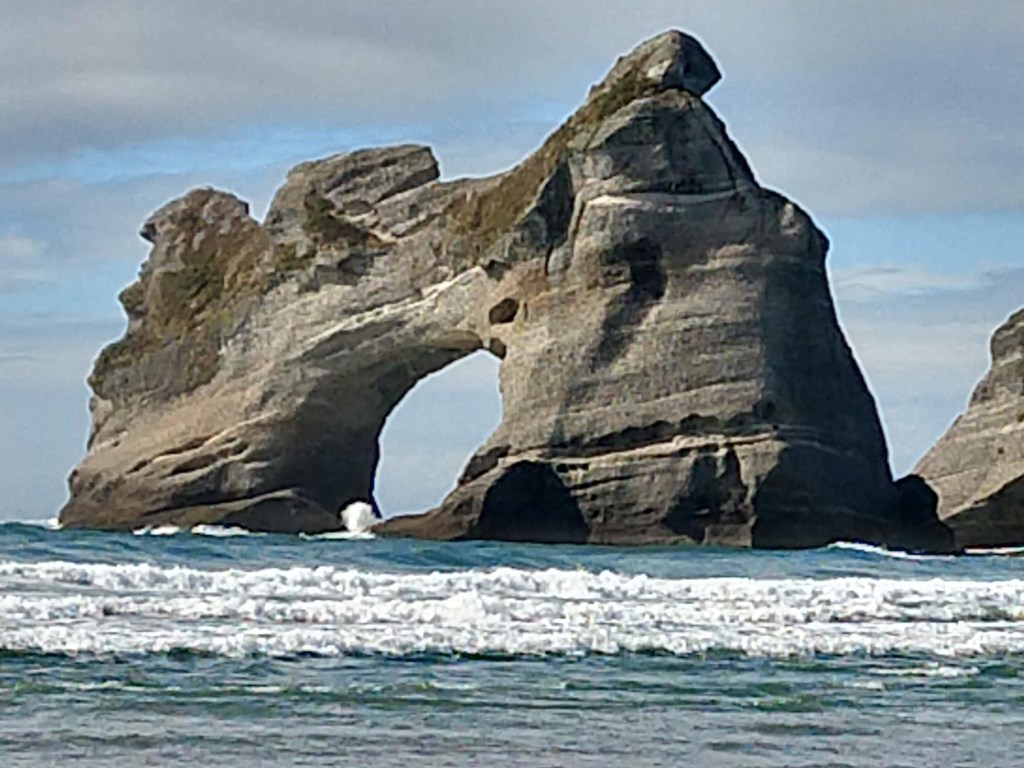
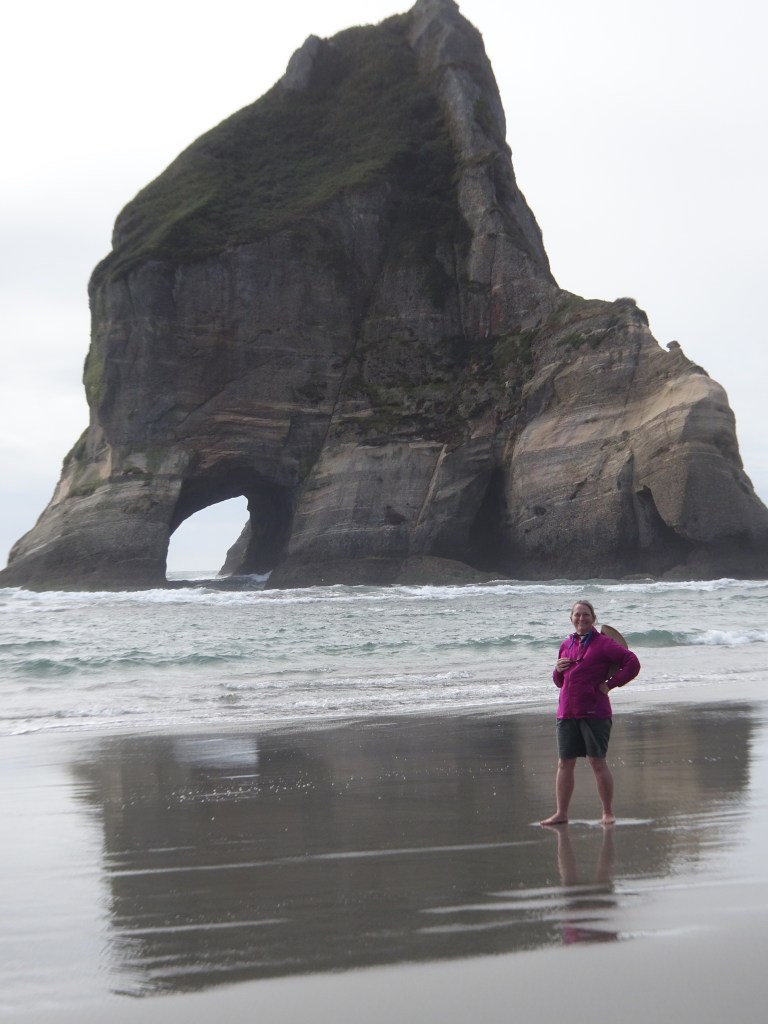
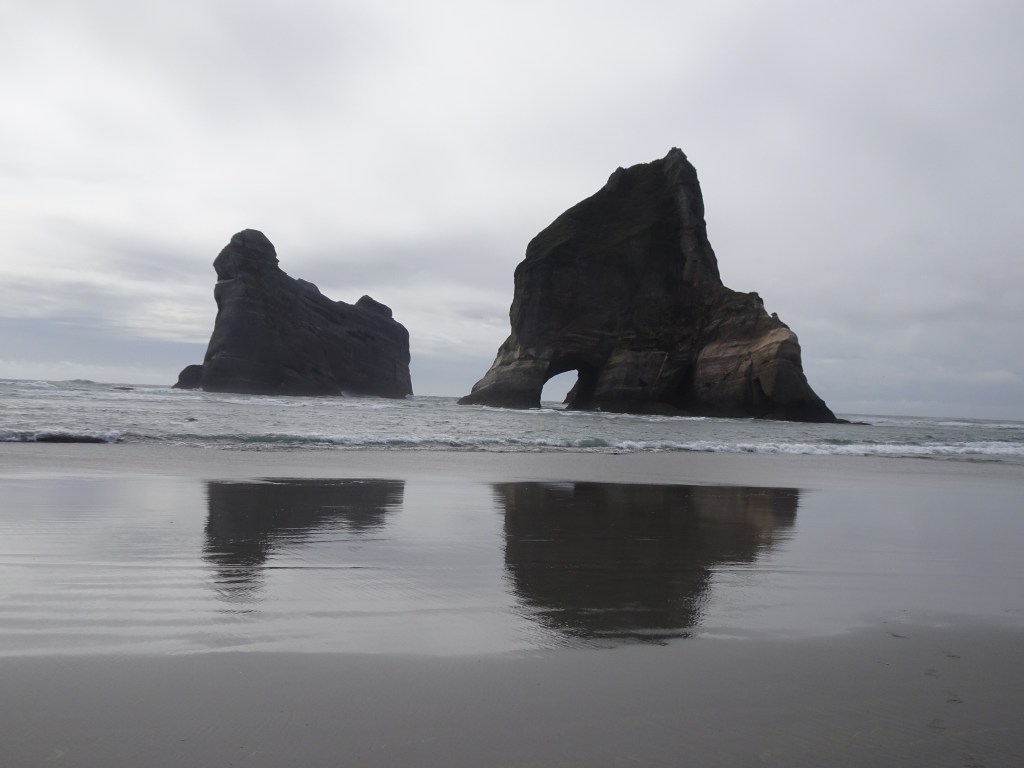
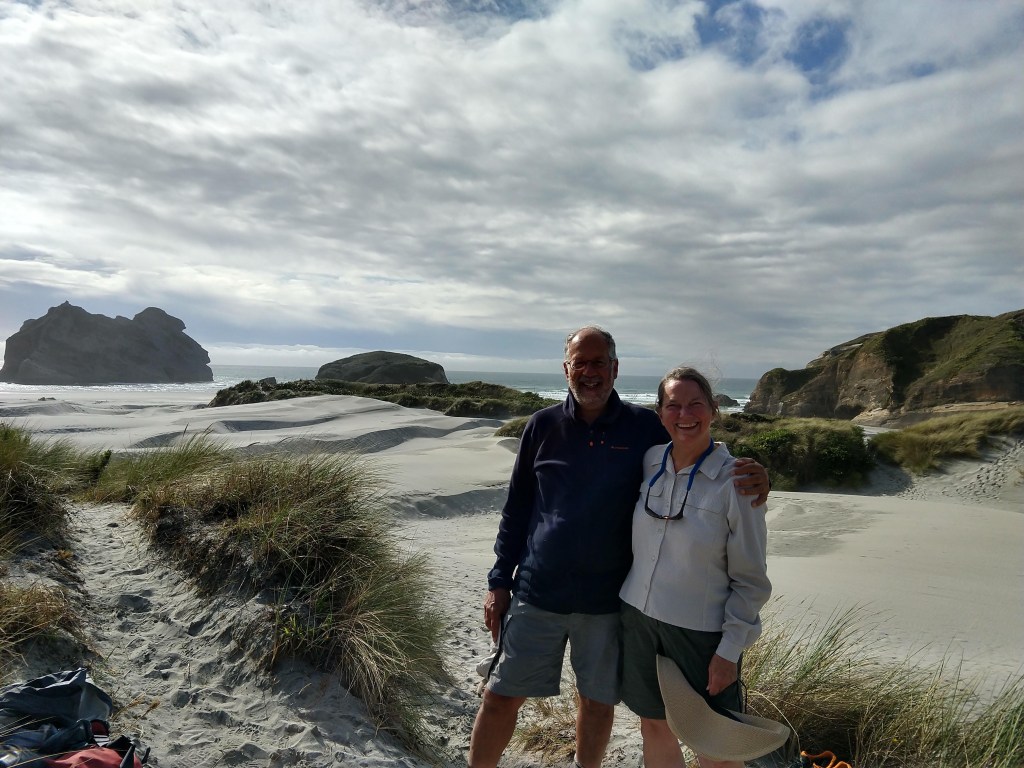
This is a wild raging beach with wicked currents, located near the “eye” of the Kiwi, a half hour walk through the dunes. Wh is pronounced like an F in New Zealand. It is Maori pronunciation. So this beach is called, “farariki.” People do not come here to swim, but rather to gape at the giant archway rocks that protrude from the water, and to witness the wild ocean. When we were there, there was a group of about ten baby seal pups swimming and playing in a tidal pool, with their parents snoozing nearby.
Into the Kayak
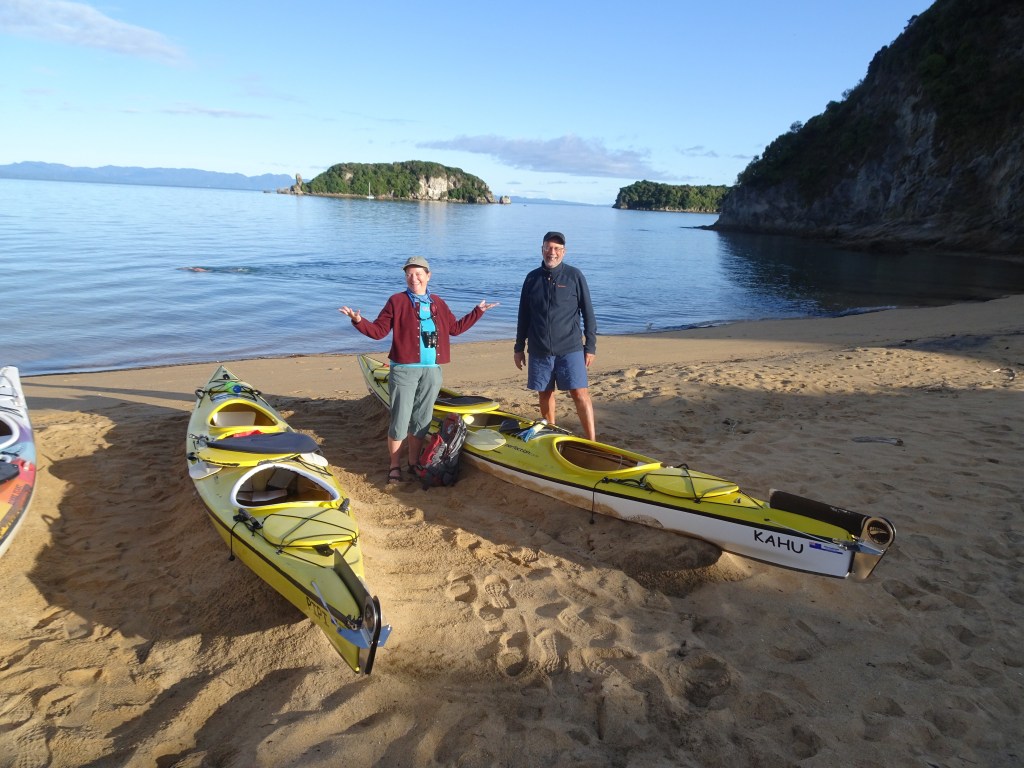
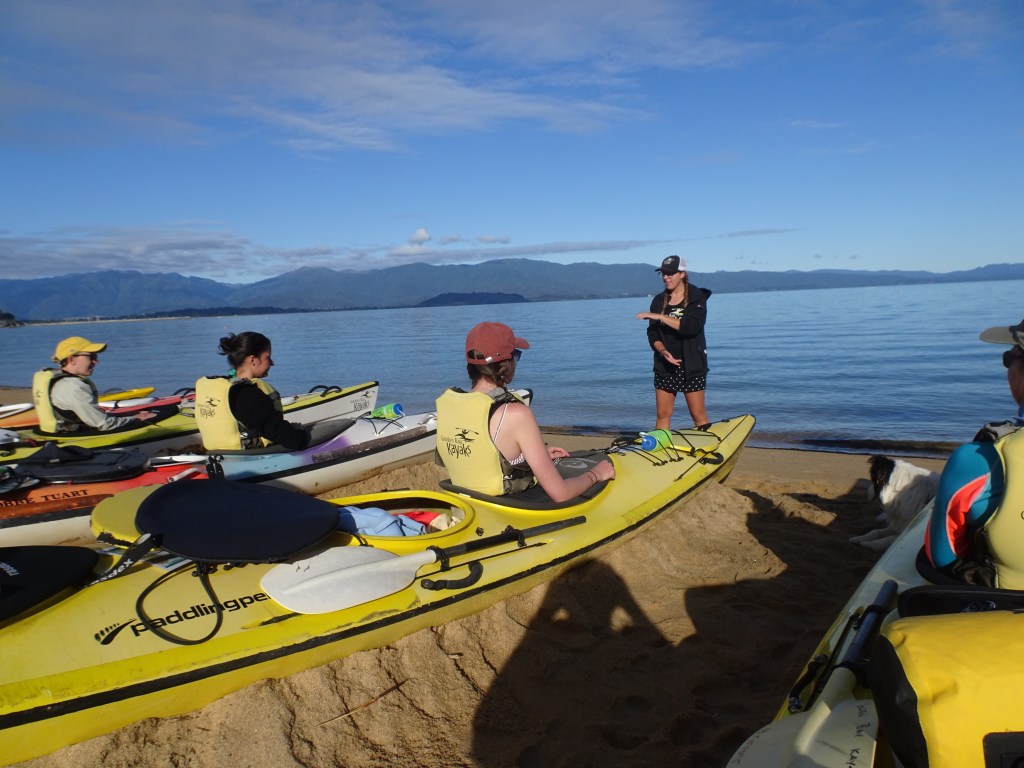
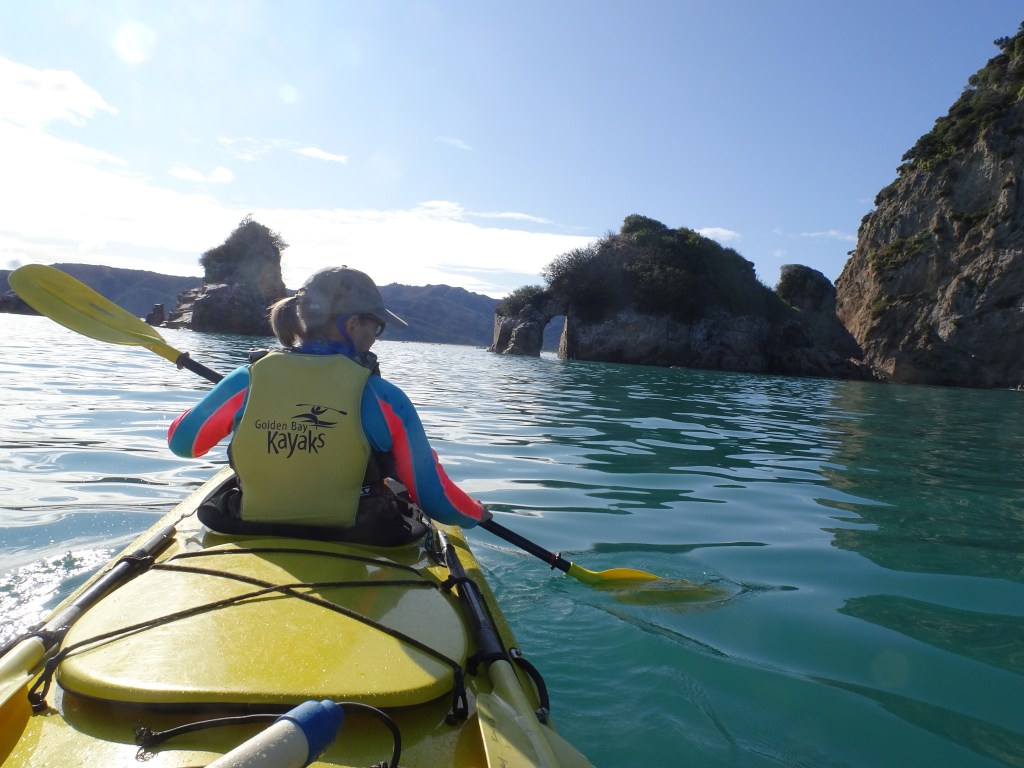
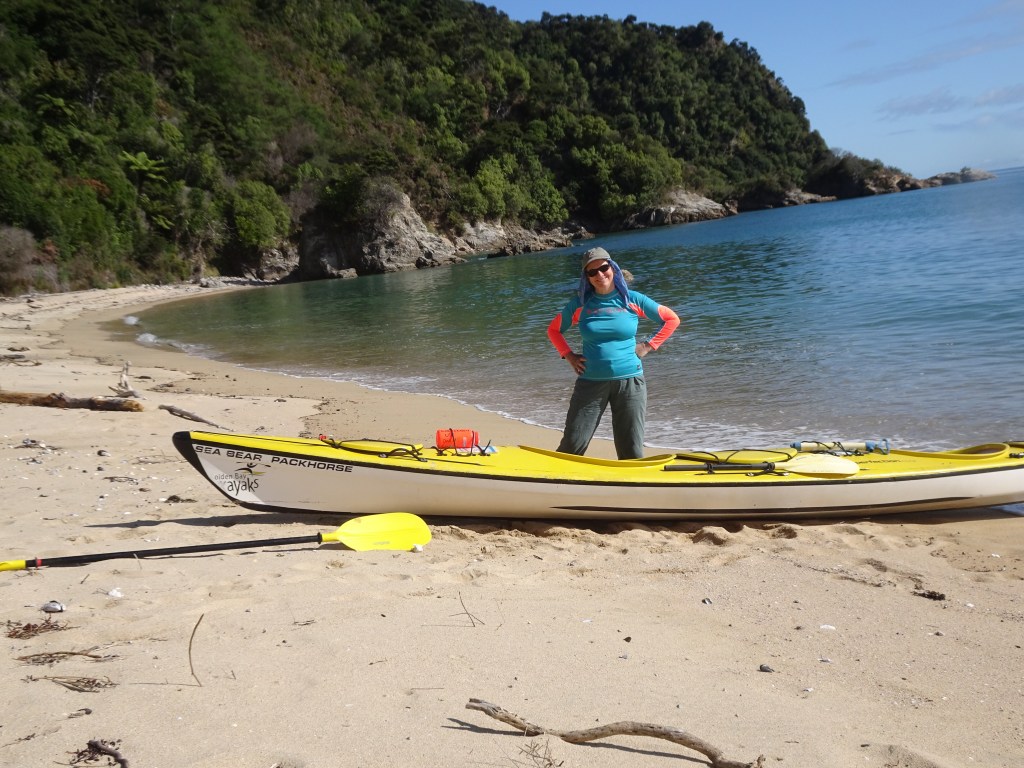
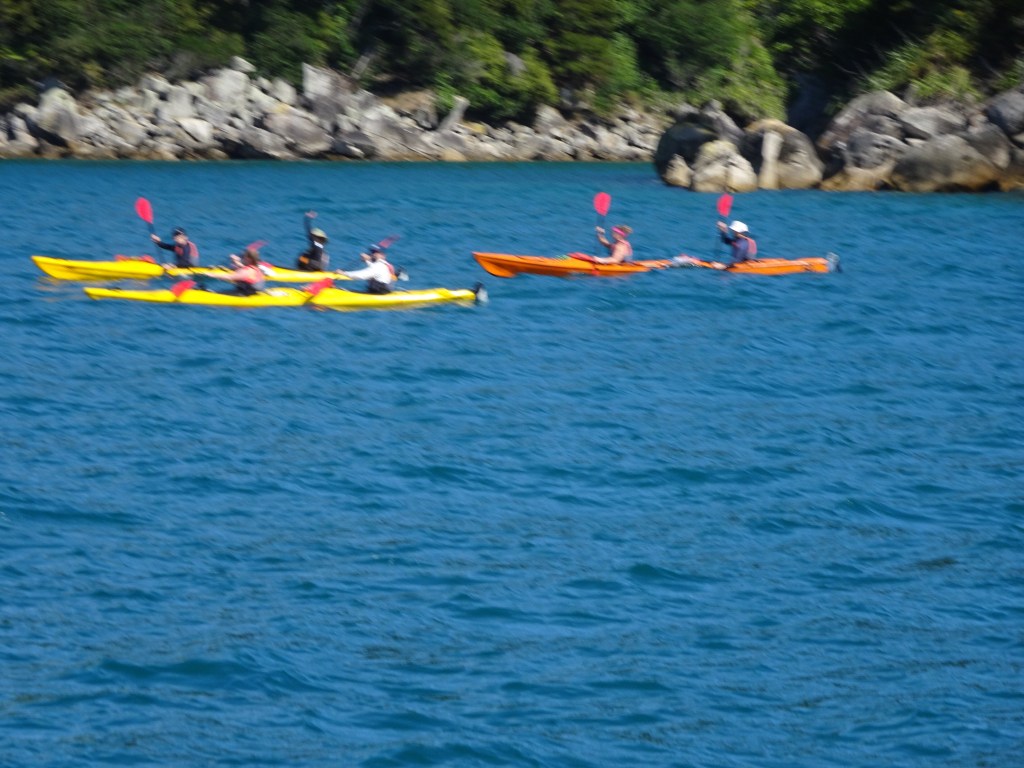
Abel Tasman Park is famous for kayaking, and we went out from Tata Beach, a ten minute drive from Pohara Beach, for a half-day paddle. Kayaks are more sea-worthy than canoes; because of their low profile, they can slice through the waves and not get blown off-course by the wind. We paddled around a headland and landed on a couple of beaches. It is wonderful to get loose from the land and move through the water.
This is a small company right on the beach.Before we took off. Glass.Everybody gets a safety talk. We all went our own ways. There were hundreds of oystercatchers on one of the islands.
Hiking Along the Coast Track
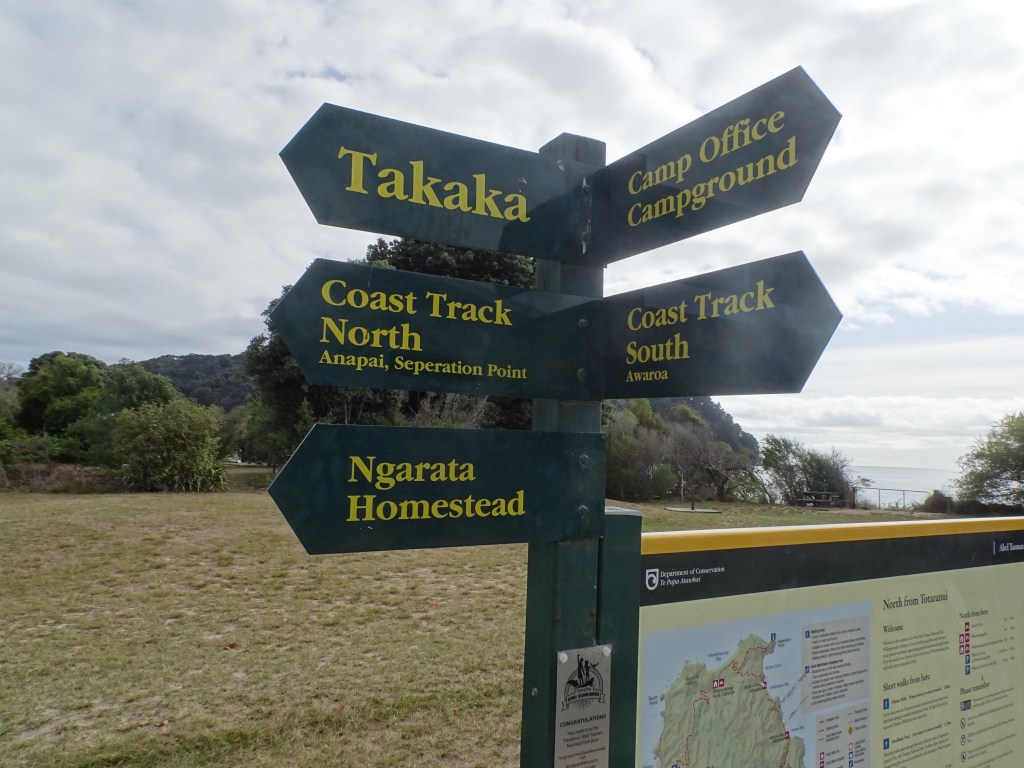
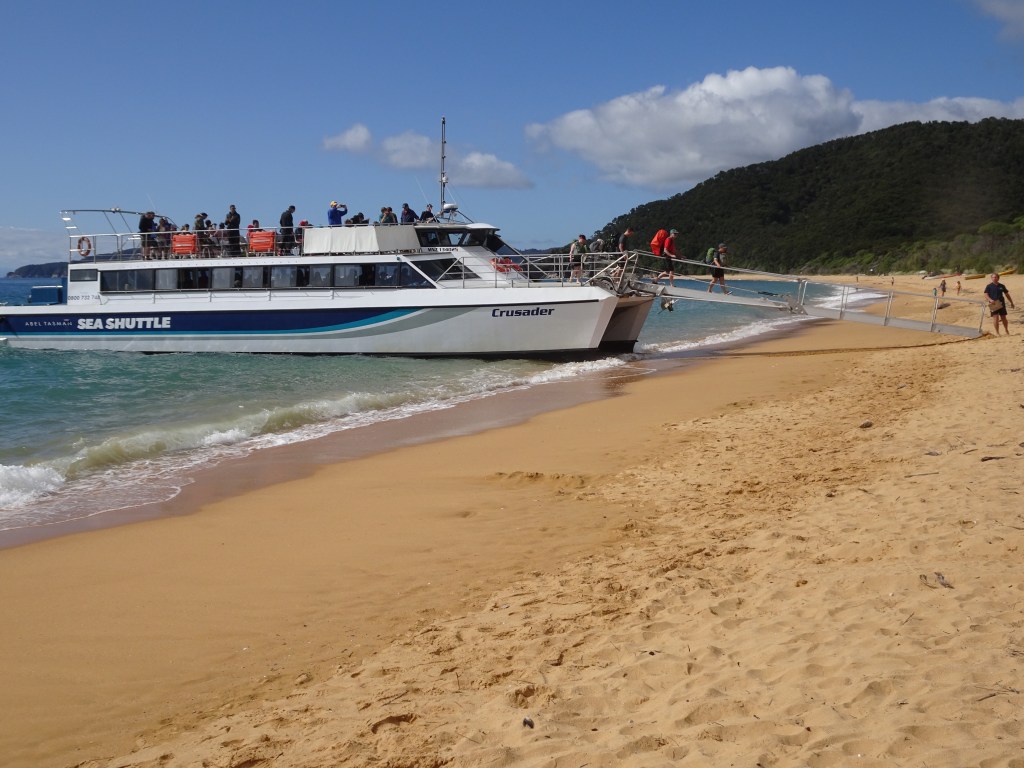
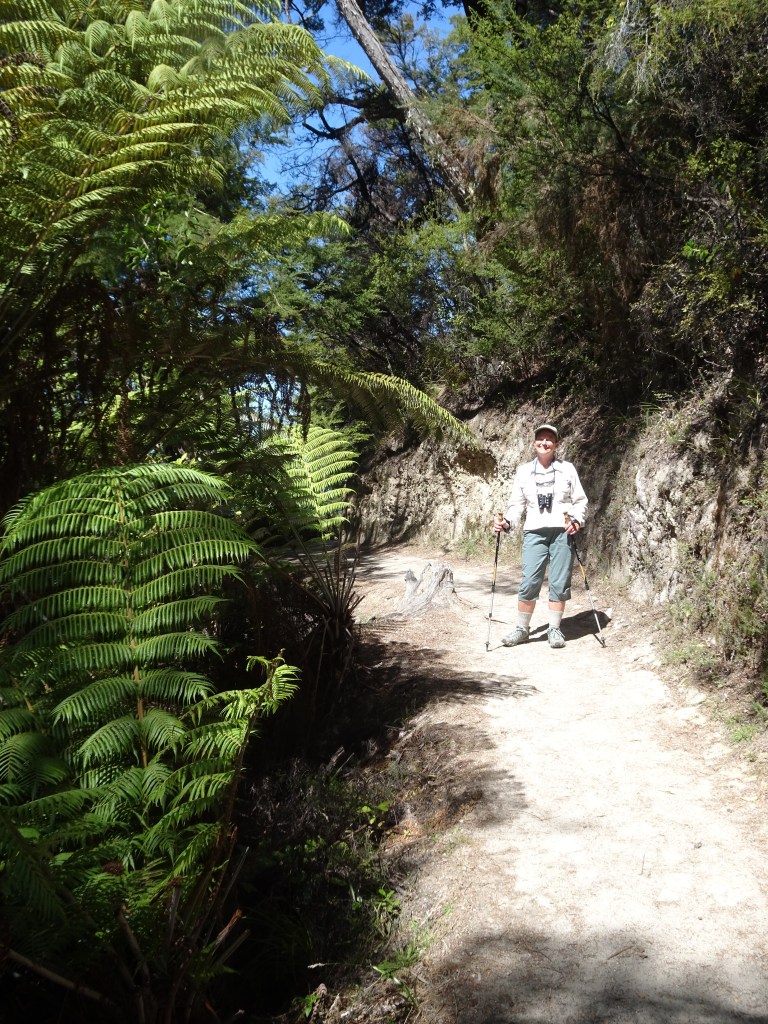
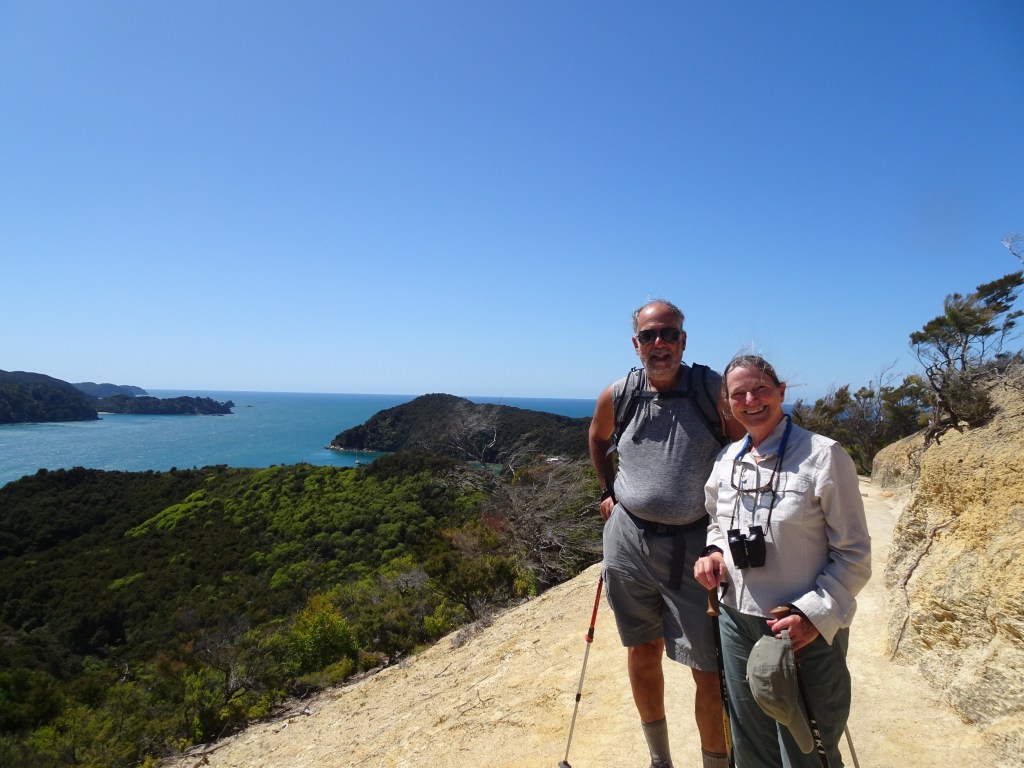
The Coast Track in Abel Tasman National Park is fifty five kilometers, and a lot of people hike the entire trail. It takes three to five days, depending. You can stay in huts or in campsites with your own tent. Or you can choose a portion or two to hike in a day. That’s what we did. We started in one bay and hiked through the forest to the next bay. A water taxi dropped us off, then picked us up three hours later in the next bay. One thing about this system is that you are under some time pressure on your hike. We were dropped off at 12:00 noon in Apple Tree Bay, and we were scheduled to be picked up at 3:15 in Anchorage Bay. It is listed as a two and a half hour hike. So that means we had forty five minutes for lunch and dawdling. We are used to more than that. But, we definitely did not want to miss the 3:15 boat because that is the last one of the day. We hiked very fast after our lunch, and we arrived at Anchorage Bay at five minutes to three. The boat pulled in, and took off at ten minutes after three. Fifteen minutes to spare. There were some people who started on the trail with us who did not make it. We will always wonder what happened to them.
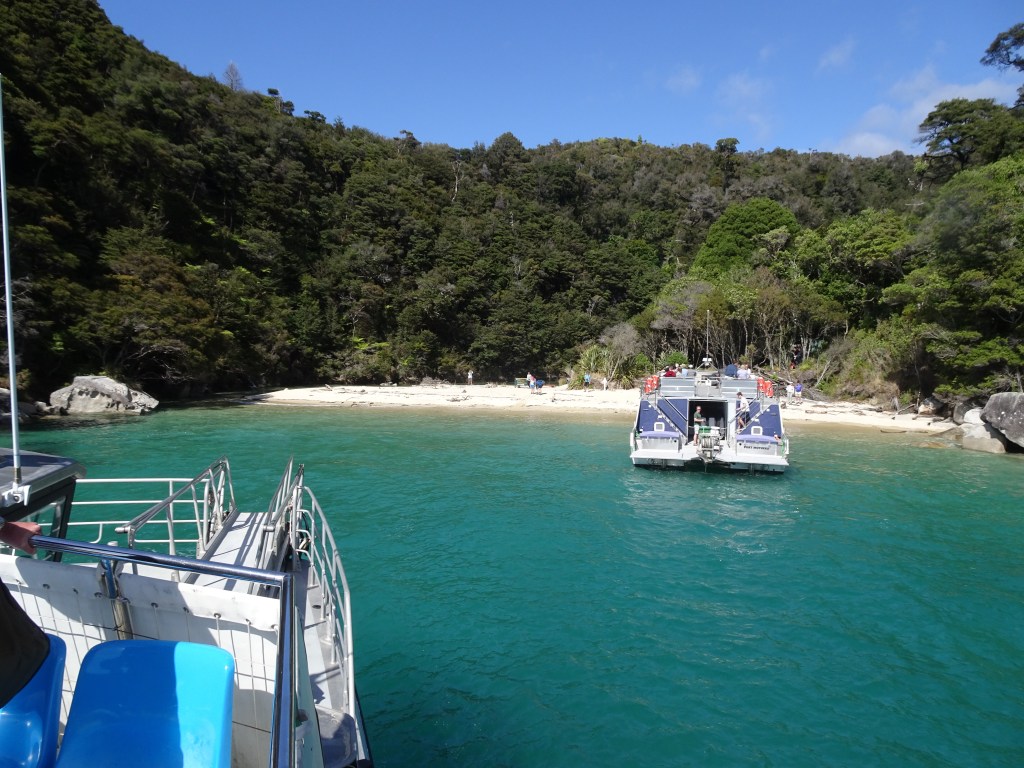
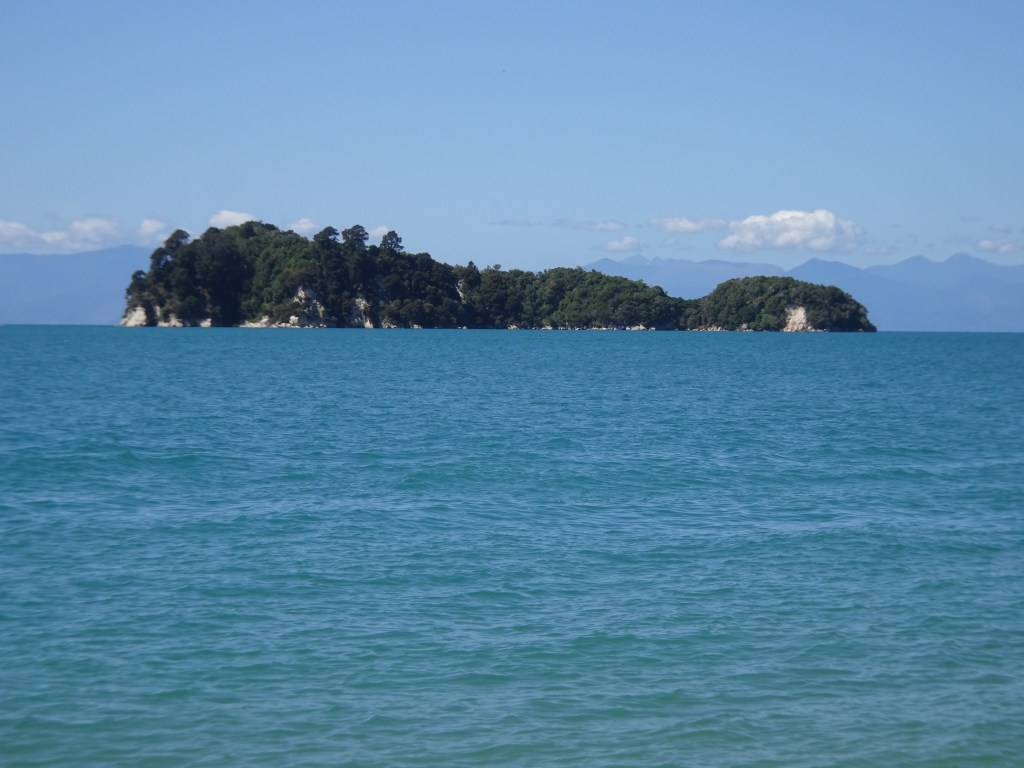
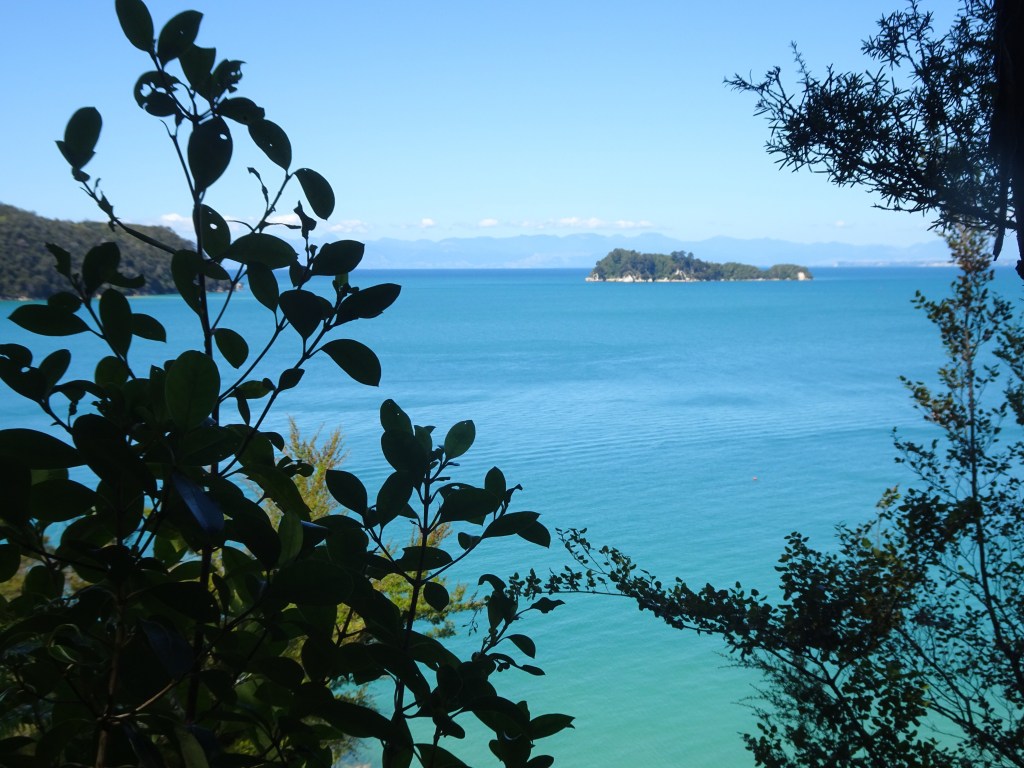
Totaranui Beach, where the water taxi picked us up. This is in the very northeast of the park. It’s a catamaran that pulls straight in to the sand.We passed group after group of kayakers, moving from bay to bay. Lots of people out on the water, but room for all.The national park is supported by the taxis. People can camp in the bays or hike or kayak between them, and get dropped off or picked up from any of them. The whole park is a marine reserve.Adele Island, near Apple Tree Bay. From the trail.
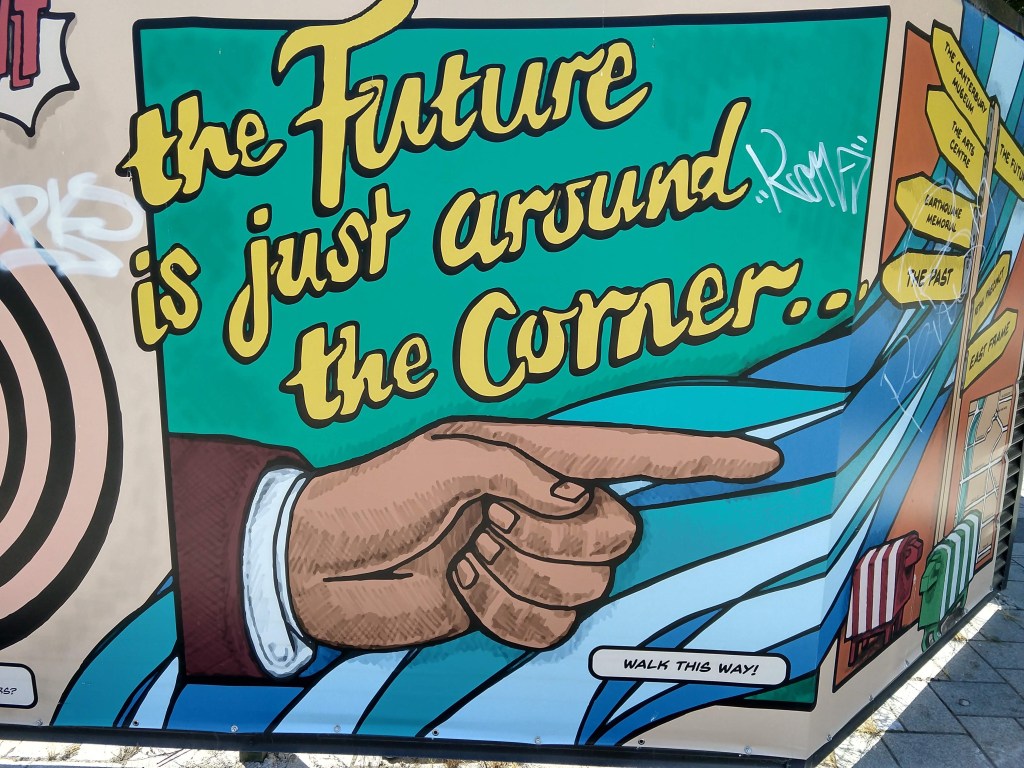
There’s something about traveling that keeps you optimistic. Maybe it’s just being on the move and always anticipating what is awaiting around the next corner. Everything is new and fresh, and once you learn your way around, it’s time to move on. Traveling simplifies your life and makes you grateful and delighted in the smallest of details, such as a returned smile or a beautiful sight around the bend. Sometimes those sights are breathtakingly gorgeous. It’s also seeing new people being excited about doing new things. Whatever it is, it seems like everything we find around the corner is better than the corner yesterday. Today is our last day on the South Island. We’ll take the ferry back to the North Island, then begin to make our way up to Auckland, with a couple of stops. We’re ready for anything.
Otis Redding could have been thinking of Nelson when he wrote Sittin on the Dock of the Bay. The city is nestled into a major bay at the northern tip of the Southern Island. It is surrounded on three sides by mountains, and Abel Tasman National Park lies just to the west. The park is a magnificent ocean refuge, with bays made for kayaking and hiking trails through the forests alongside.
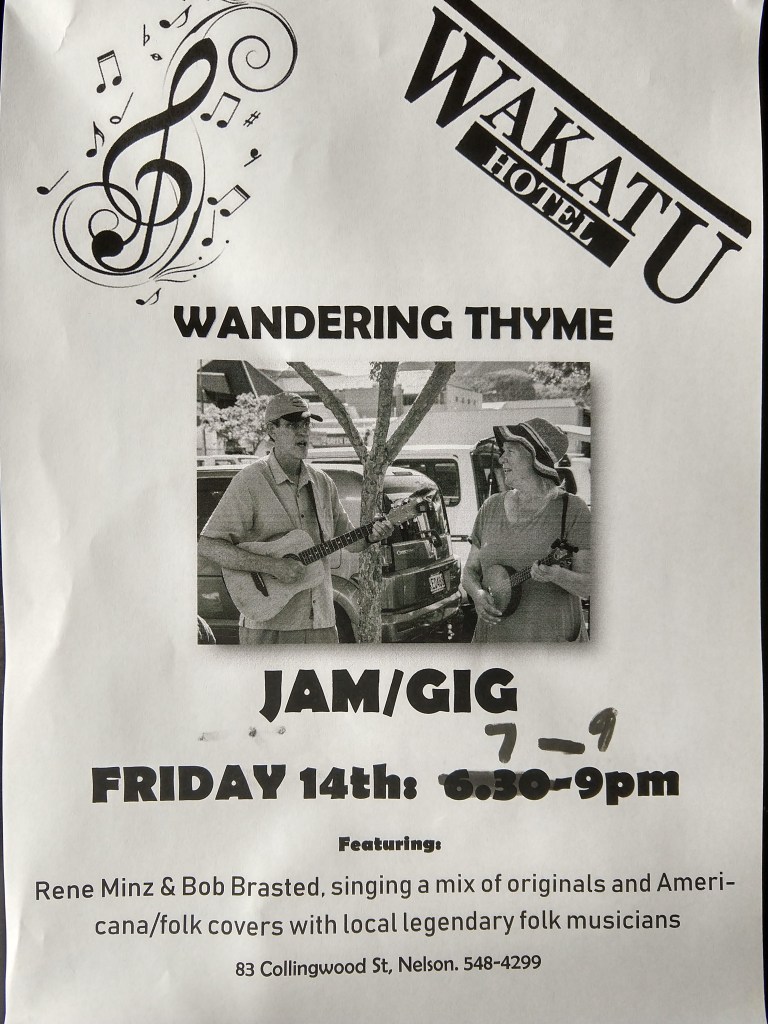
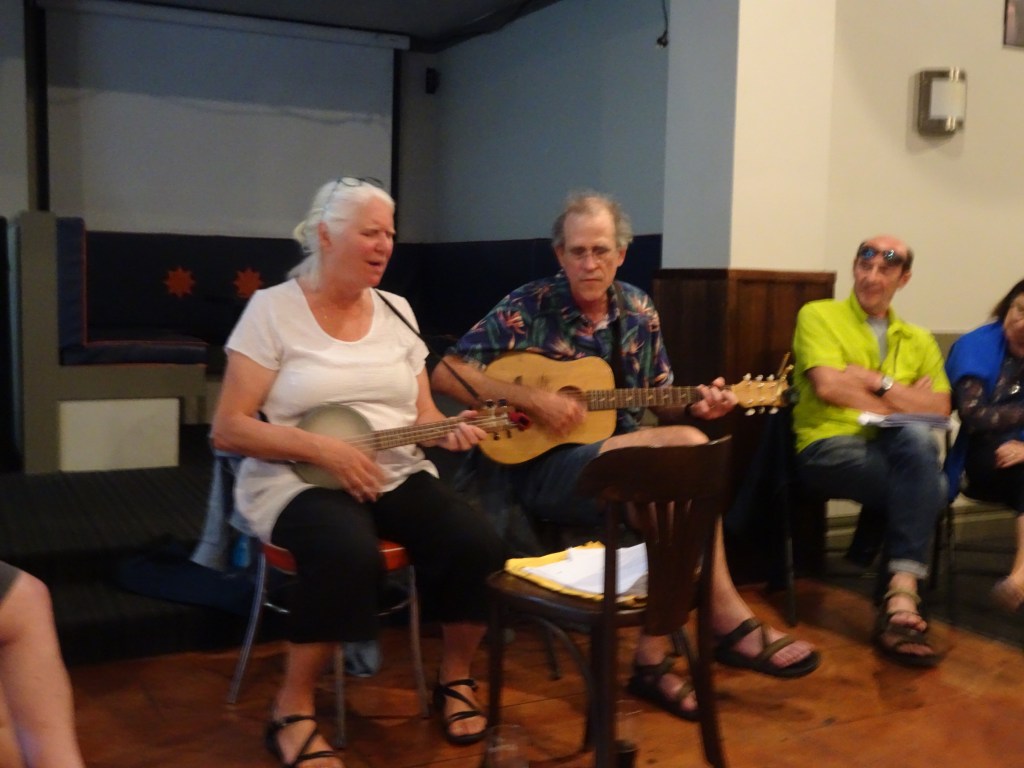
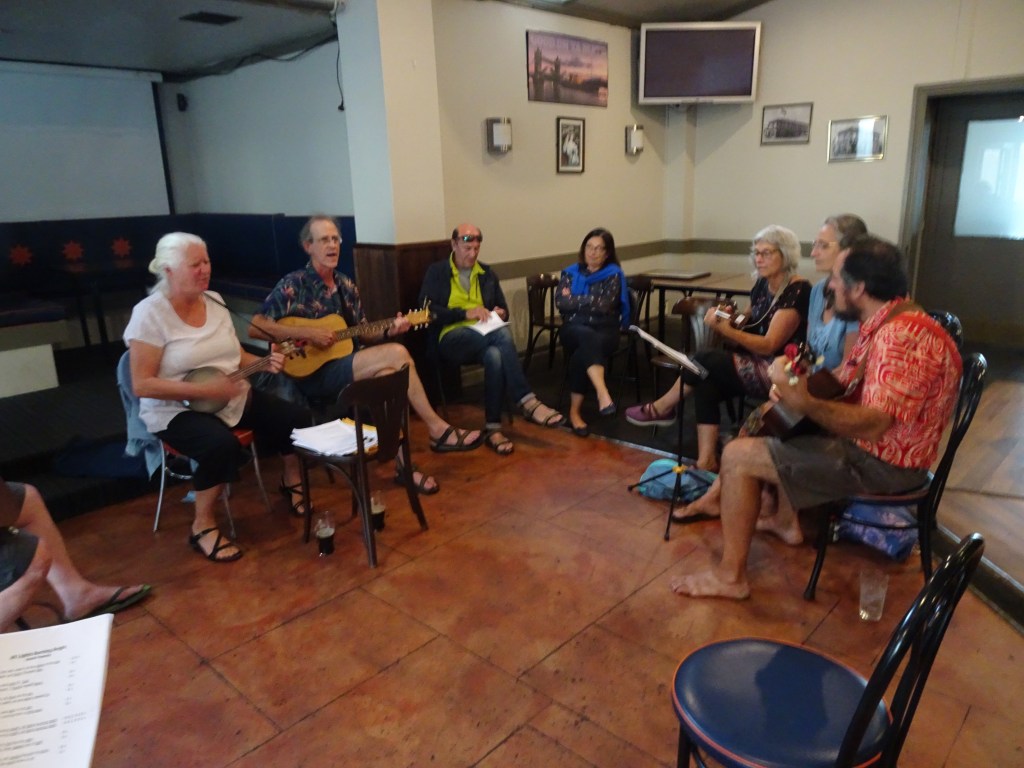
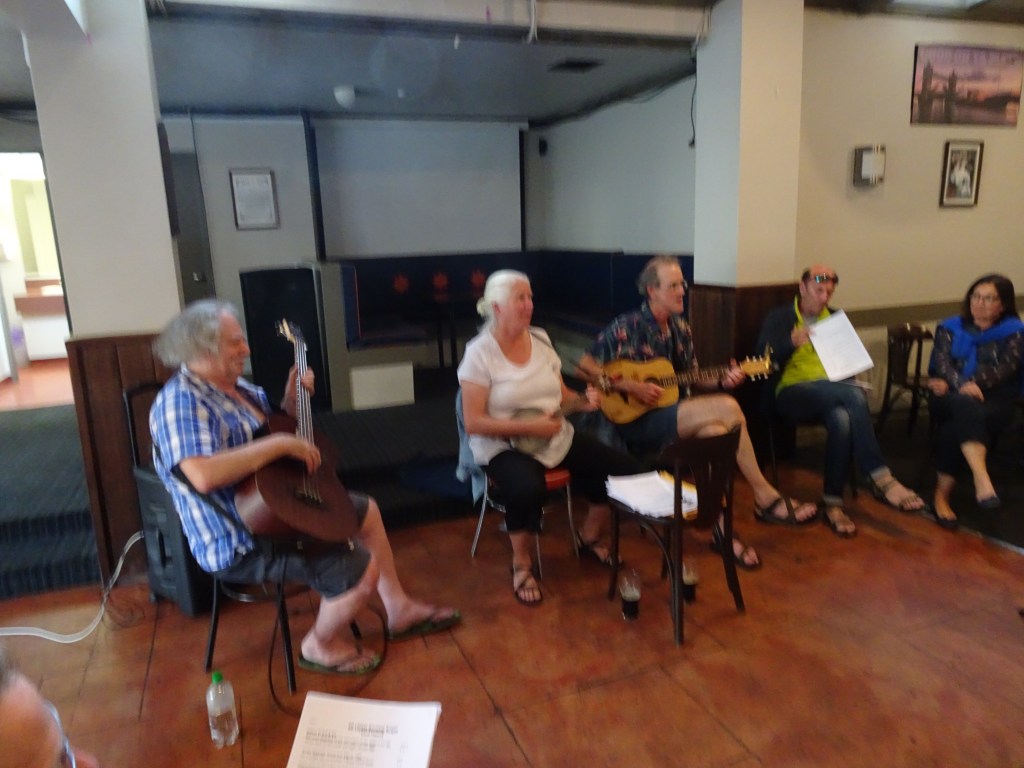
It rained for most of the time we were in Nelson, and our time there was mostly spent on urban exploring. We met up with our friends Bob and Rene, who mostly live in Eugene but have lived in New Zealand over the years. They are musicians, and are very active in the Nelson folk-music scene. We accompanied them one evening to one of their weekly music sessions in a hotel bar. Some Americans, some Kiwis, just playing music and singing.
Trevor played bass. He loves the bass because he says that it ties all the other music together. He wants people to just barely be aware of it. “If people hear it and like it, and want more, then it’s enough. If you give them more, it will be too much.”
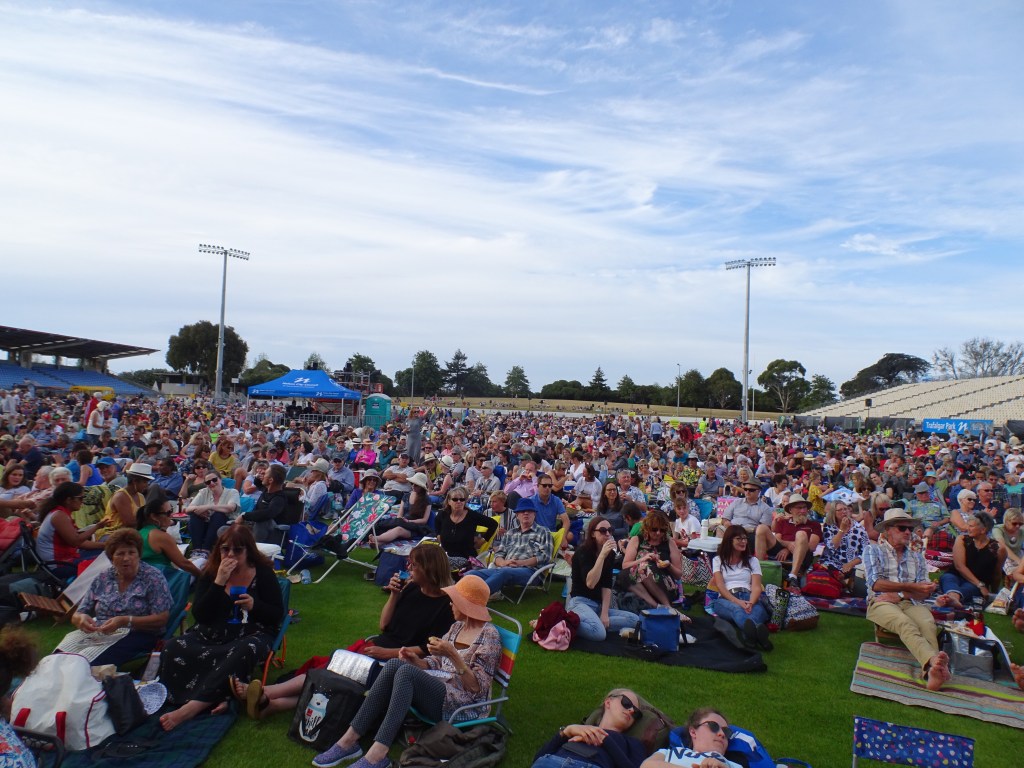
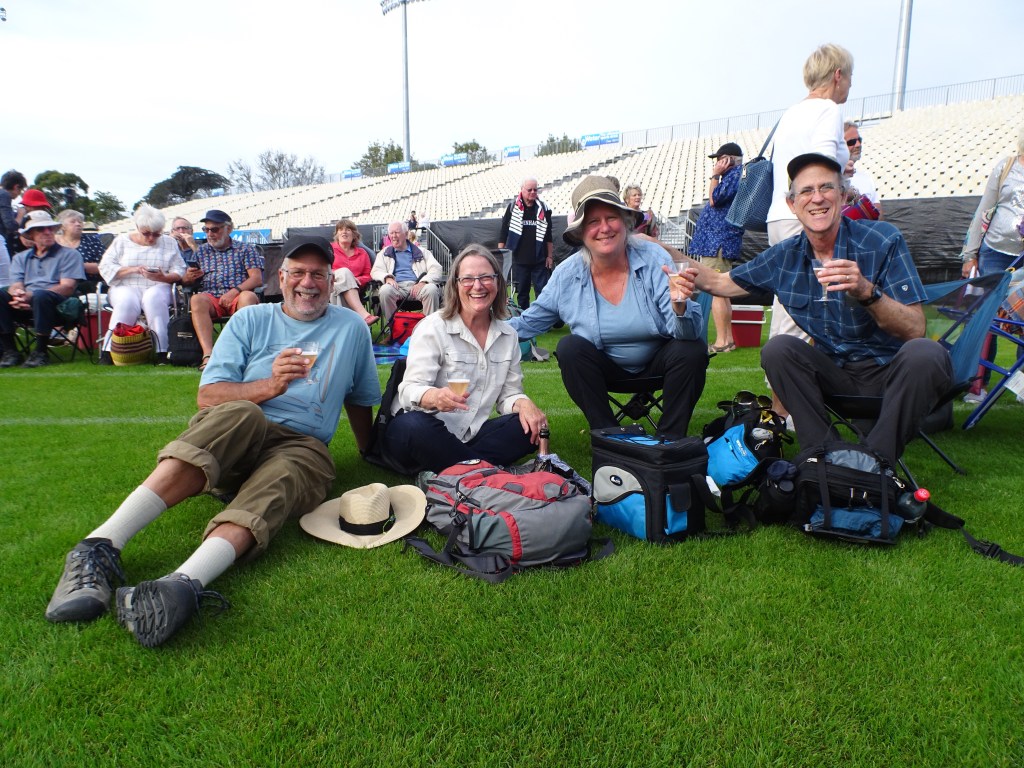
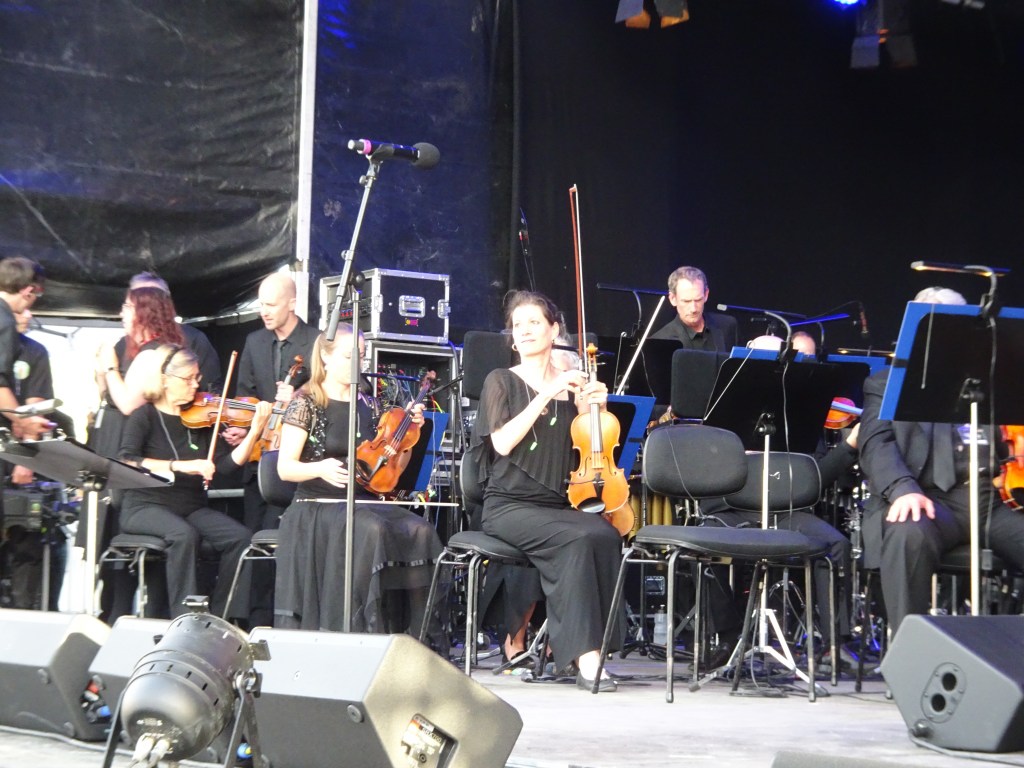
Nelson is a city of artists and musicians and culture. Opera in the Park is an annual event that celebrated its twentieth anniversary while we were there. The New Zealand National Symphony Orchestra came to Nelson to perform in Trafalgar Park. An evening performance on a delightful summer evening. The park filled up with Nelsonites and their chairs and their picnics. It seemed like half the town was there, with everybody happy and cheerful. And yes, there was some serious opera, but there was also some rock n roll, and country western. It was great to hear the symphony orchestra let loose, and they finished with a stirring version of Hey Jude, with the audience singing along and waving their cell phones.
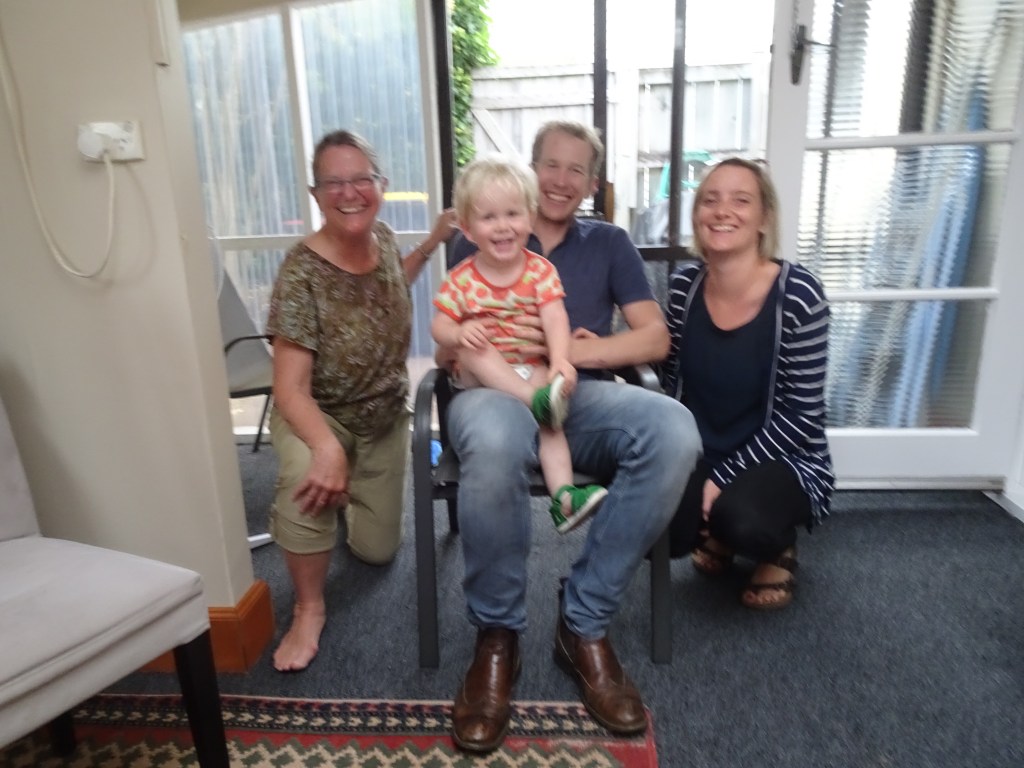
We also got into contact with some other friends with a Eugene connection. Lora grew up in Eugene, and was (still is) friends with Amber and Amber’s mom Marilyn. She came down to NZ as an exchange student, then came back with a work/stay visa, and she met Drew. Drew is a Nelsonite, and they got married and now live in Nelson with their son Jim. Lora is a teacher and a pedagogy developer, and Drew, who used to be a teacher, now works in a convention and events coordinating business. They came over to our house for an afternoon of conversation. Hopefully we’ll meet up again in Oregon.
The Marketplace
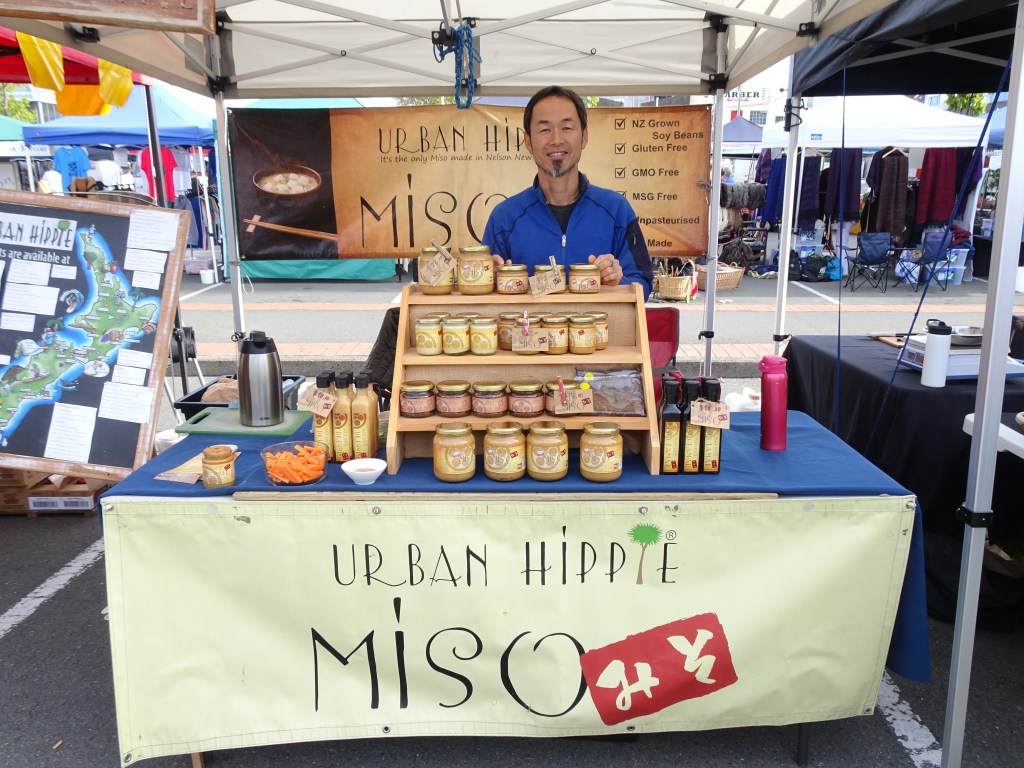
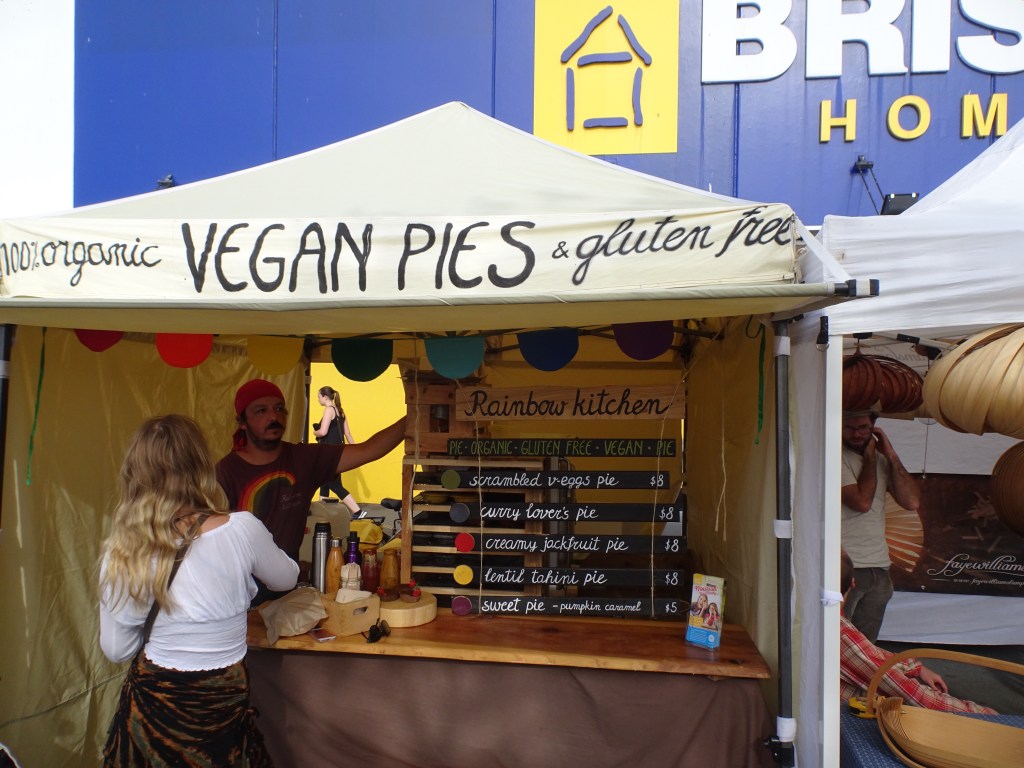
On Saturday morning, we went to the Nelson Saturday Market. It was full of food vendors and crafts people. In Eugene, the Saturday Market is the longest-running market in the USA, fifty years and going strong. The Nelson Market was similar, a little smaller but with the same emphasis on hand-made goods.
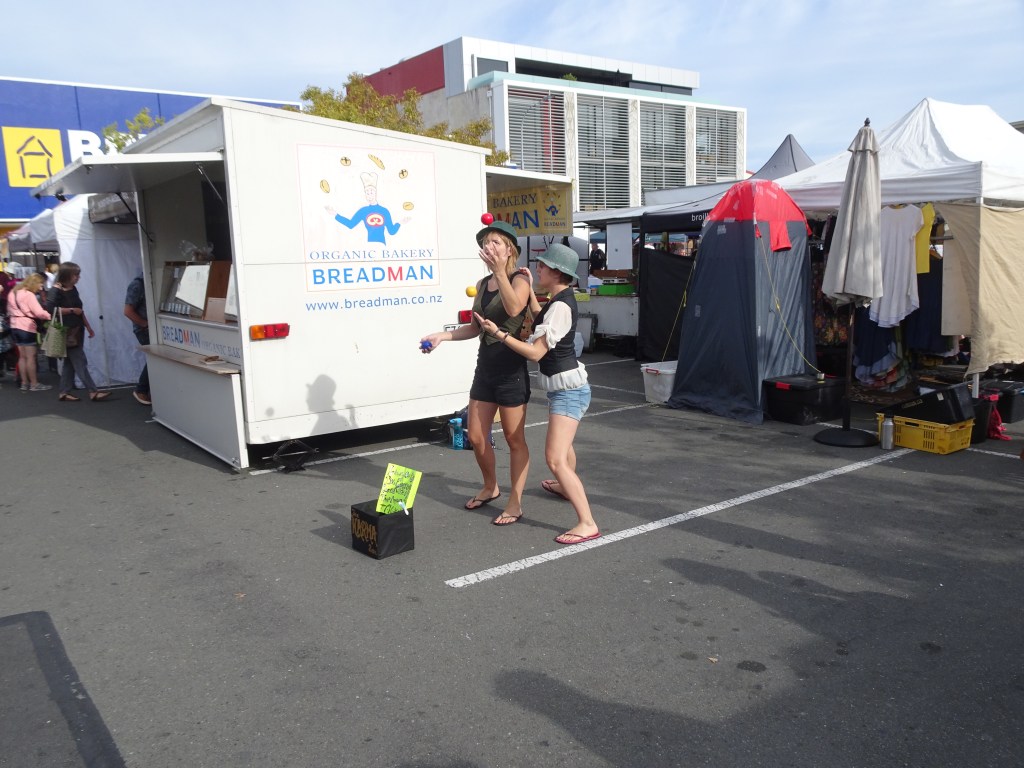
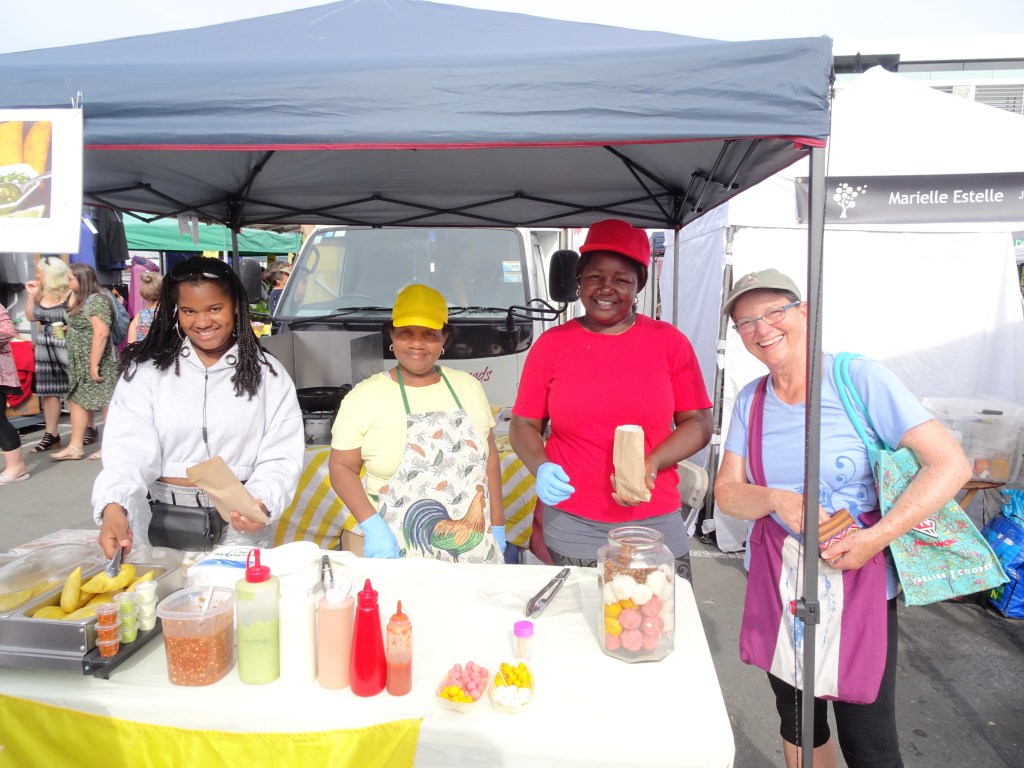
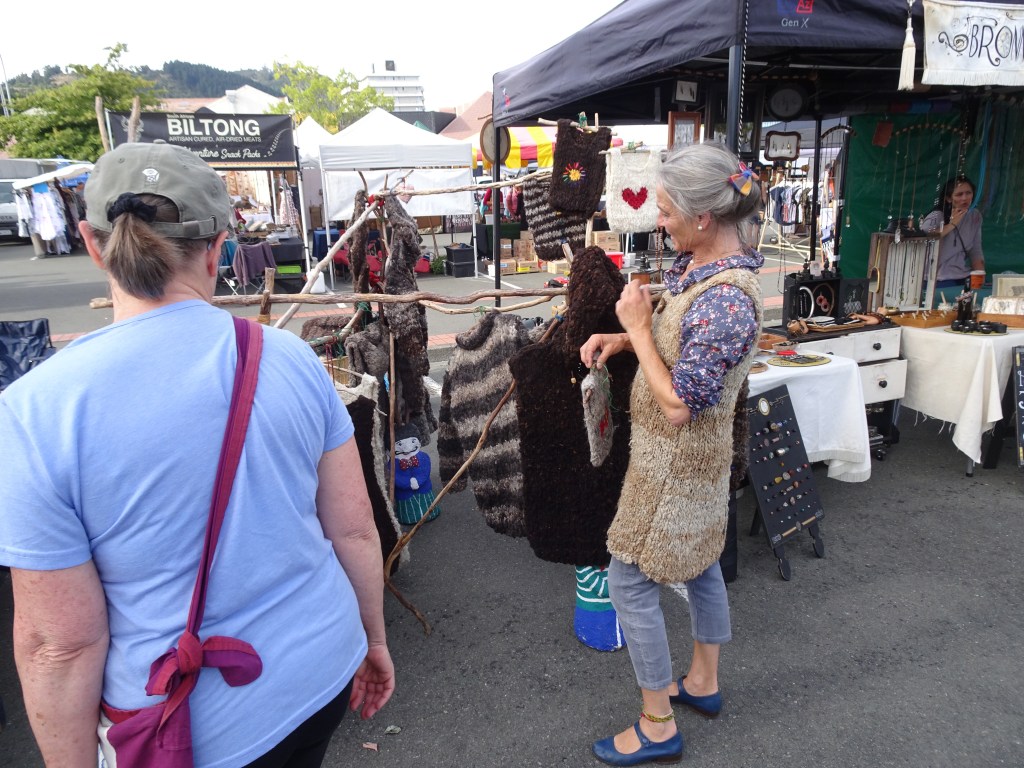
We bought a jar of miso from Takei, so we can boil some water and have a cup sometimes. He’s the only miso maker in New Zealand. You make me so very happy.We met Christina and Diane, two jugglers from Calgary, juggling from town to town.Chicas from Cali, Colombia, selling empanadas and coconut sweets. They are political refugees here after fleeing the strife in Colombia. They say they will never go back, and that New Zealand has welcomed them. It’s a big world and a small world. She loves her sheep and loves their wool.
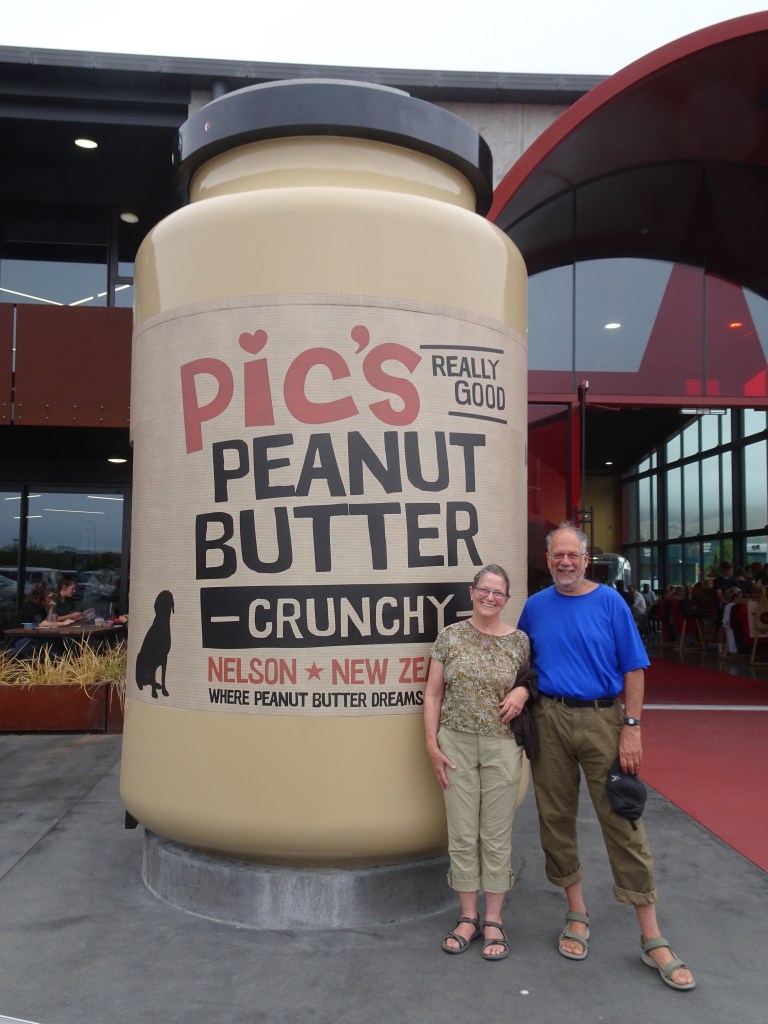
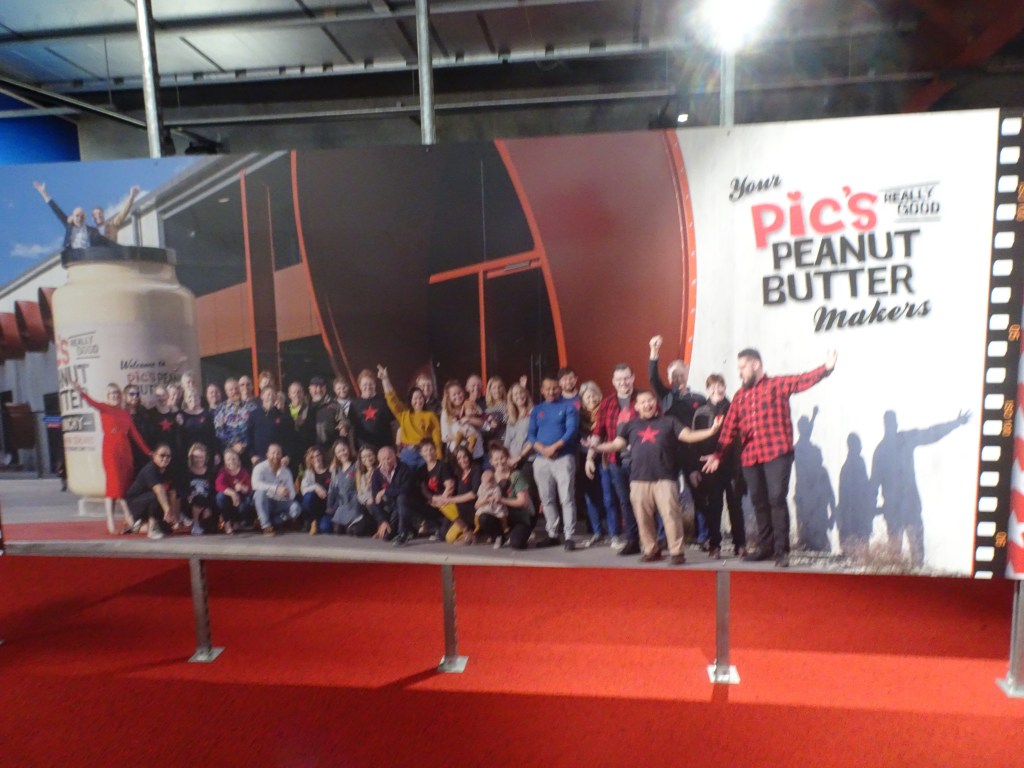
Pic’s Peanut Butter
There’s something about peanut butter that is inherently lighthearted and funny. The story of Pic’s peanut butter, though, is a Kiwi success story that reveals a lot about the national character, and also shows what can be done with a lot of hard work, perseverance, and integrity.
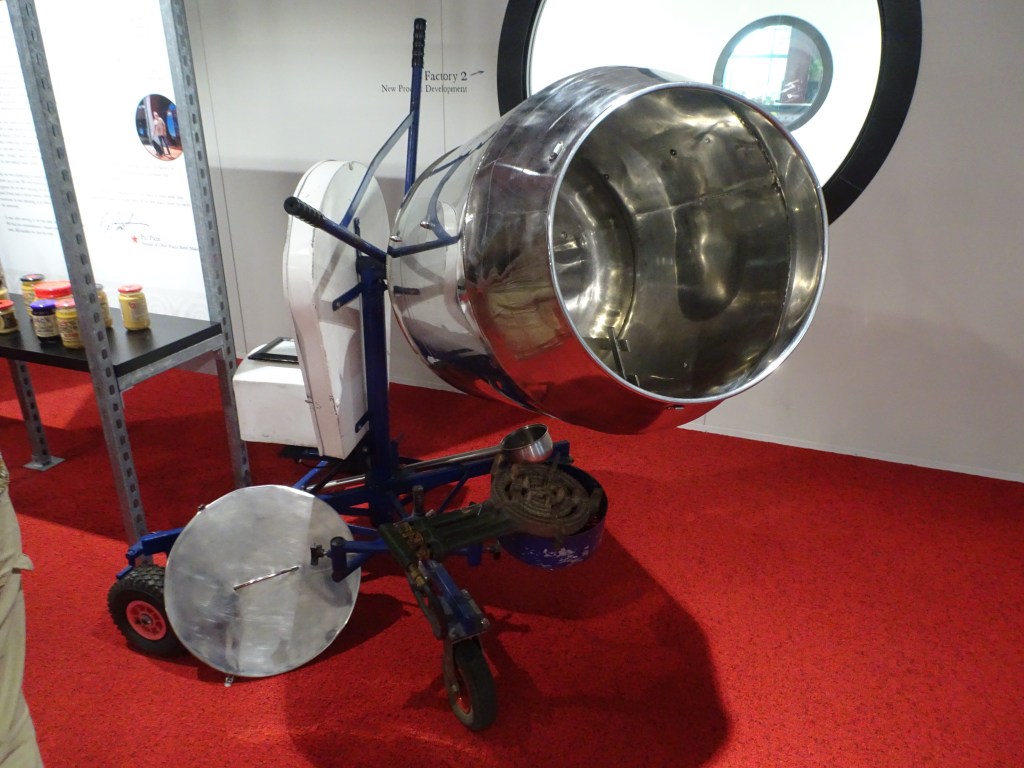
Pic Picot traveled the world and did lots of things before landing in Nelson. He started making peanut butter when, in 2005, he bought a jar of peanut butter from the grocery store, brought it home, opened it up to make a sandwich, and was “disgusted” by the amount of sugar in it. He called the customer help line to complain, and was told that “that’s how people like it.” He then went out and bought some peanuts, roasted them in his oven, and blended them in his blender. He started making jars of peanut butter with nothing added to the peanuts except perhaps a little salt, and selling the jars from his garage and at the Friday Farmers Market in Nelson. Soon, his oven wasn’t big enough, so he bought a cement mixer and put a propane burner underneath it, and roasted the peanuts in it.
Pic’s cement mixer, now on display in the factory.
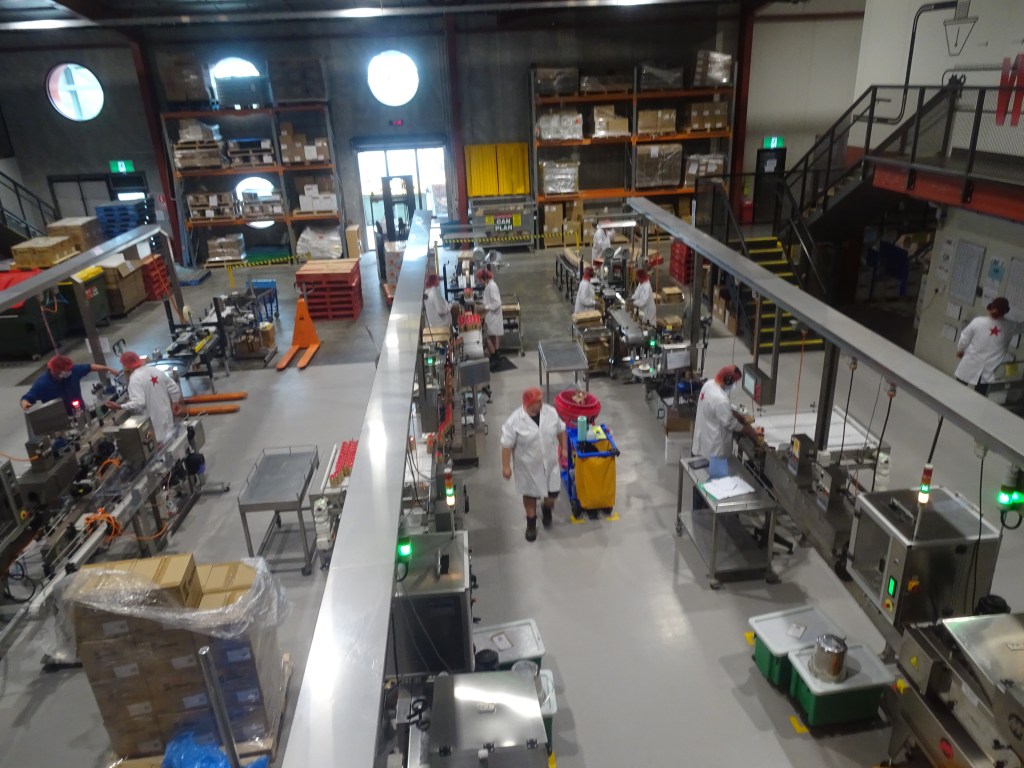
Soon he hit the road, sampling his peanut butter and spreading the word. New Zealand has three grocery chains—New World, Countdown, and Foursquare. It wasn’t long until all of them picked up the peanut butter, and it became available throughout the country. Now, in the new factory in Nelson that opened one year ago, the crew produces thirty five million jars a year.
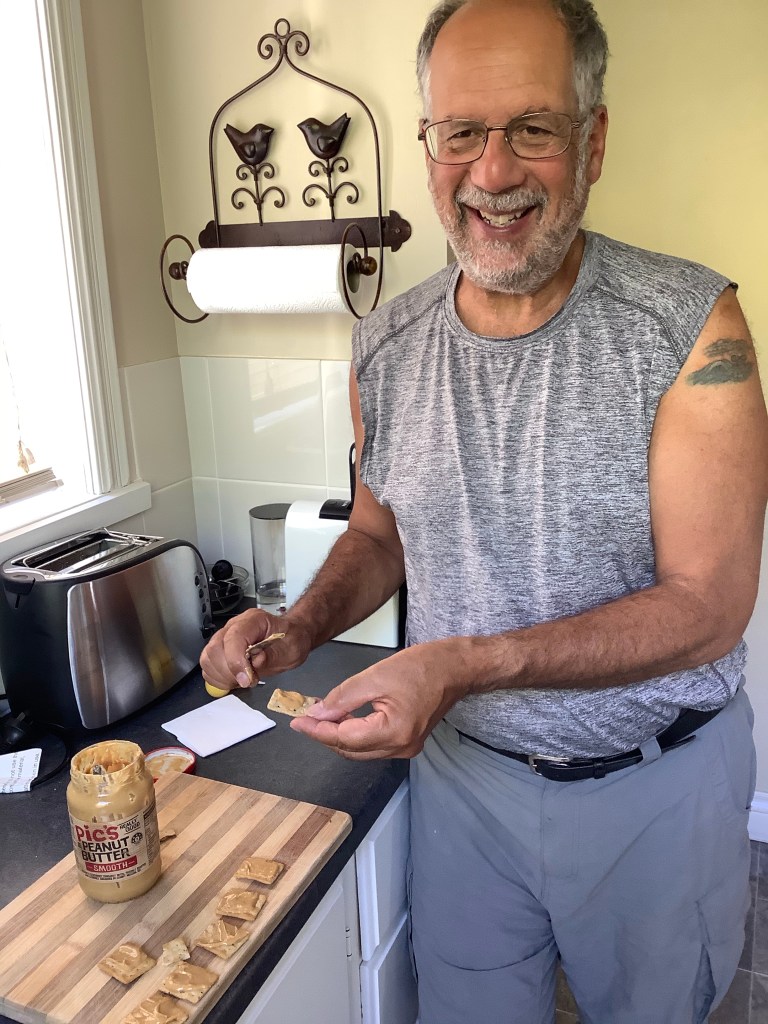
We went on a tour of the factory. Who goes on a tour of a peanut butter factory? Well, we were intrigued by the story, and impressed with the quality of the product, and we’re both kind of foodies anyway, so we wanted to see it. Turns out, there were thirty people on our tour, and they give two and three tours a day. It is popular. Pic was warned by partners not to open the factory to tours. “People will come and see how easy it is, then they’ll go home and start their own business.” And in fact, there is no secret to making peanut butter. Get peanuts, roast them, then grind them. That’s it. “Let them,” he said.
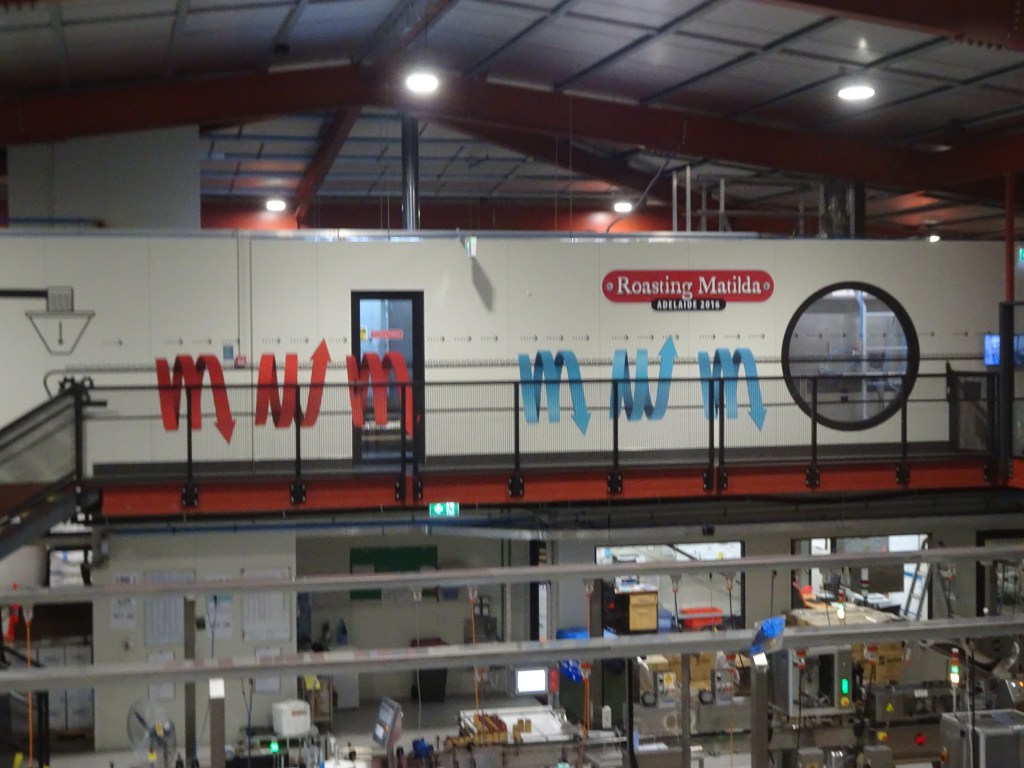
Roasting Matilda is the big oven. The peanuts are transported through, and come out perfectly roasted.Roast ‘em, grind ‘em, fill the jars, screw on the lid, label the jars, pack the jars in cases, and send ‘em out. Pic
Up For A View
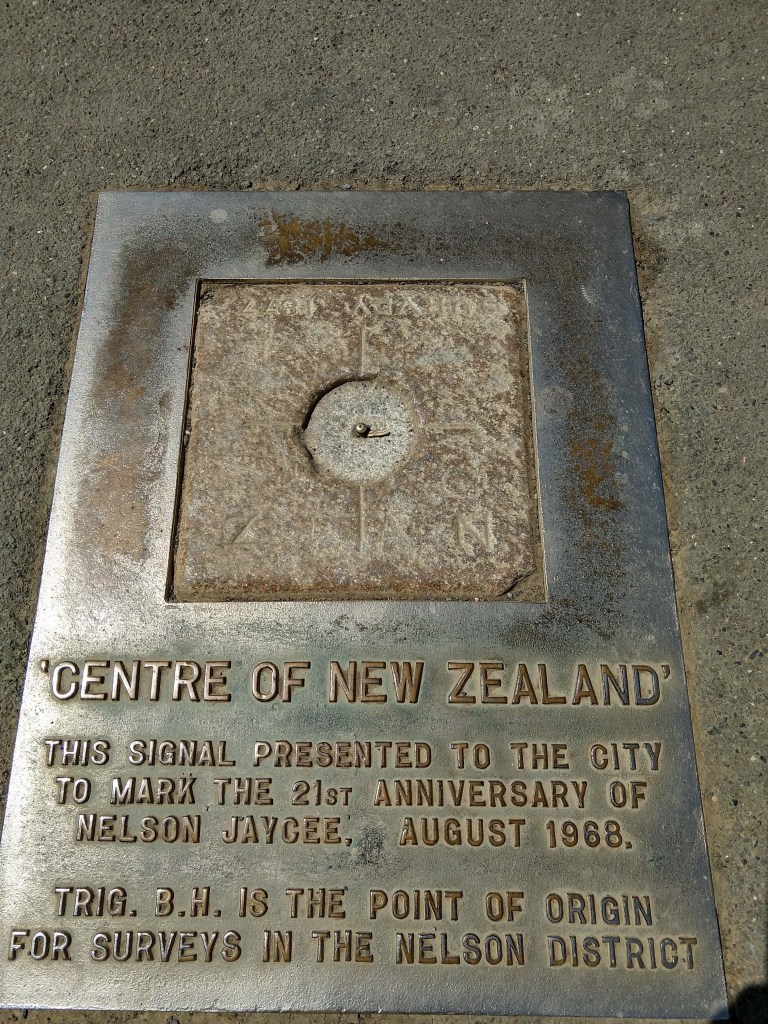
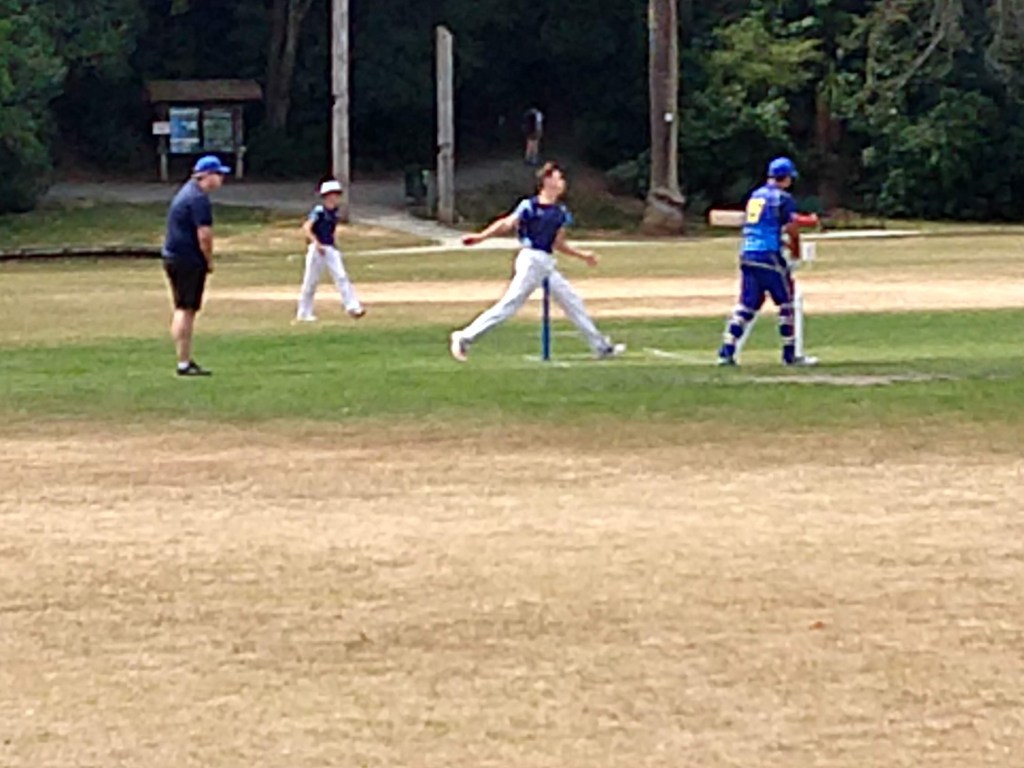
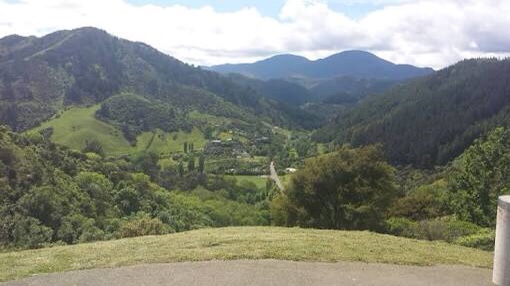
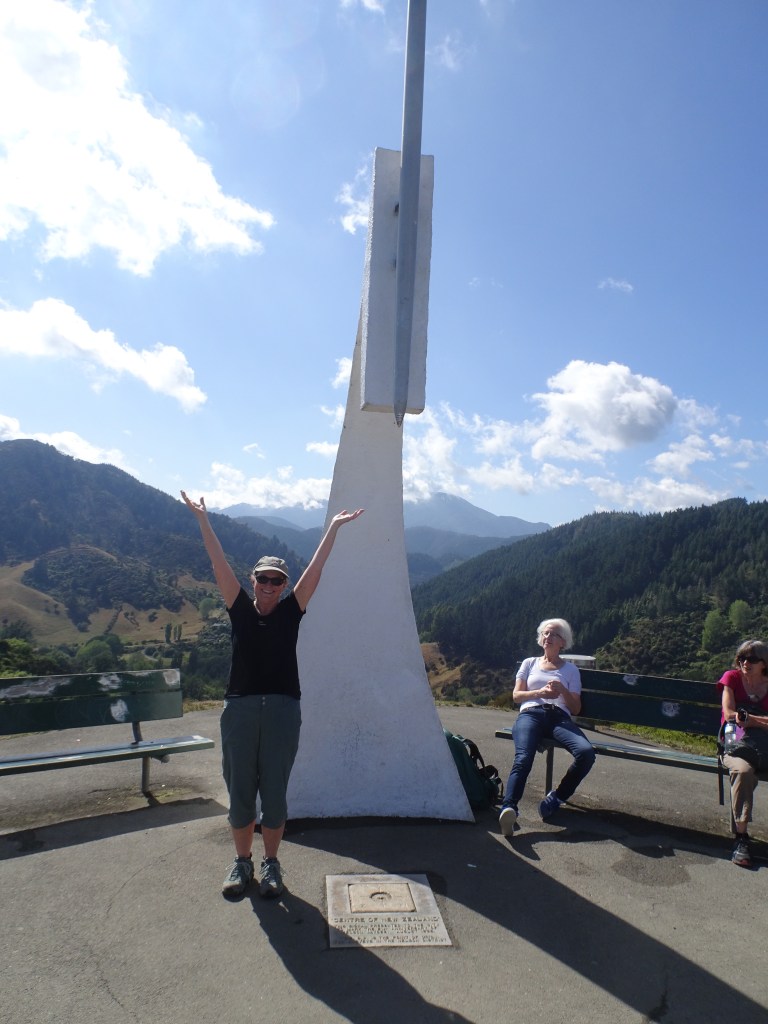
Just two blocks from our house is the trail that leads to The Centre of New Zealand. This is a hilltop that was used in some of the first surveys of the country. It may not be the geographical center of NZ, but it is close. There is a park near the trailhead which is used for all kinds of sports, including cricket. When you see a group of guys playing a game of cricket, you do get the feeling that you’re not in Kansas anymore.
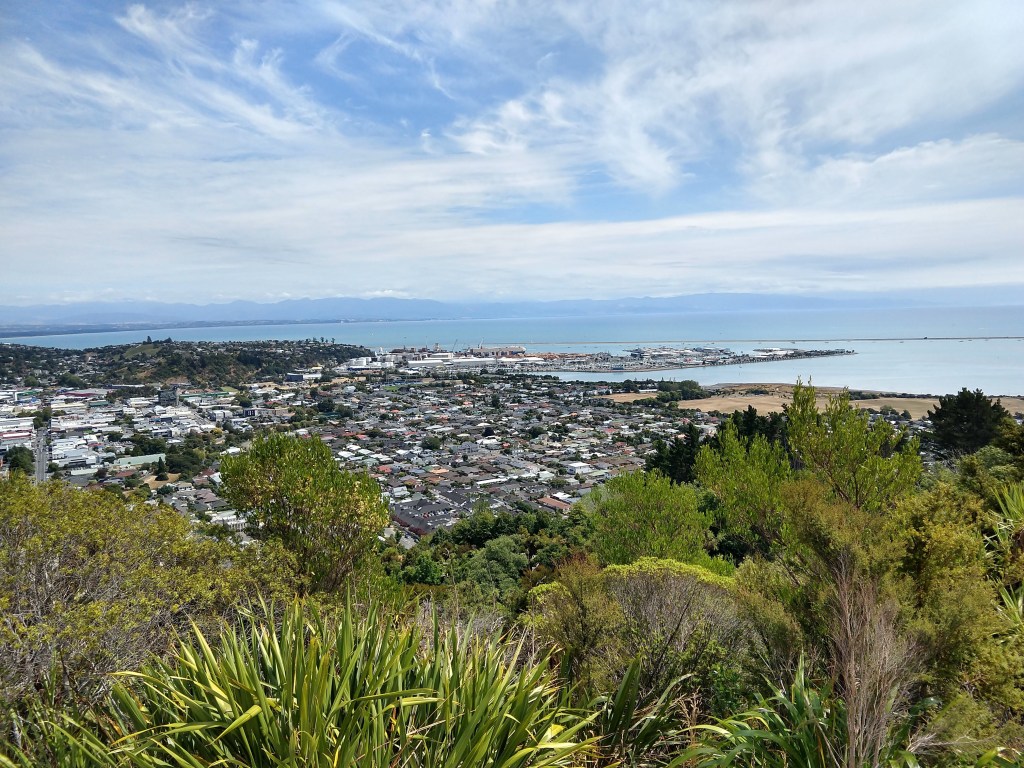
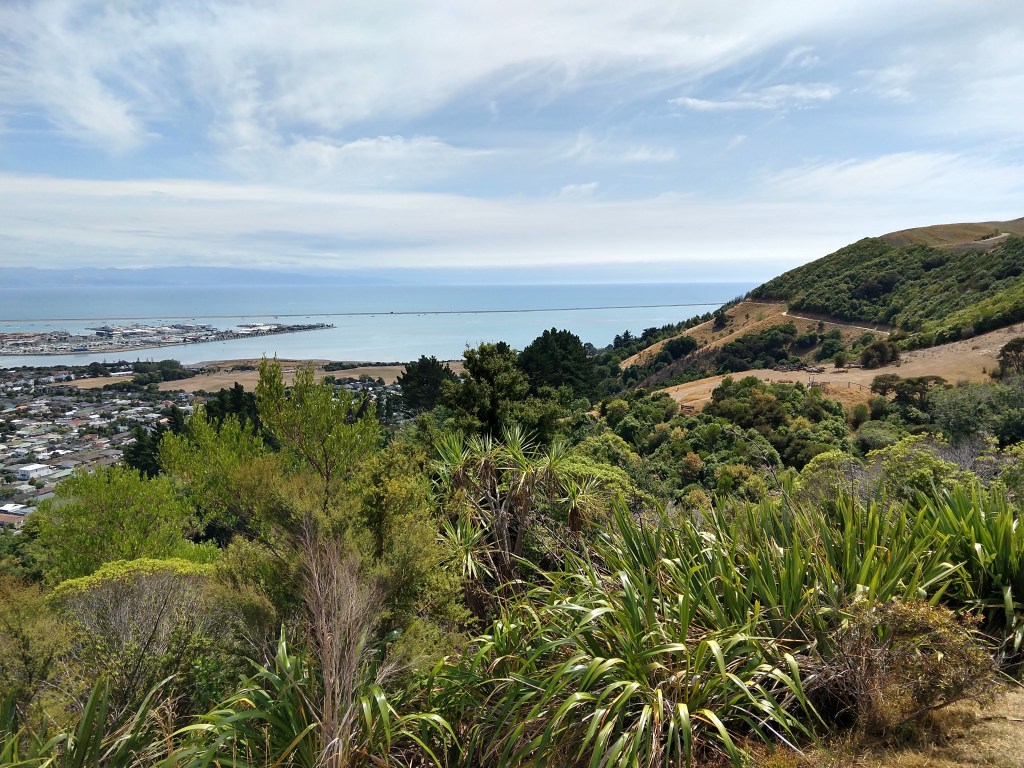
You really get a sense of the ocean from the top. The peak is 500 feet in elevation, with a 360 degree view.
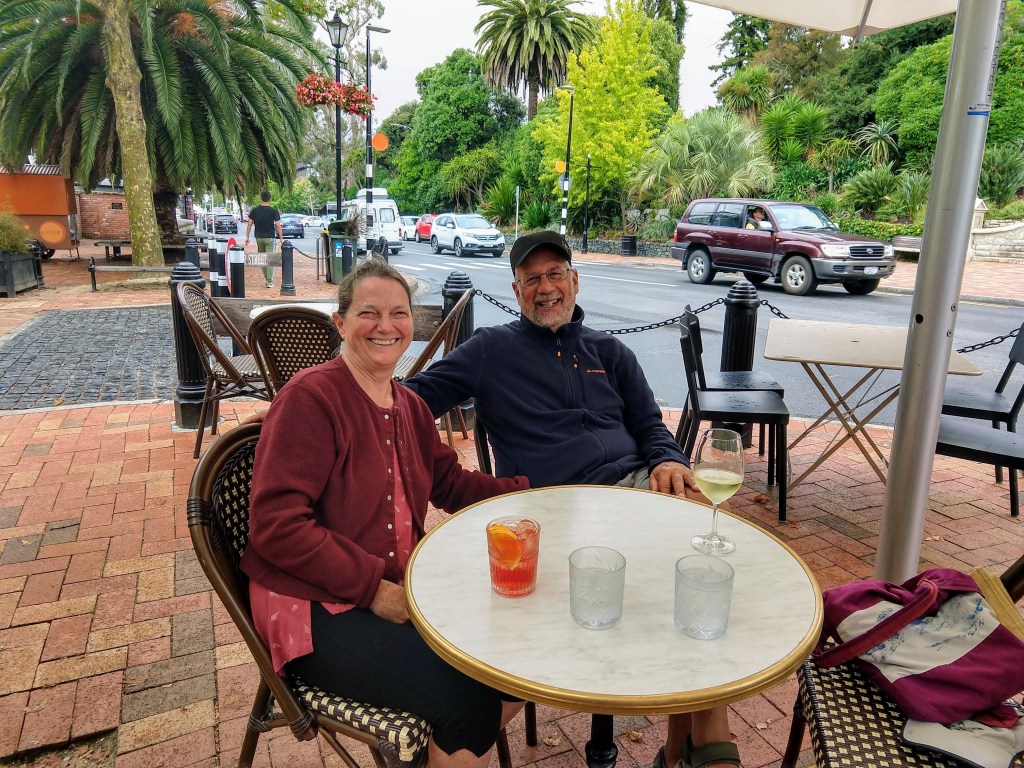
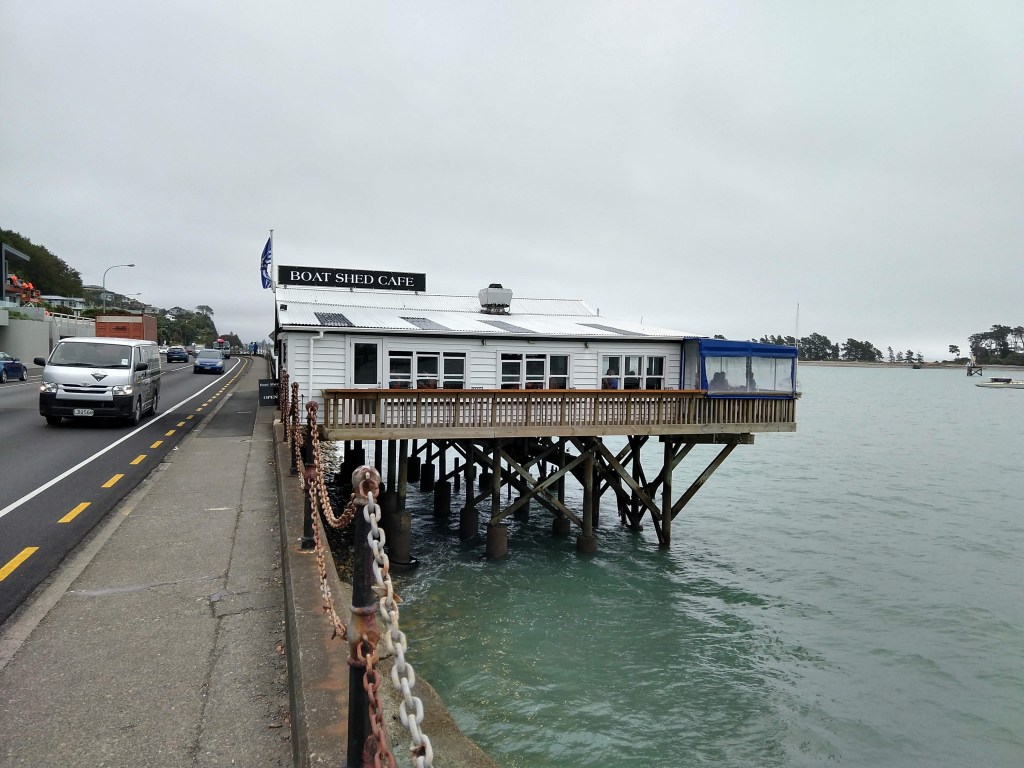
Monica turned sixty nine years old in Nelson! We woke up on her birthday to a pouring down rain which lasted until noon. Then we strolled through downtown for a treat, before going out to dinner at The Boatshed. This is an old-time restaurant on the waterfront, specializing in seafood. It was a fun day.
Thank you Nelson for a lovely stay. Now it’s time to head for the beach at Golden Bay.
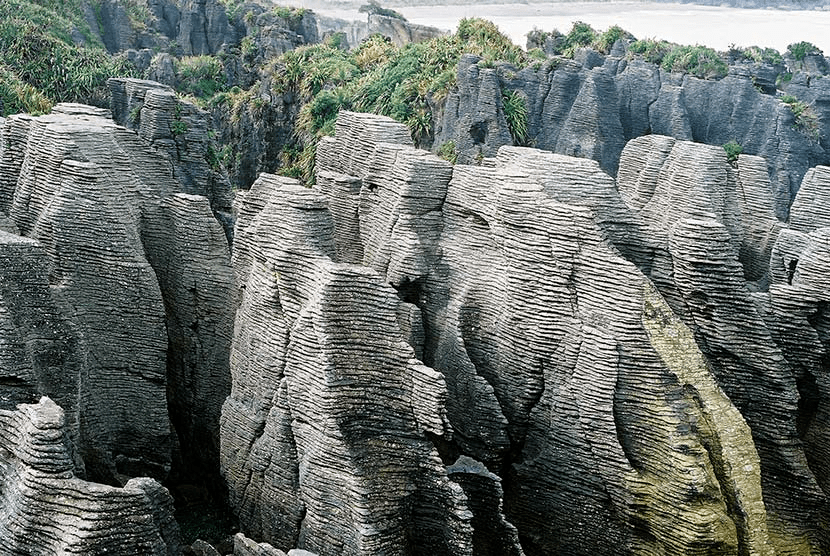
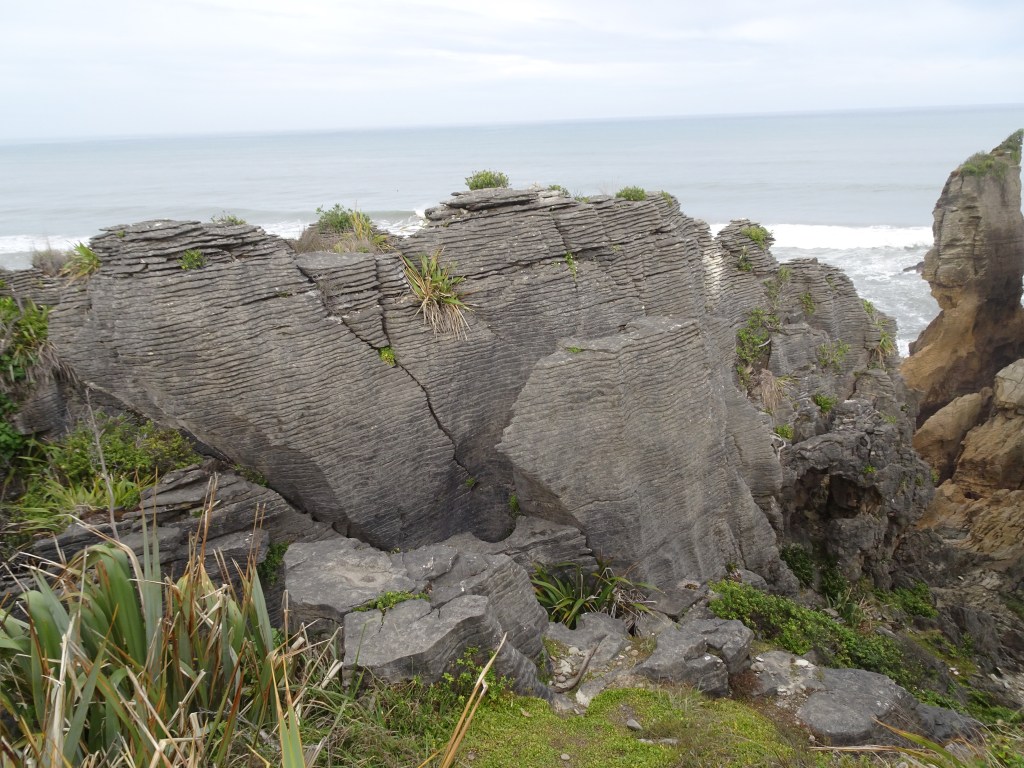
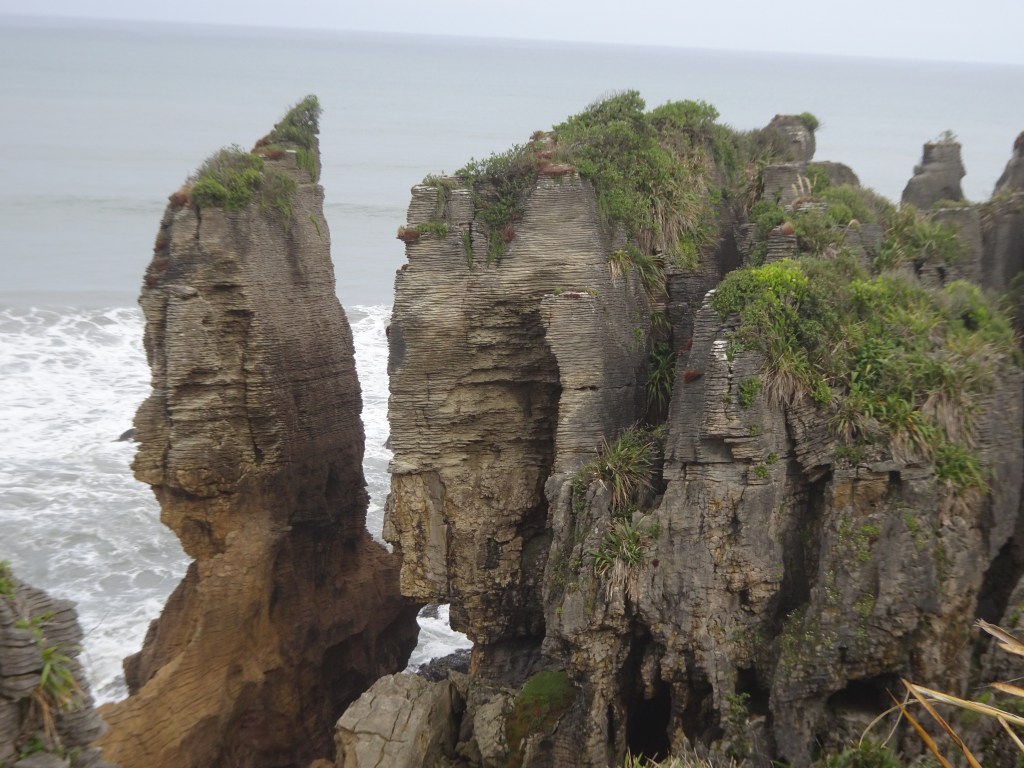
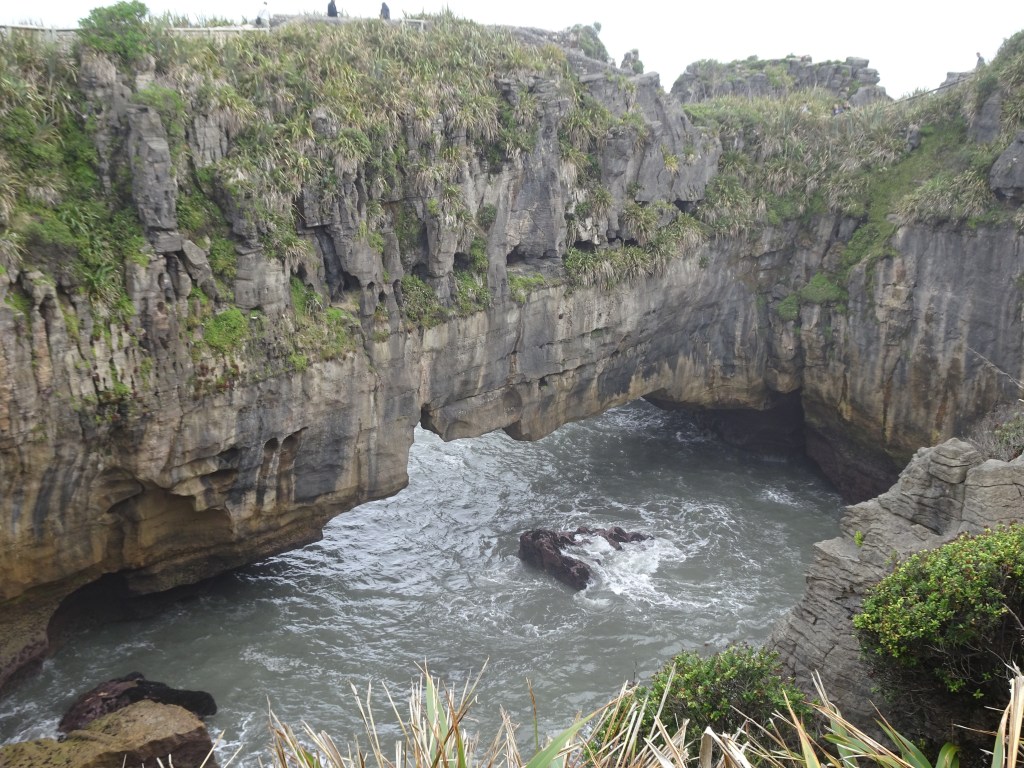
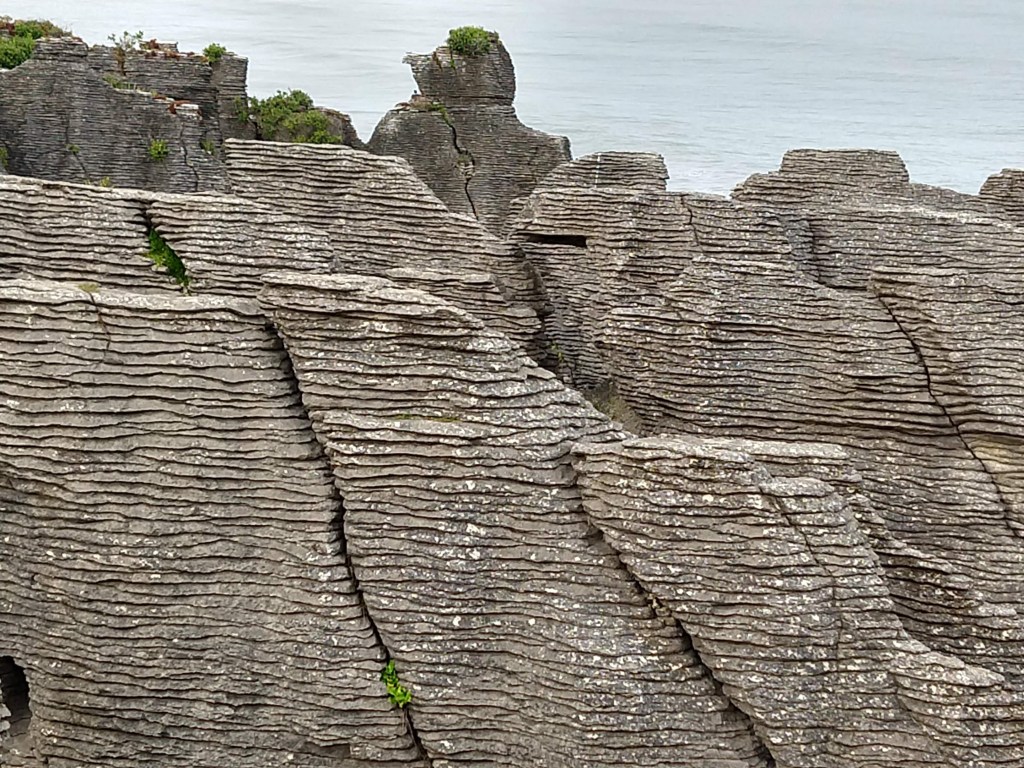
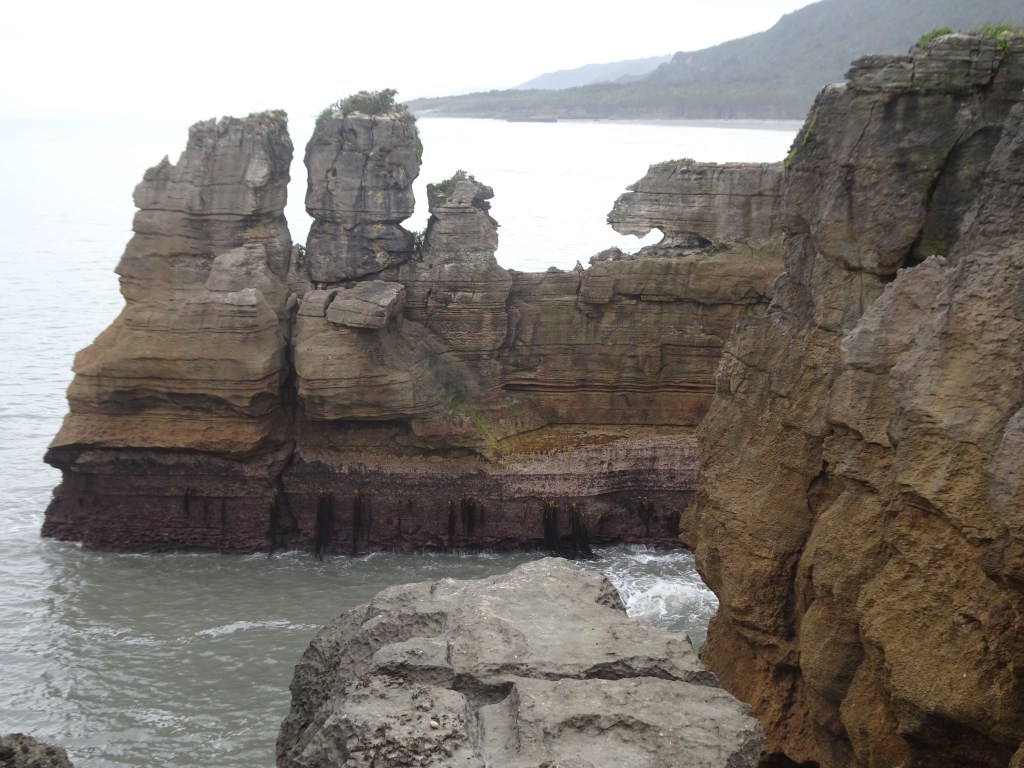
Pancake Rocks is a limestone formation on the ocean, on the northwest coast. We passed by on our way from Hokitika to Nelson, and stopped to see them. There is a short loop trail carved through the rocks that takes you out to the ocean for some great viewpoints.
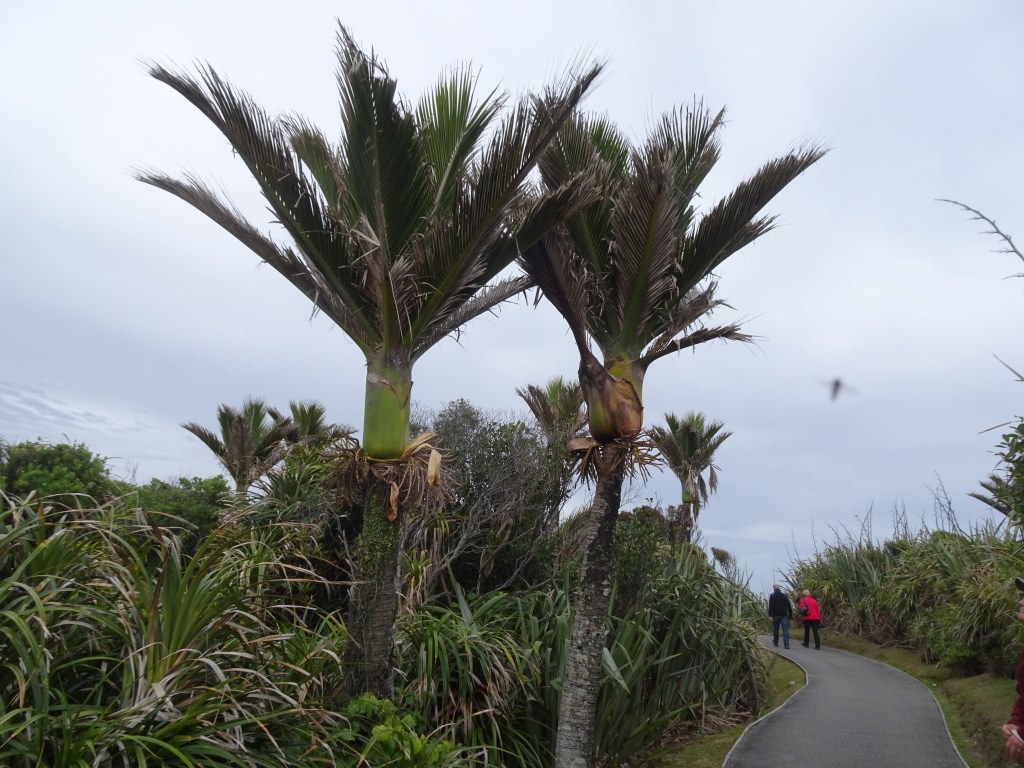
Relatives of date palms, on the path to the rocks.
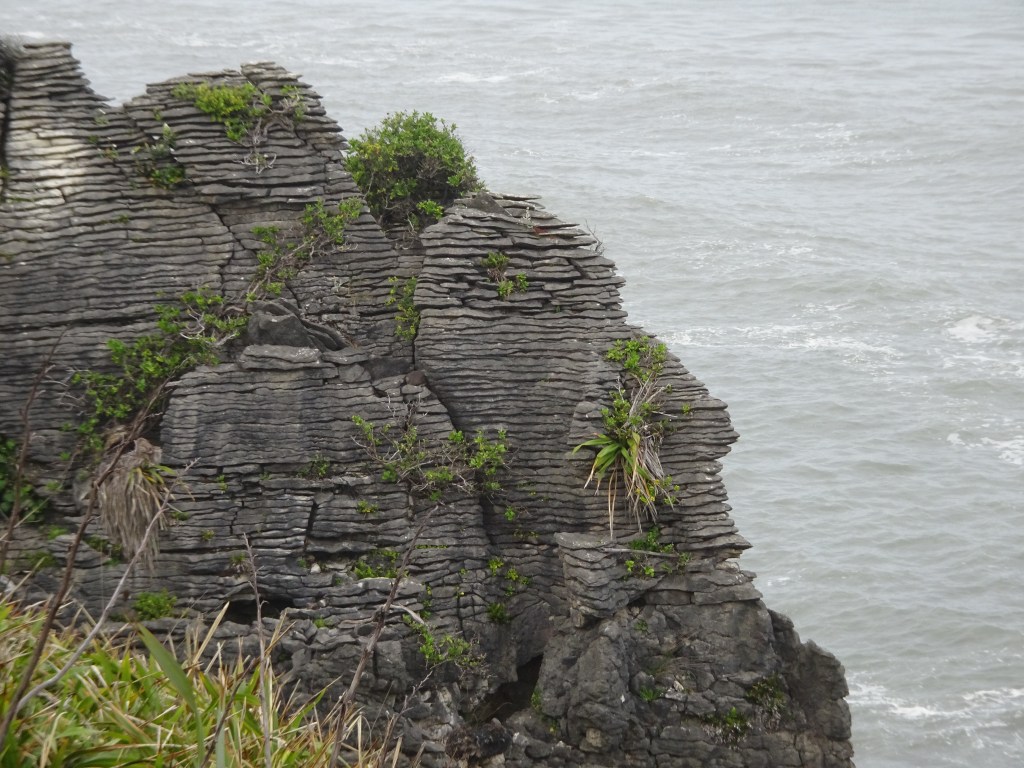
These formations are unique and stunning. The coast itself is similar to the Oregon Coast, but Oregon doesn’t have this. The story of the rocks goes back thirty five million years. Layers of skeletons and shells of marine animals fell to the ocean floor and were piled in layer after layer. They were compressed under pressure, and then the tectonic plates pushed the layers up, over a period of tens of millions of years. The process is still happening. Once the layers poke up through the water, waves and wind erode them.
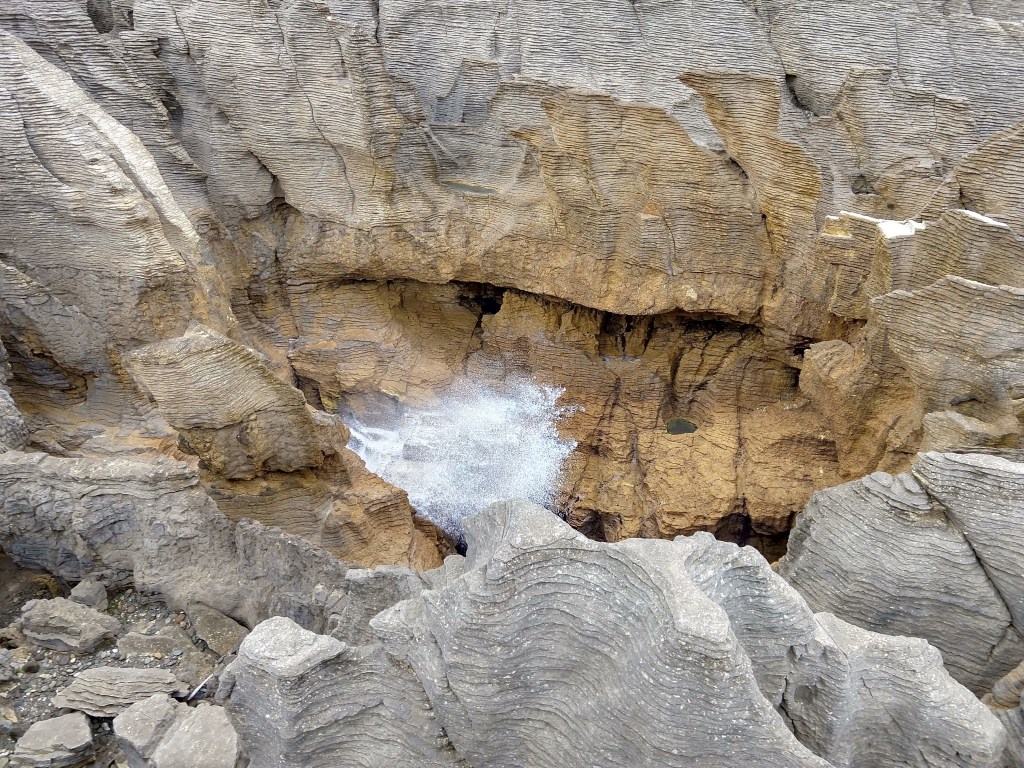
The ocean surges through the rocks and erupts in big blowholes. We were there at low tide, and didn’t see the big blows. Why do they call it “Pancake?”Animal Spirits
Thirty five million years in the making, a one-hour stop along the highway. Next stop, Nelson.
Knight’s Point, just north of HaastOne of the few signs of civilization on the 120-kilometer stretch north of Haast.
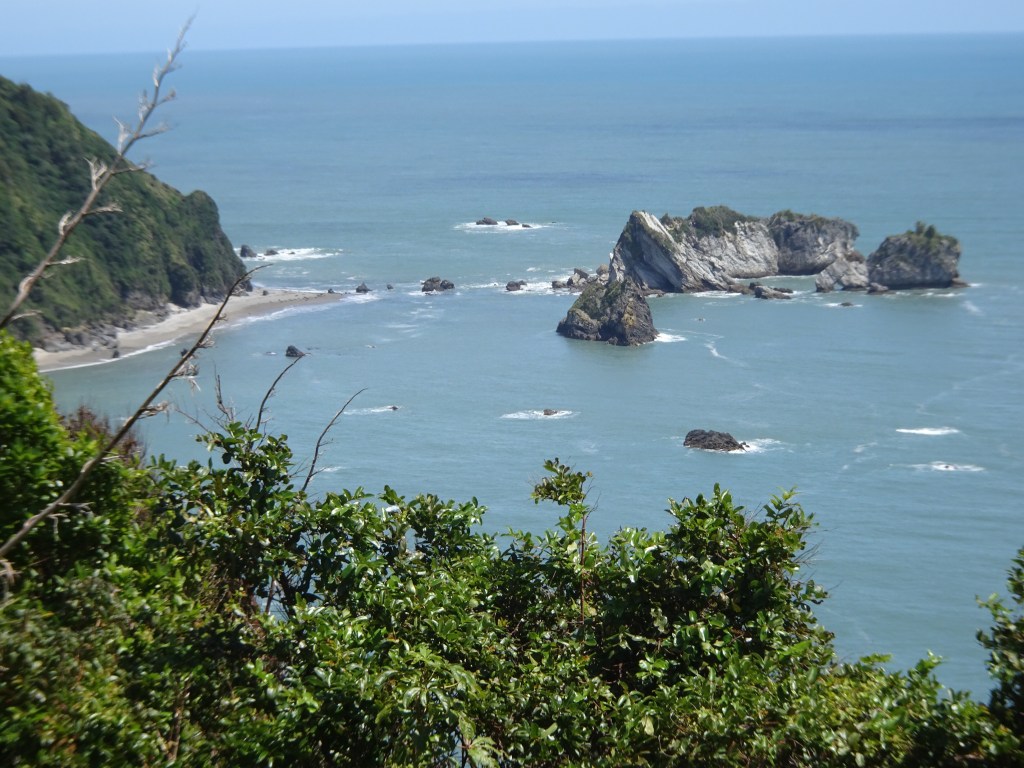
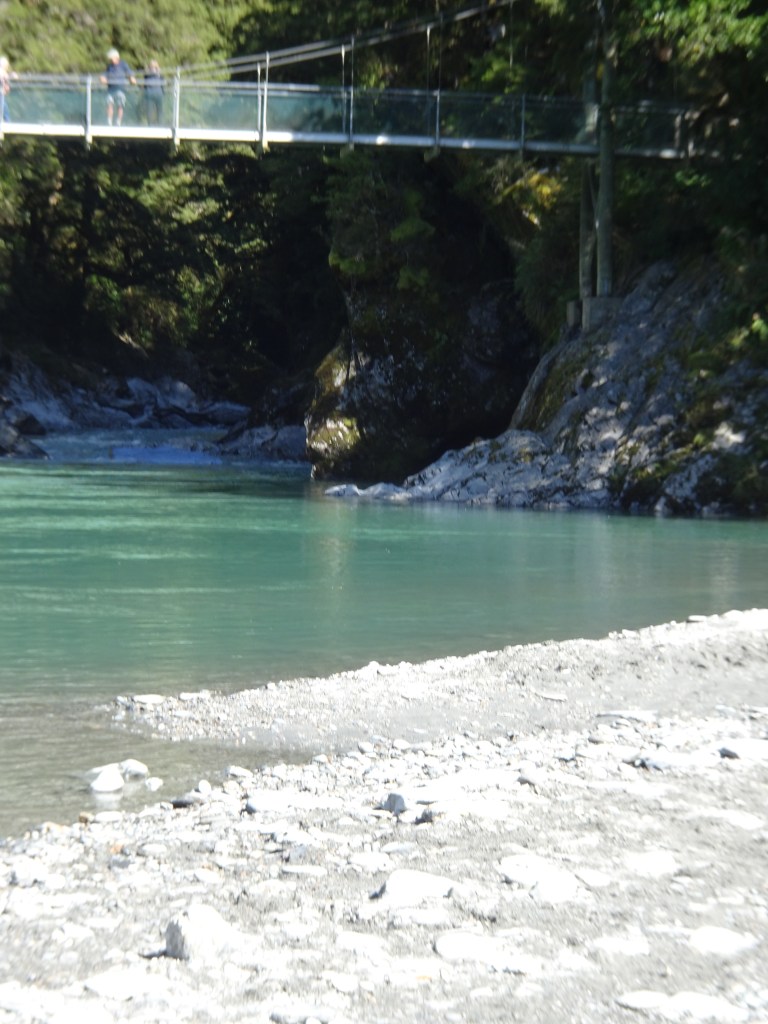
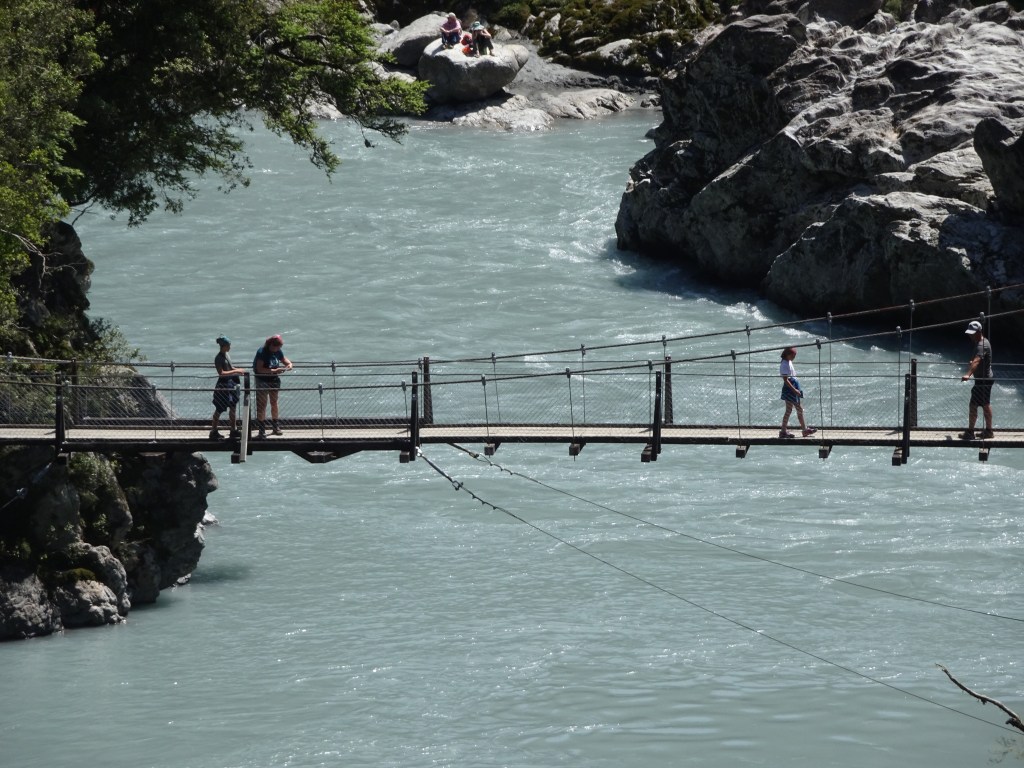
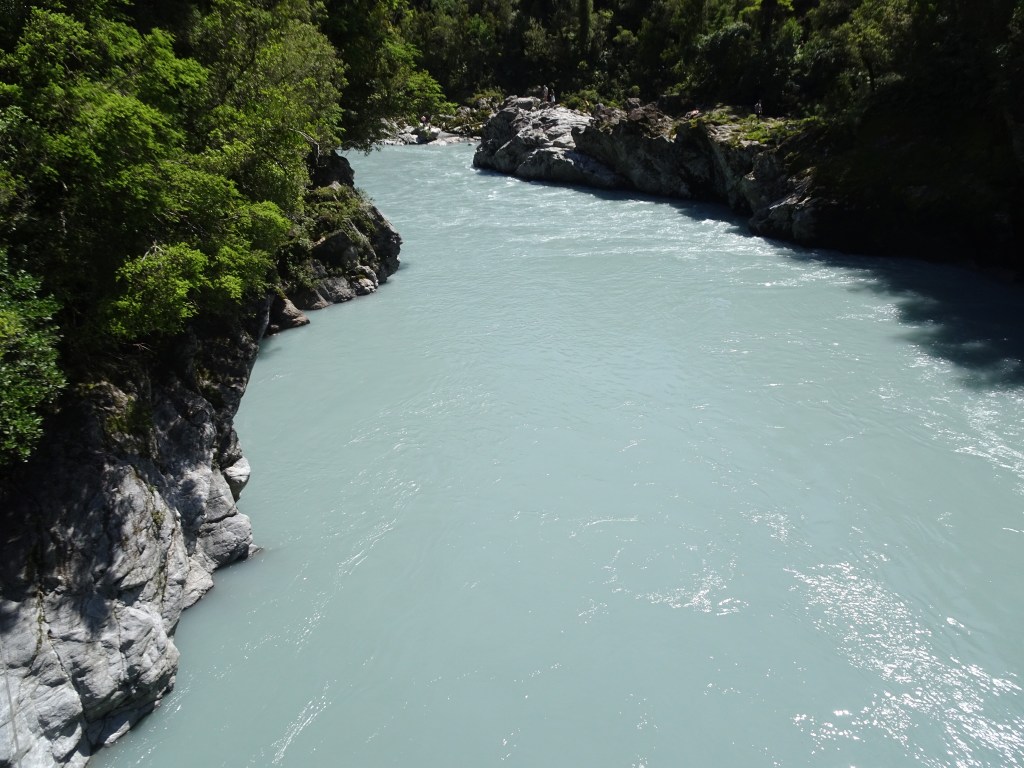
The West Coast of the South Island has long stretches of remote mountain forests and wilderness, cascading rivers flowing down from the glaciers of Mount Cook and other peaks, a few small villages tucked into the valleys, and a glimpse of what New Zealand used to be. We drove from Wanaka to Hokitika. We crossed the Alps on the Haast Pass, then turned north up the coast. The first stop was the Blue Pools, near the pass. This is glacier water. We also went to the Hokitika Gorge, which is also turquoise glacier water flowing down directly from the glaciers. The mountain peaks are not far from the ocean. It’s beautiful to see the snow caps from the beaches.
The Blue PoolsThe Hokitika Gorge, water flowing from Mount Cook
We drove past Fox Glacier and Frank Joseph Glacier, and stayed for two nights in an airbnb farmhouse in the tiny town of Whataroa. From there, we went to Okarito, which is an even tinier settlement right on the ocean. We hiked up for a viewpoint at sunset. There are kiwis living here, and we were hoping to see one, but it didn’t happen.
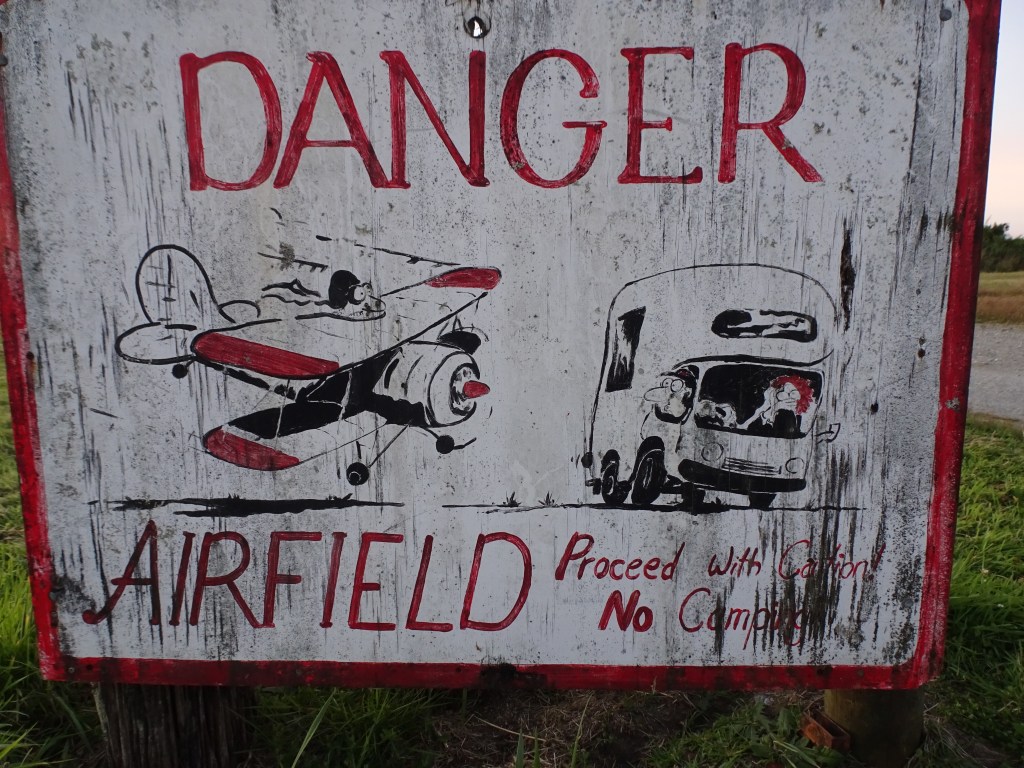
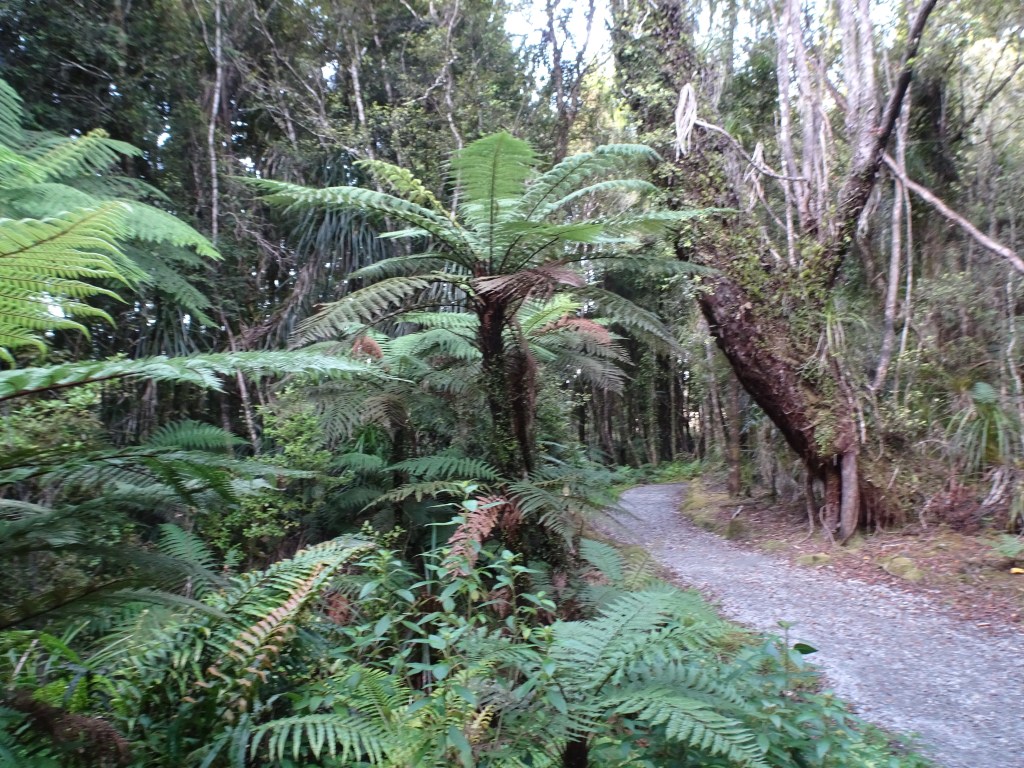
No camping on the airfield? Okarito.Tree Ferns on the Trig TrackThe beach and lagoon from the overlook at trail’s end
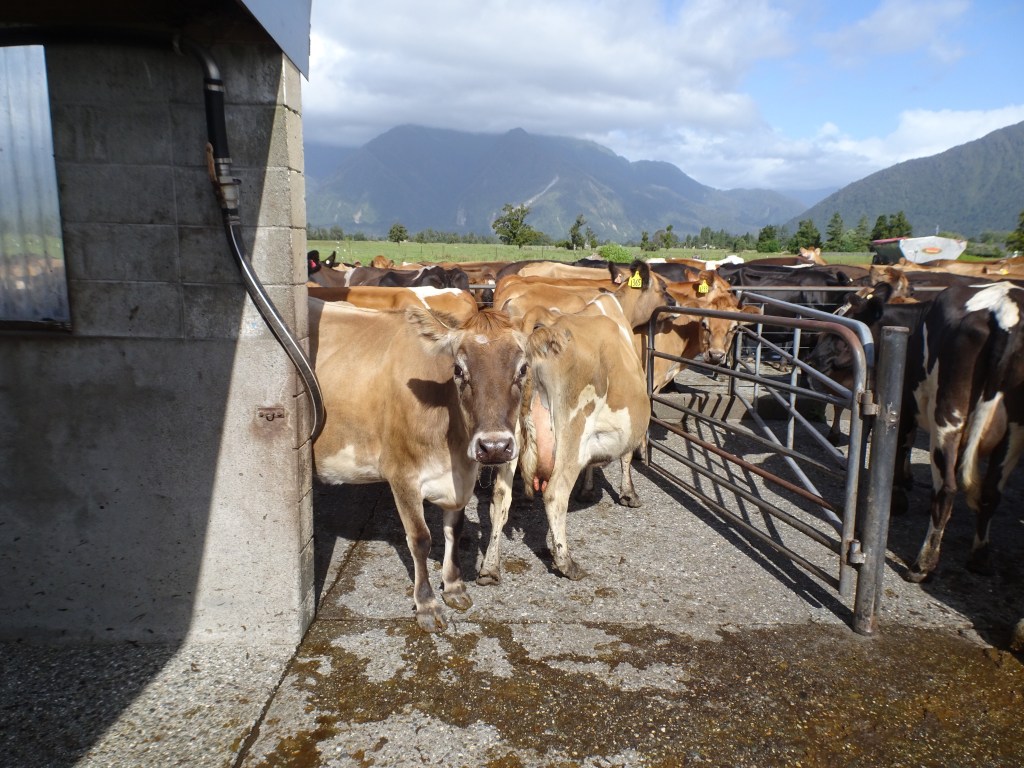
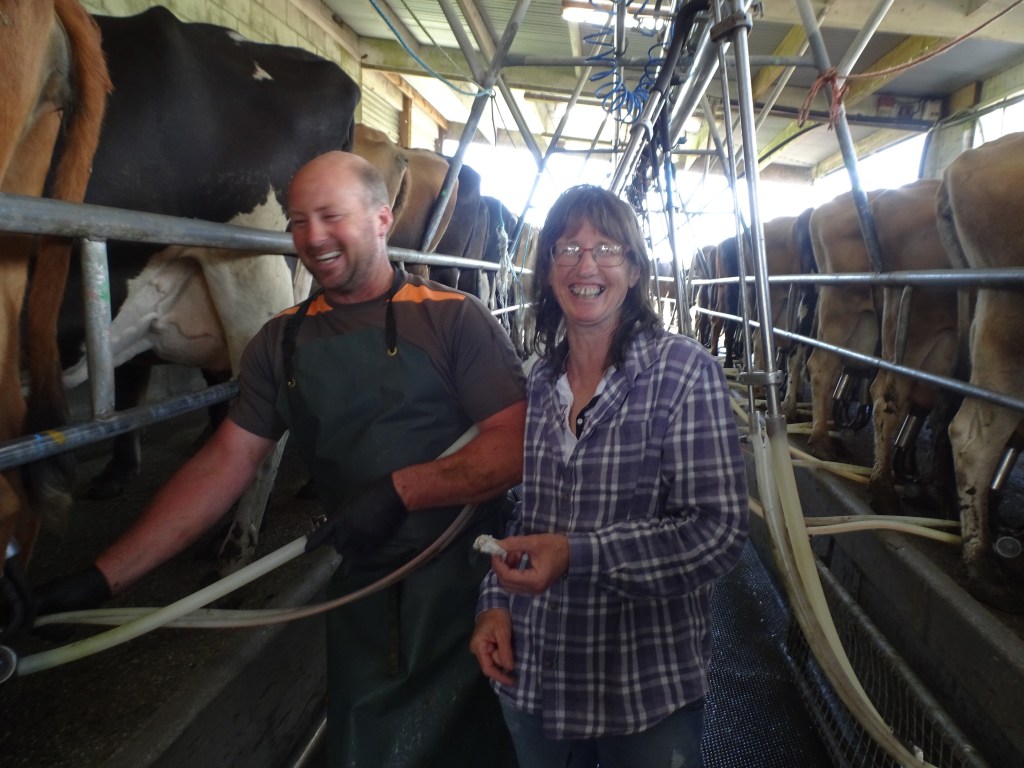
Our airbnb host, Madeleine, told us that she saw a kiwi here last year. She’s lived here her whole life, though, and it only happened once. Madeleine also showed us her dairy farm, which she runs with her husband Ian. A real mom and pop operation.
Our farmhouse home in Whataroa
Taking Care of the Cows
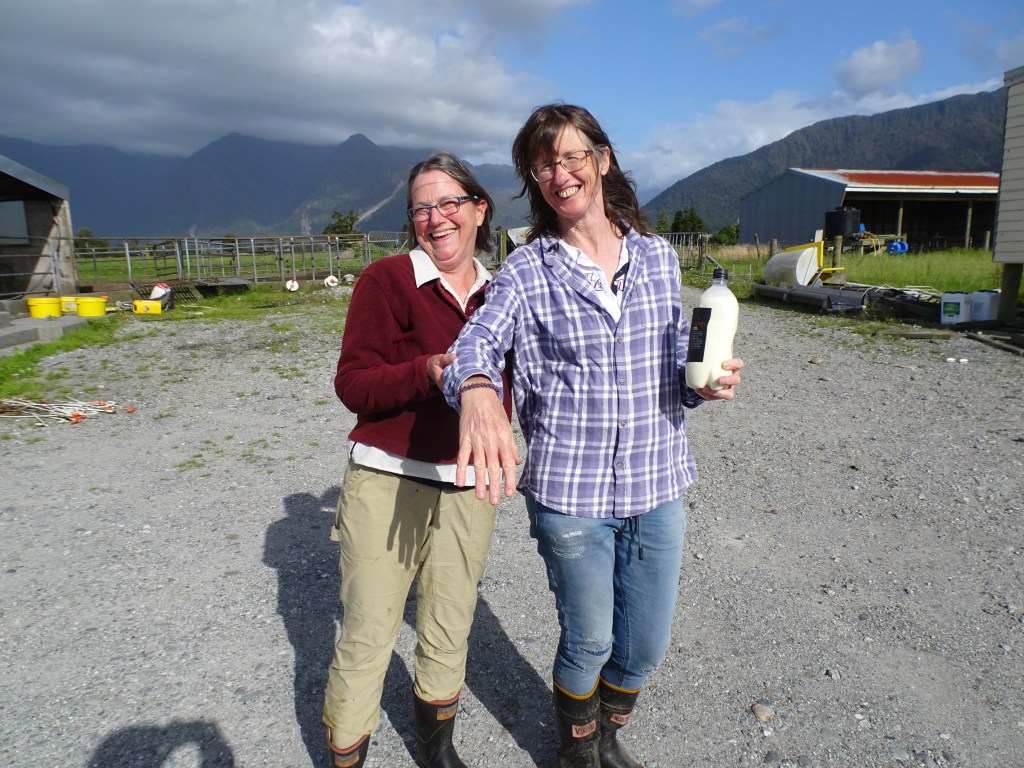
Madeleine and Monica at the dairy farm. She and Ian have 180 cows. It’s just the two of them. Milking morning and evening. The life of a dairy farmer.Monica’s been making bracelets on our travels. She had just finished a purple one and gave it to Madeleine. Mad’s favorite color. Mad is holding a quart of fresh milk, which she gave us. They could be sisters.
Hokitika
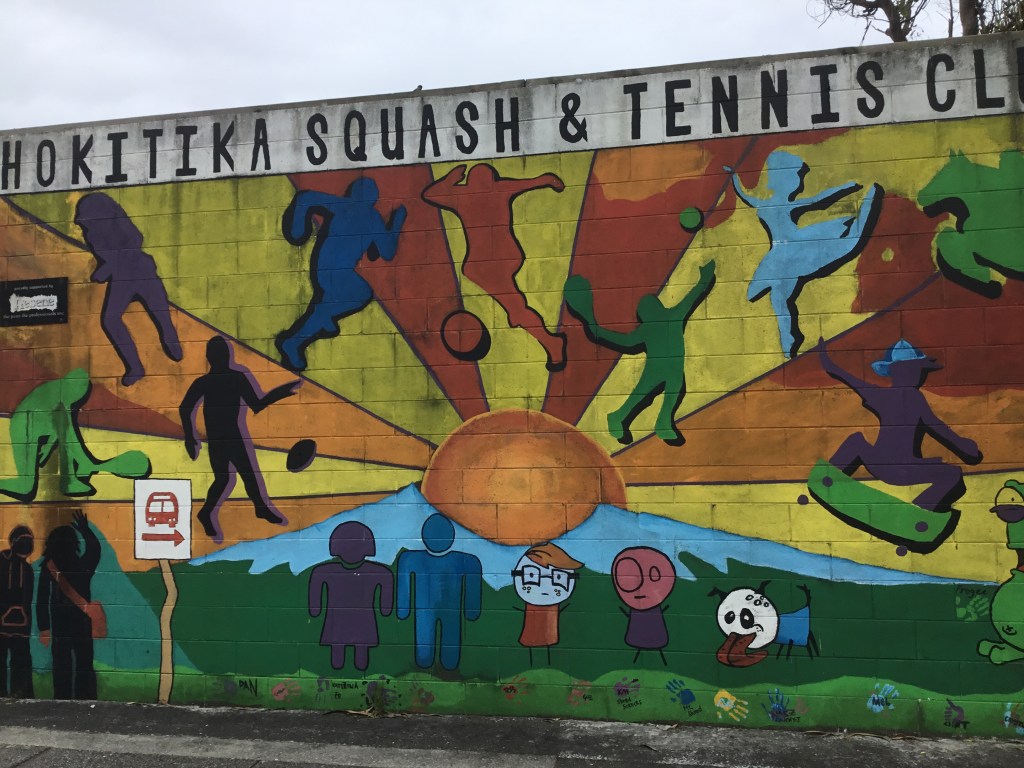
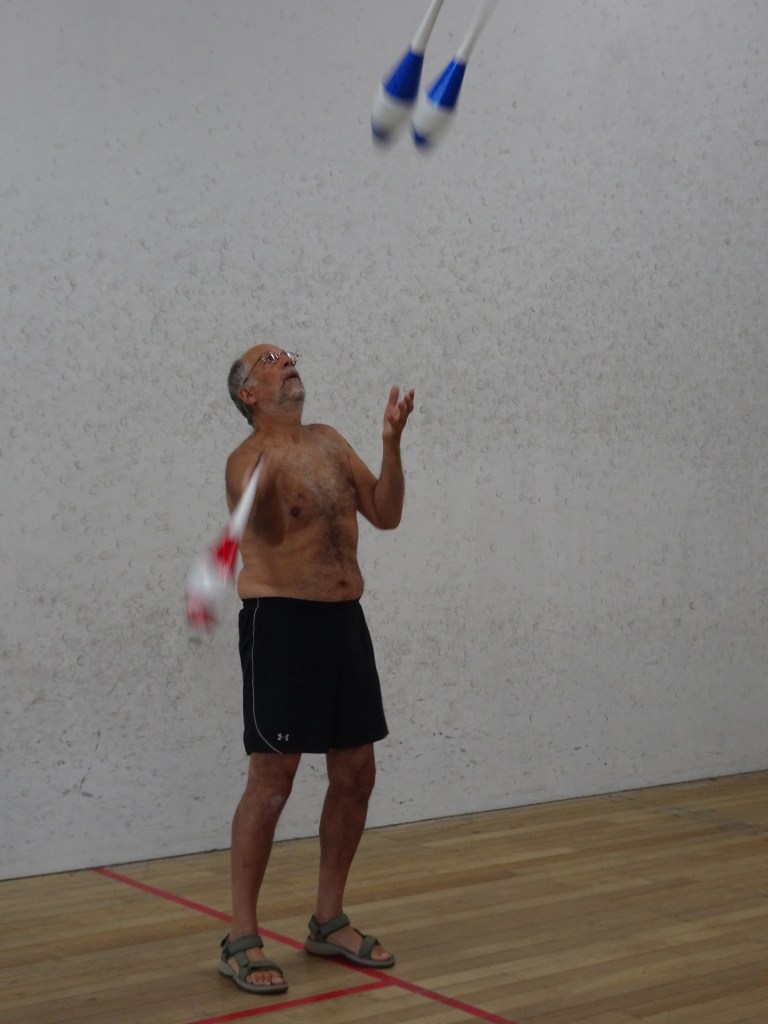
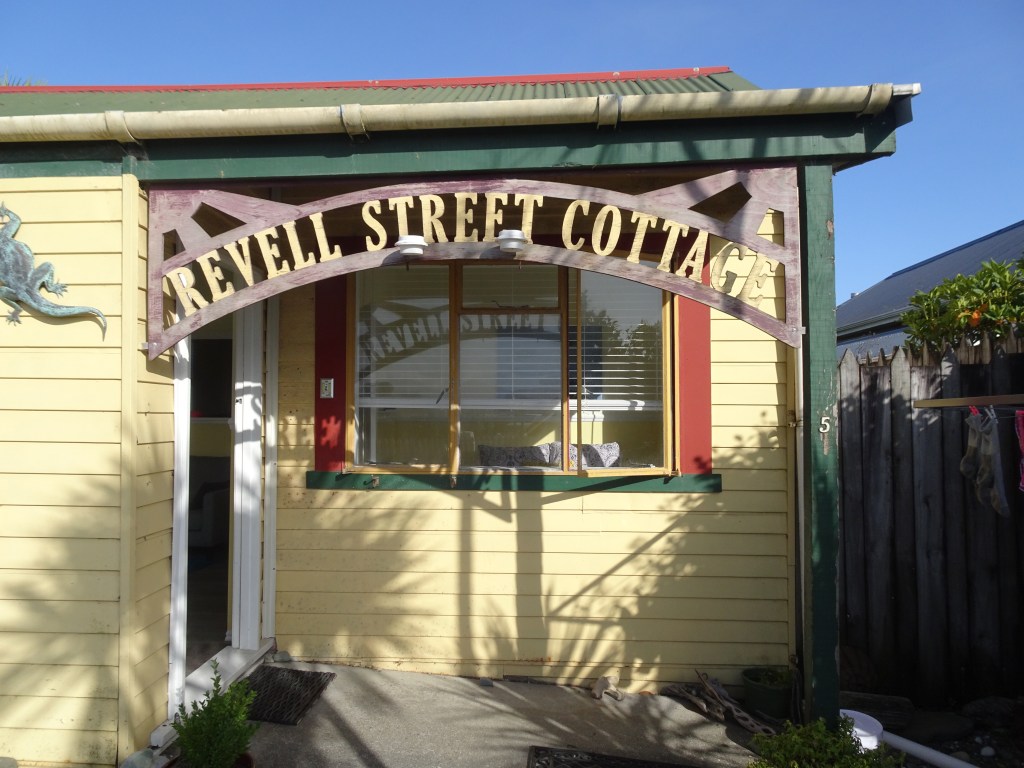
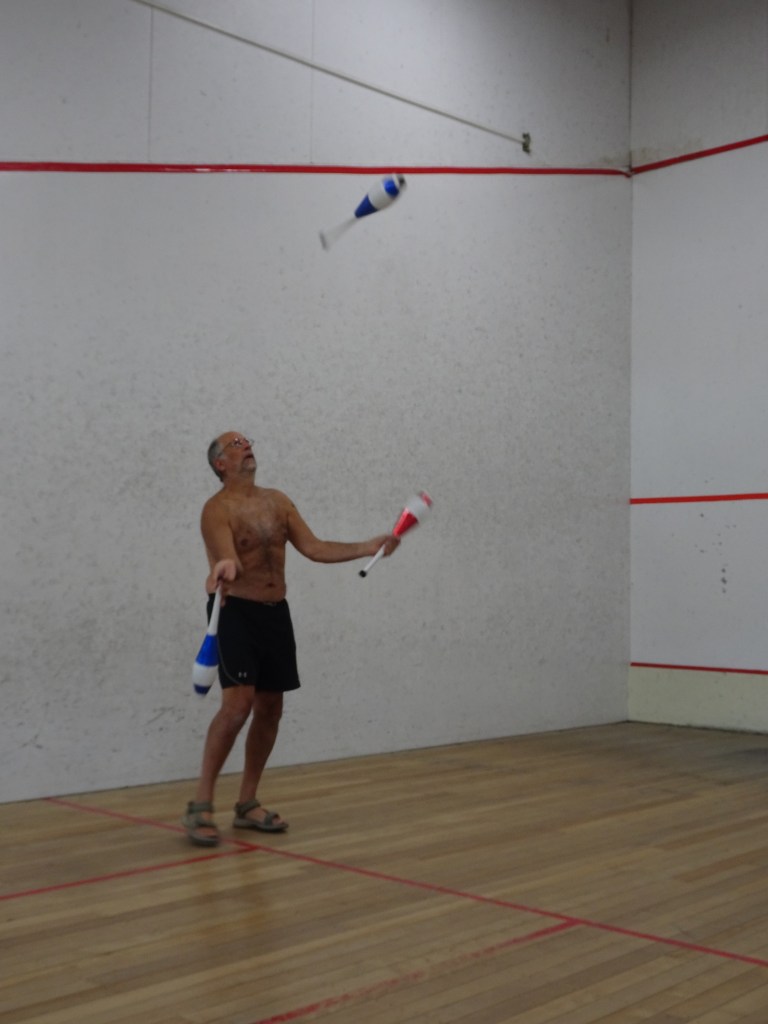
Hokitika is a small town on the central coast. It is far far away from the buzz and glamor of Wanaka and Queenstown. Just a small town with not much to do. We spent four nights here and were just about locals. A great revelation to me is that most, if not all, of the small NZ towns have a squash court. It’s not hard to find the keeper of the key, and the courts are a perfect place for juggling. I got the key to this one from Barry, who owns the Gold Room, a jewelry shop. When I went to return it, he told me to just hang on to it until I was going to leave town. That way, I could use the court whenever I wanted.
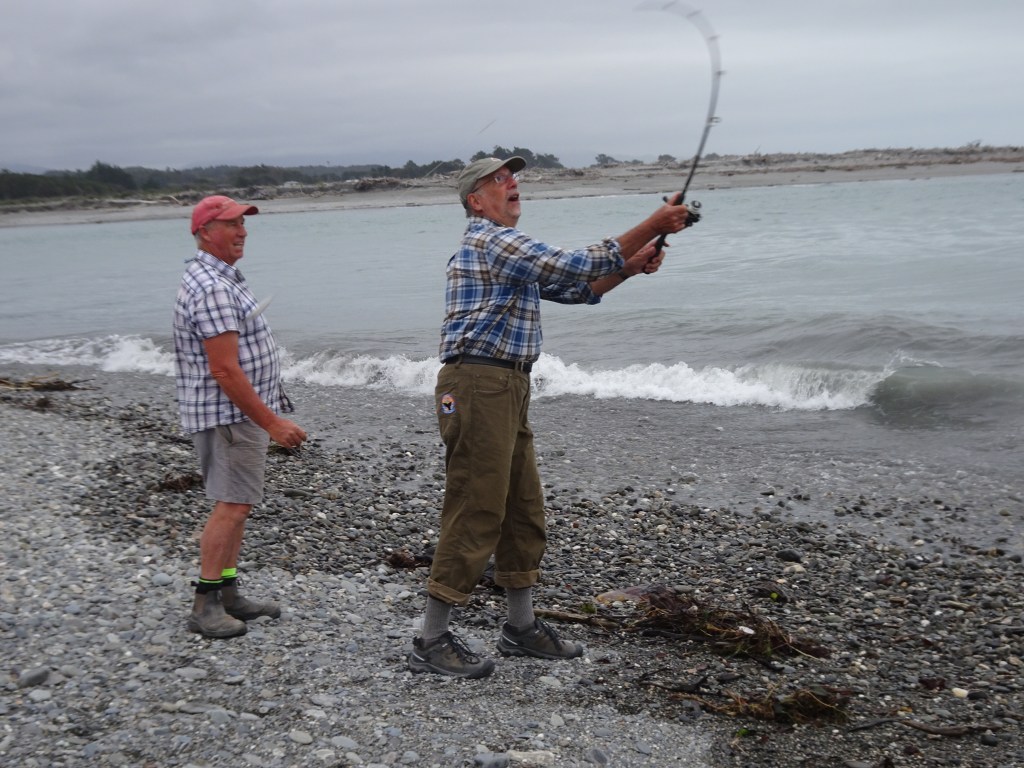
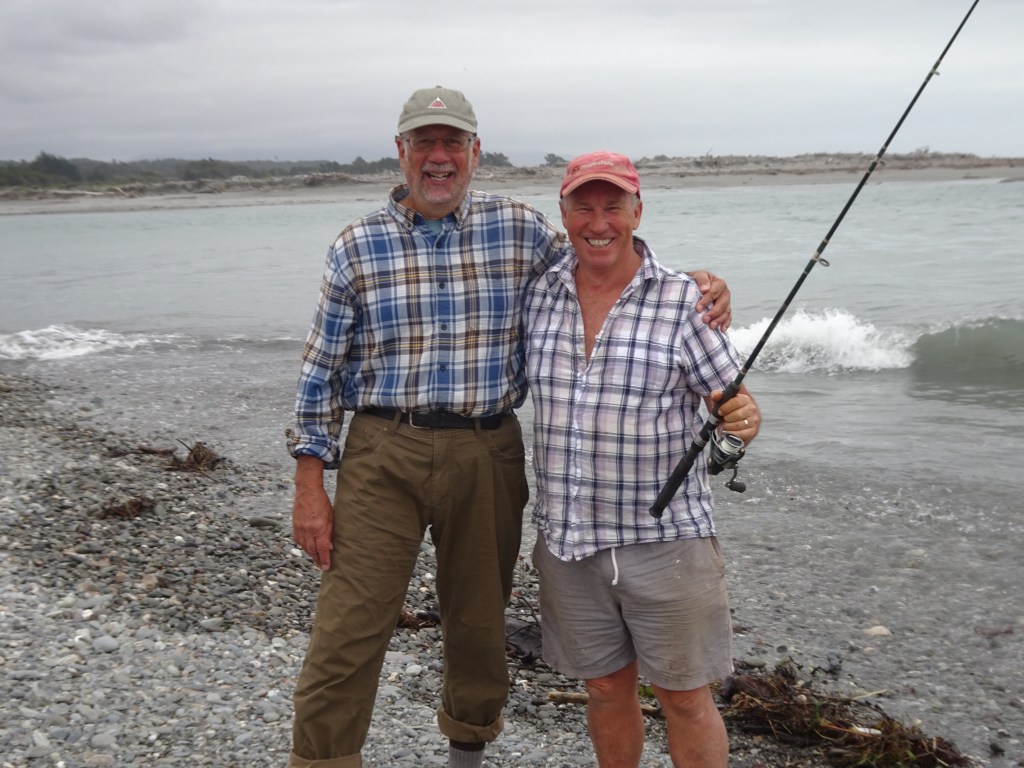
Owen and Pina were our airbnb hosts. They came over one evening for wine and snacks, and we spent a couple of hours talking with them. Owen wanted to take me fishing. The next day he showed up with his pole, and we walked to Sunset Point, five minutes from our house. We didn’t catch any fish, but it was fun.
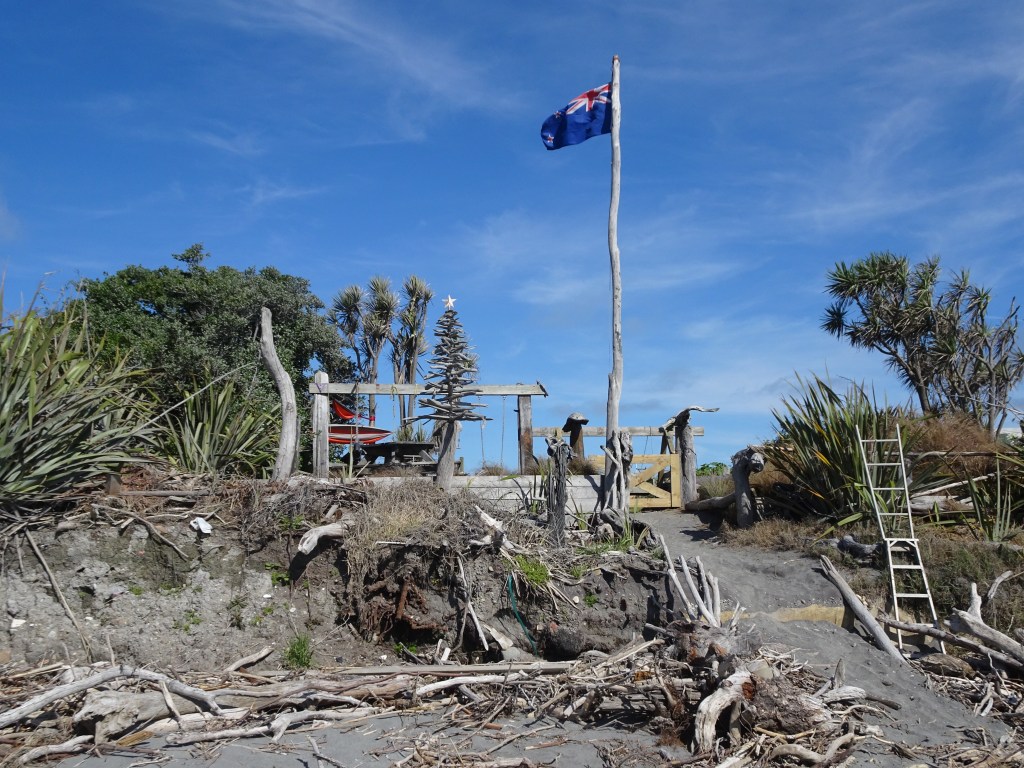
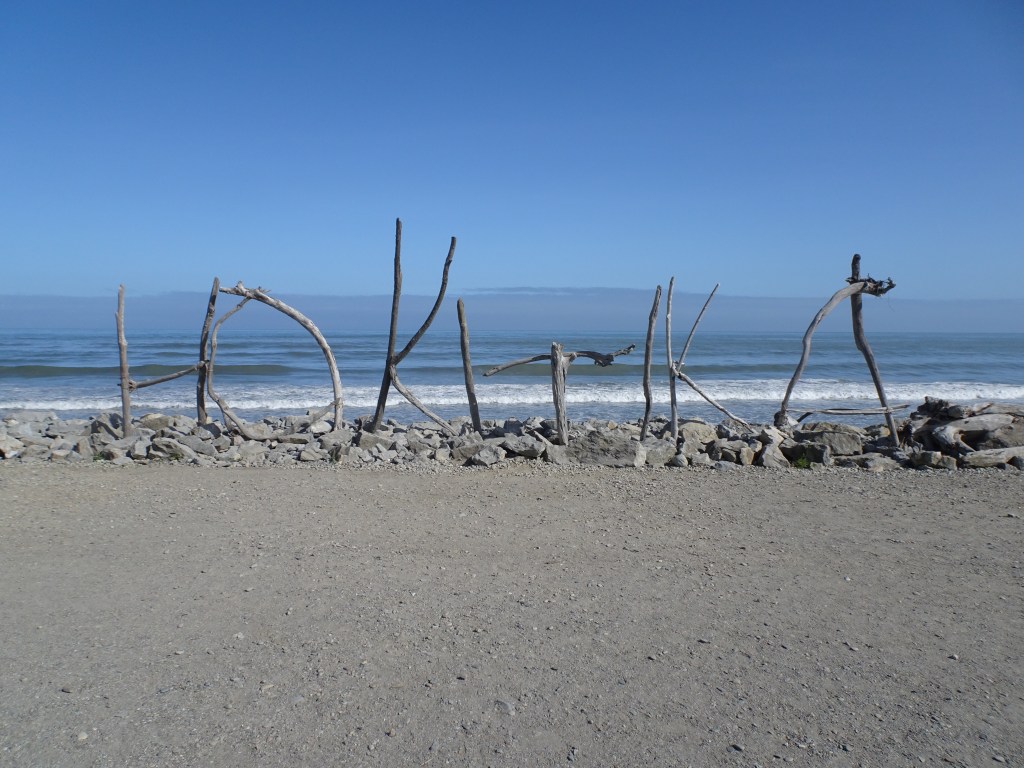
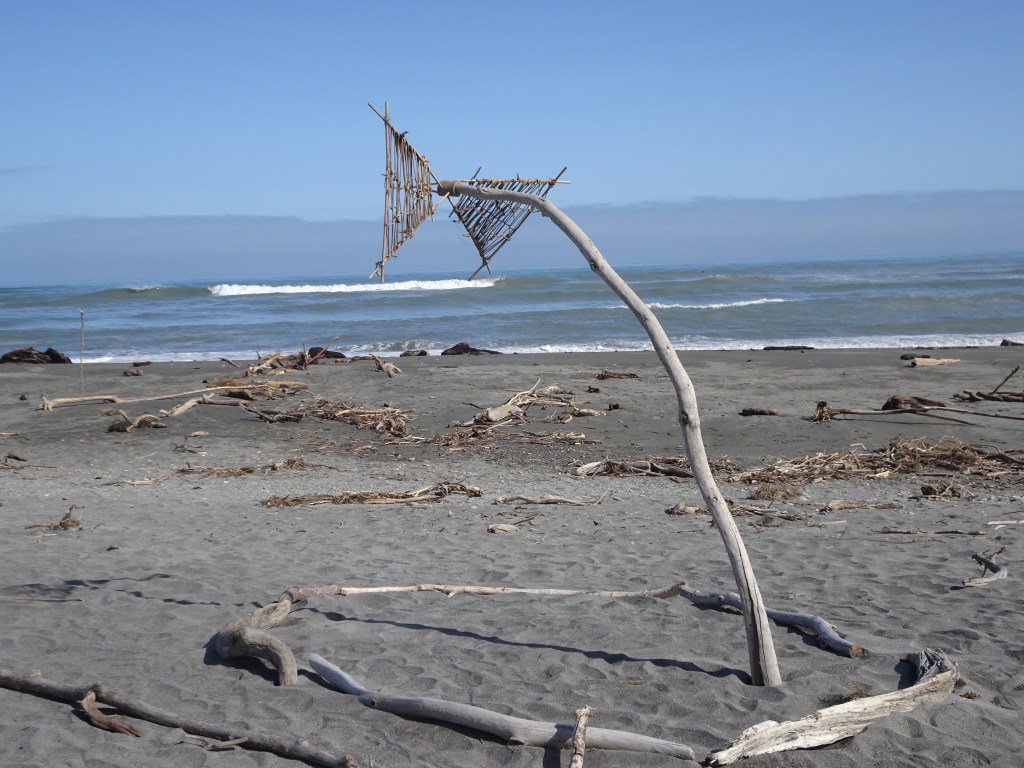
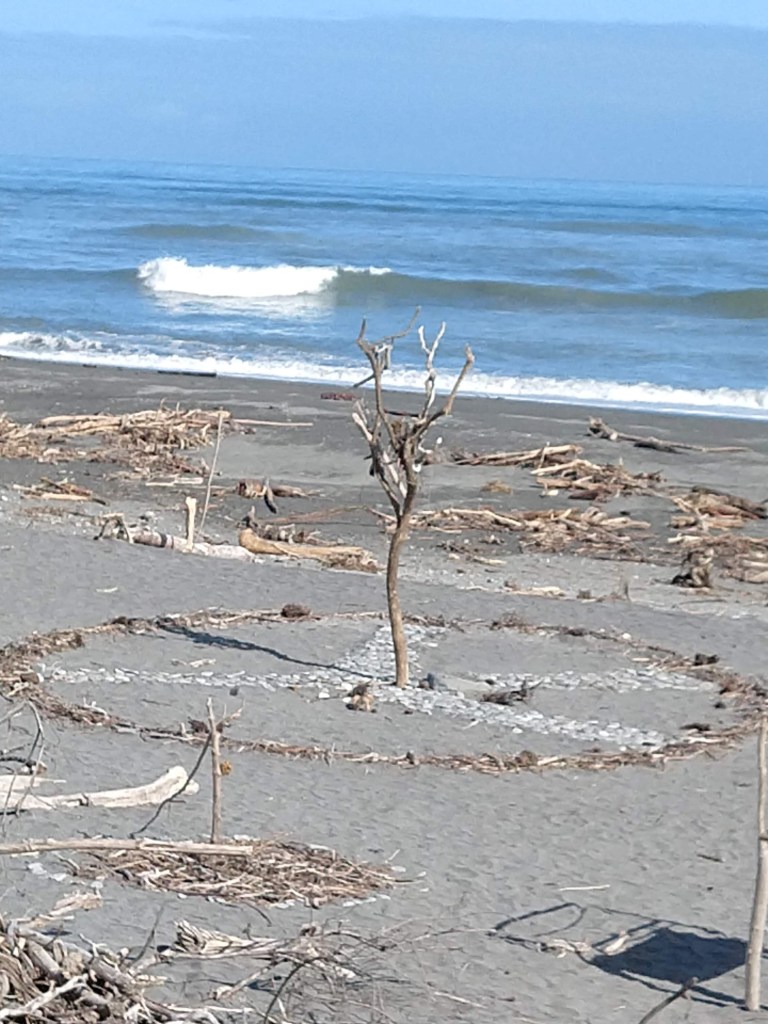
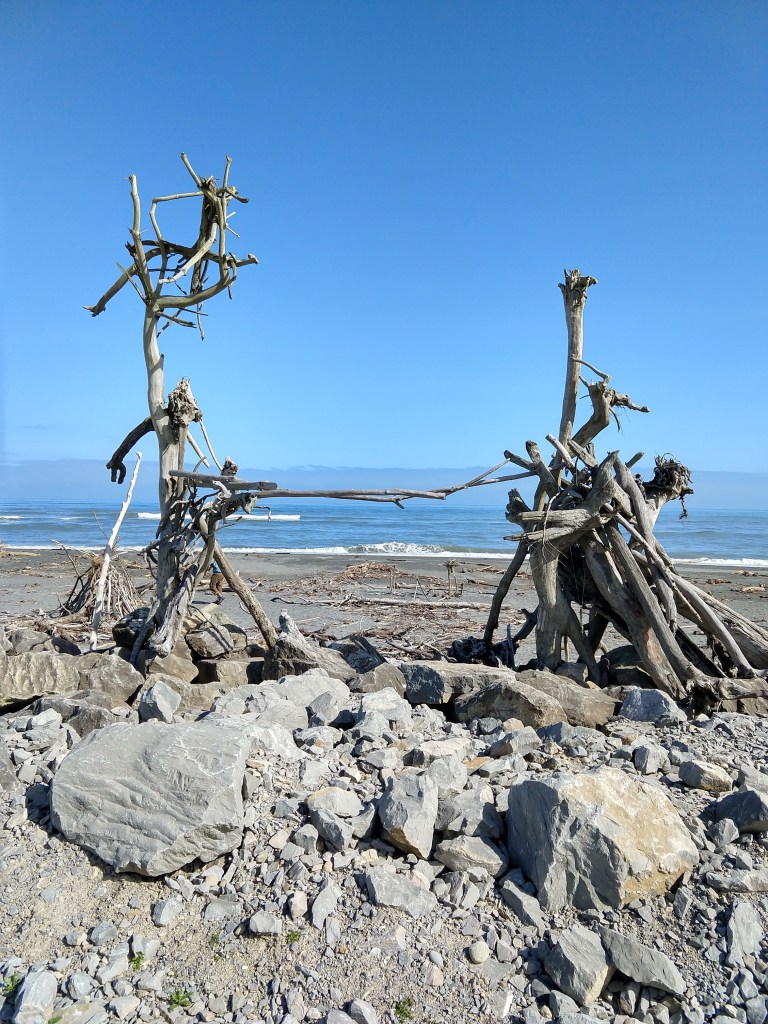
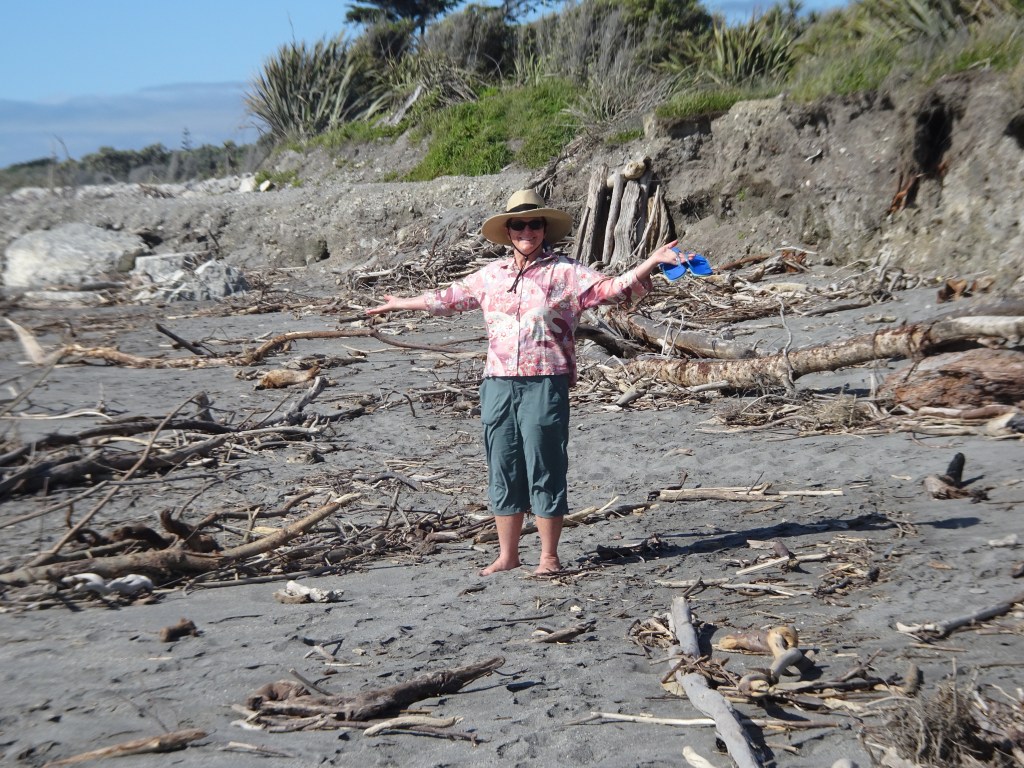
We stayed in a little cottage one block from the beach. For us, the beach was the major attraction of the town. A little coastal getaway. The beach is full of driftwood, and Hokitika is kind of known for its driftwood sculptures. It even has a driftwood festival, which we just missed by a couple of weeks. Some of the sculptures were still up though, tempting wind, waves, and time.
The reason for traveling is to learn about the world, to see life from other perspectives, and to to build bridges and connections between cultures and people. The west coast is a perfect place for all of these. The relaxed pace and the friendliness are apparent everywhere we look. We also think about the way things were versus the way things are. We think of our friend Jan, who was here in Enzed (NZ) in the early 1970’s, before the tourists. She hiked on the tracks and was the only one there. Now, it’s a parade and you need a reservation. We met a fellow here from California who lived here from 1968 until 1978. He lamented how the old-time pubs were all gone, and how Queenstown had become an unlivable behemoth. We think about ourselves. Monica and I met forty seven years ago (!!) on Kauai. There were no sidewalks, just sand, in Kapaa. We slept on the beaches, and hitchhiked. We had to wait a long time for a car, but it was easy to get a ride. Now, there are traffic jams and almost nobody picks you up.
Everything is different now. But that’s all, just different. When we were twenty, people in their seventies would tell us that life used to be much better. Older people have always said that to younger people. Well, it has changed. Travel is no longer a test of endurance, with a week-long trip through the untamed west in a stagecoach. The world is different now. But it is not ruined. It still is fun to travel, there still is lots to learn, and there still are bridges to be built.
“The North Island is beautiful, but the South Island is majestic.” “The North Island is lumpy, but the South Island has real mountains.” “The North Island is nice, but the people on the South Island are much friendlier.” “So, which island do you like better?”
We’ve heard these things from South Islanders, and that final question is not really meant as a question. The South Islanders love the South Island. And, well, as far as natural beauty goes, the North Island is beautiful, and the South Island is majestic.
We spent three nights in the town of Wanaka. (Wanaka rhymes exactly with Monica.) The elevation here is only 1000 feet, but the mountains rise up and ring the city, and it felt like we were high up in a mountain village. Wanaka is in the Southern Alps. This is a mountain range that runs for hundreds of miles. The highest peak is Mount Cook, also called Aoraki, at 12, 200 feet. There are sixteen peaks over 10,000 feet.
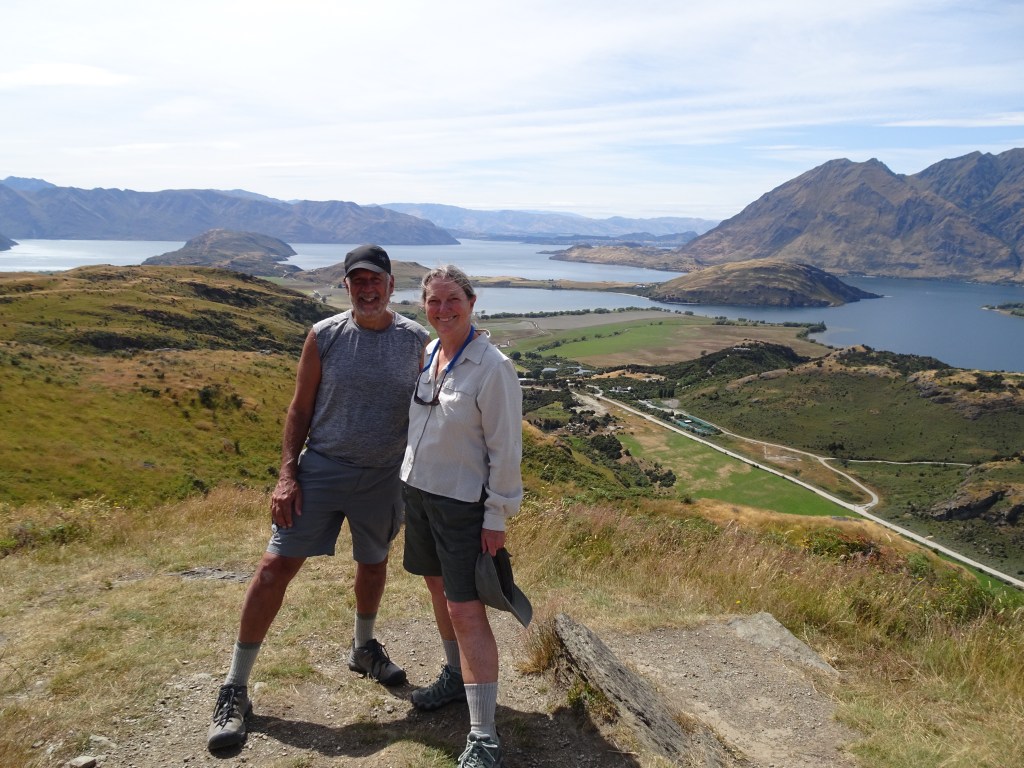
Wanaka has a population of about 8000 people. It is full of people with backpacks and boots and trekking poles, planning or coming back from serious backpack trips. We went on three day hikes and spent a few hours swimming in Lake Hawea while we were there. The first hike was up Mt. Iron, which is right in town, and almost obligatory for the newly-arrived.
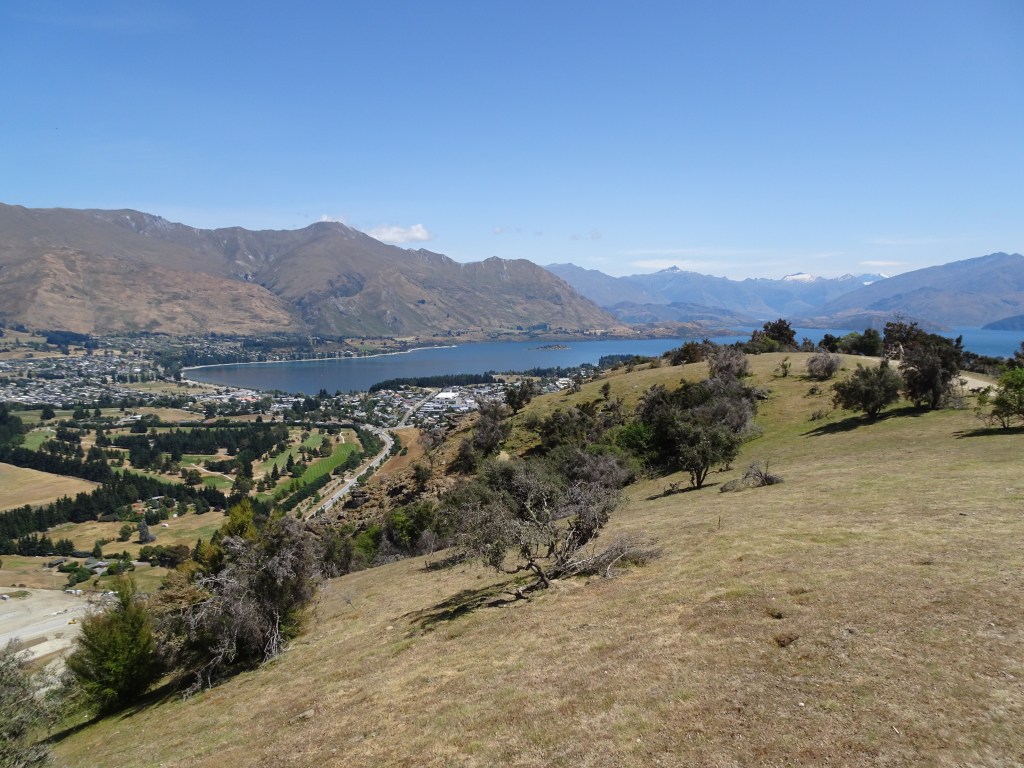
The town of Wanaka and Lake Wanaka from Mt. IronCooling off in Lake Hawea after the hike. Beautiful clear glacial water.
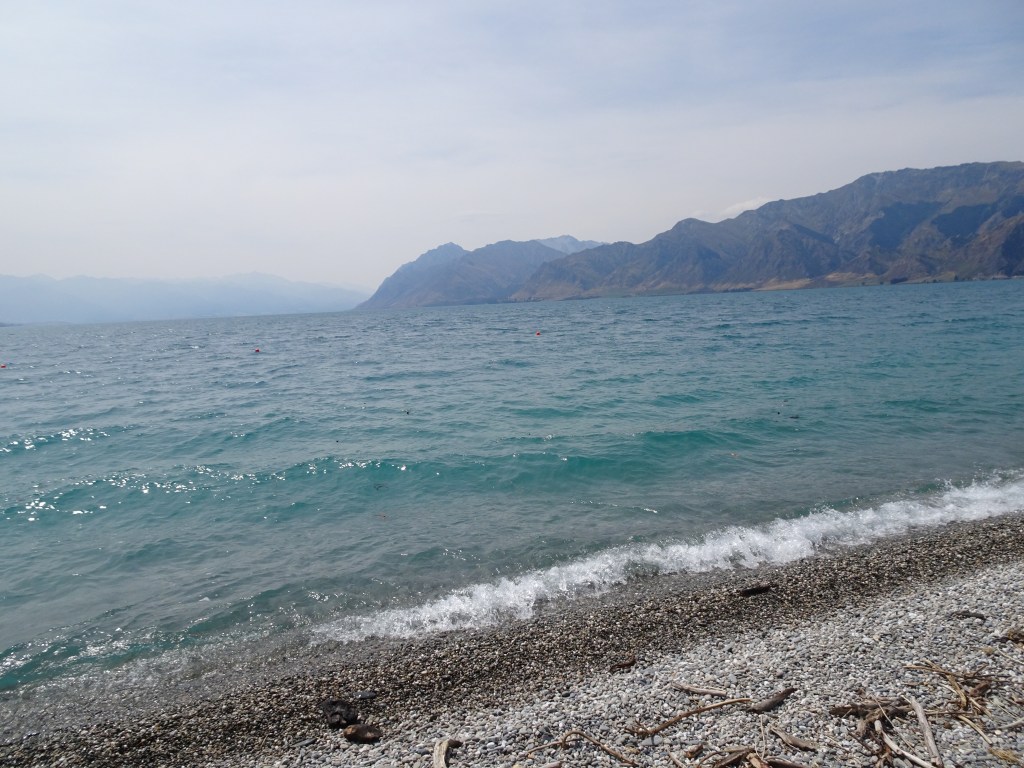
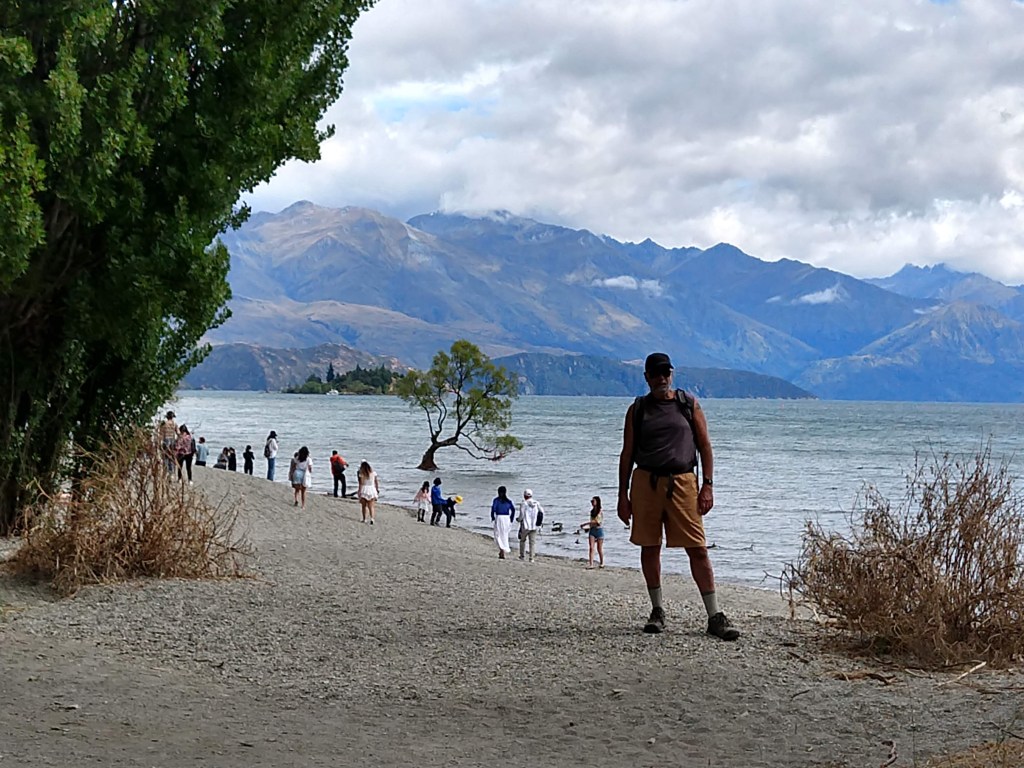
Wanaka is right on the shore of Lake Wanaka, and there is a trail that goes a few miles along the shore. There’s a tree growing in the lake that has become famous through Instagram. Hundreds of people make the pilgrimage each day to take a photo and post it on their account.
#ThatWanakaTree
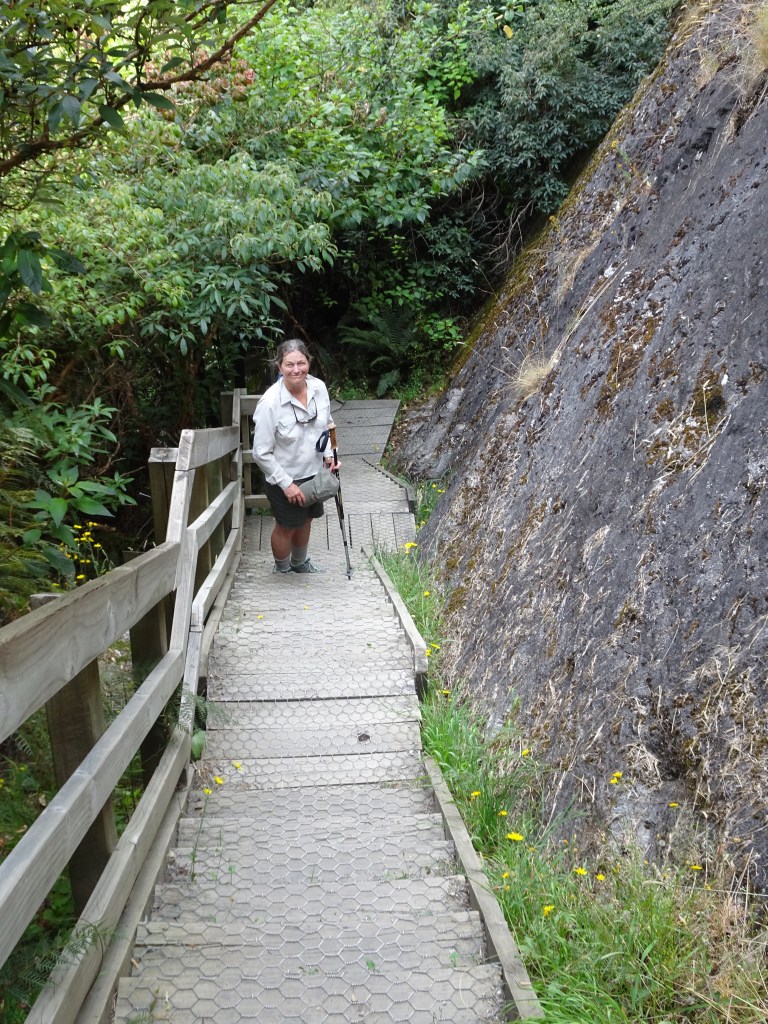
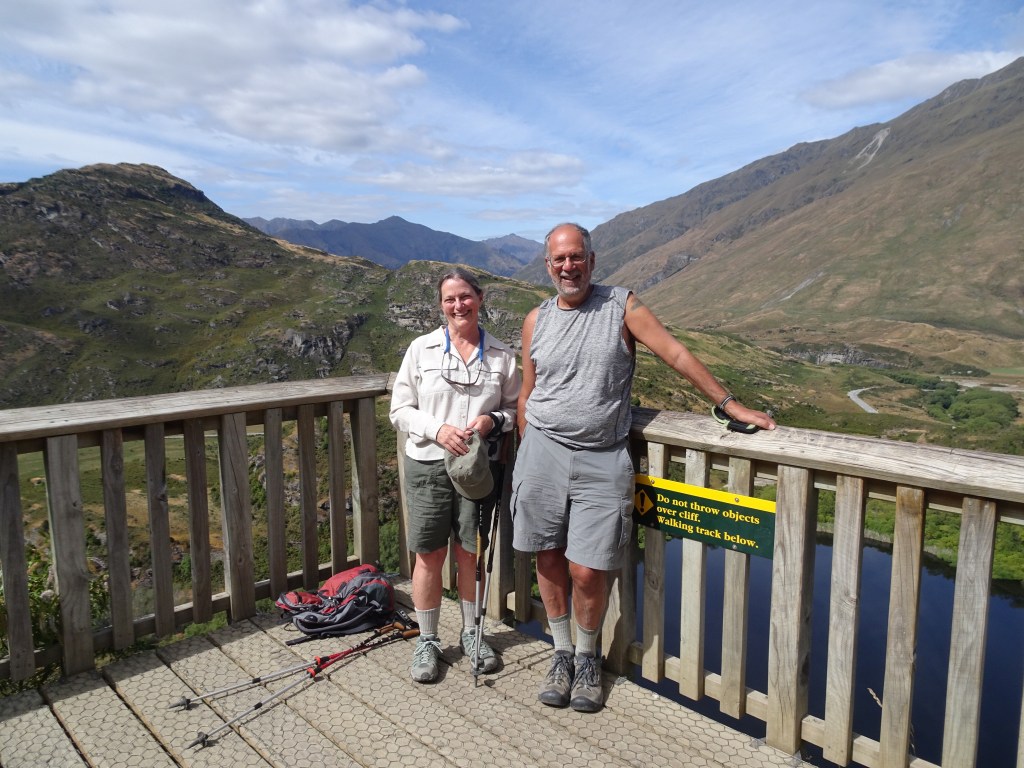
The next day we drove a bit out of town to Diamond Lake, and hiked up the mountainside for some big views.
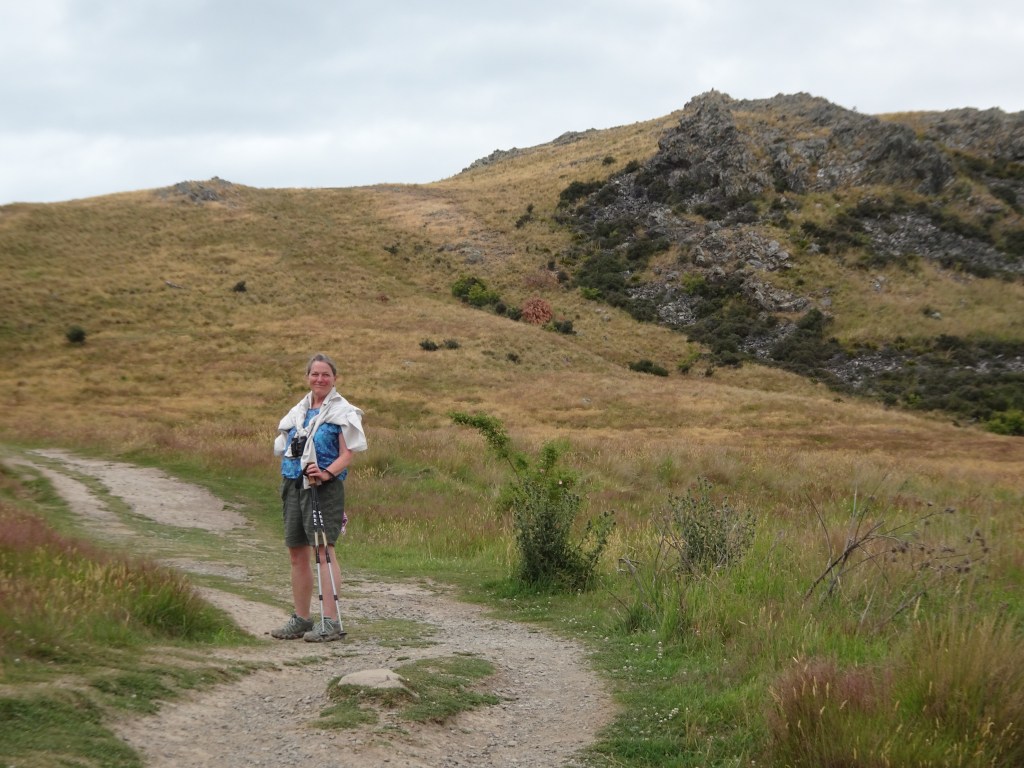
Walking is a pleasure. Sometimes the uphills get a little too uphill, and sometimes the sun gets a little intense, but the simple act of walking remains one of our greatest pleasures. To pick a place to go to, then go there and just walk. Nothing more. It gets us to some awesome places and lets us spend the days in beauty.
Queenstown!
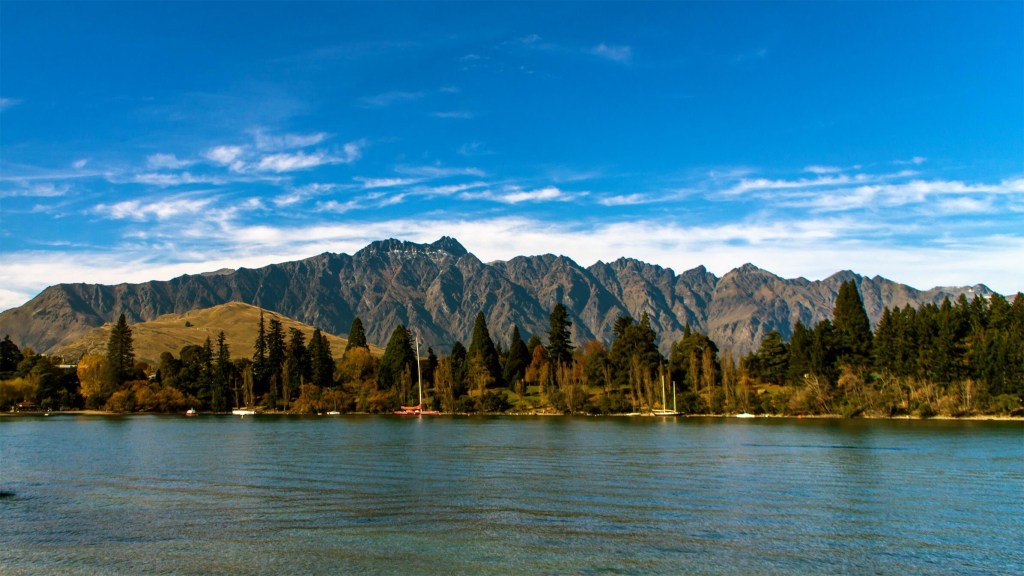
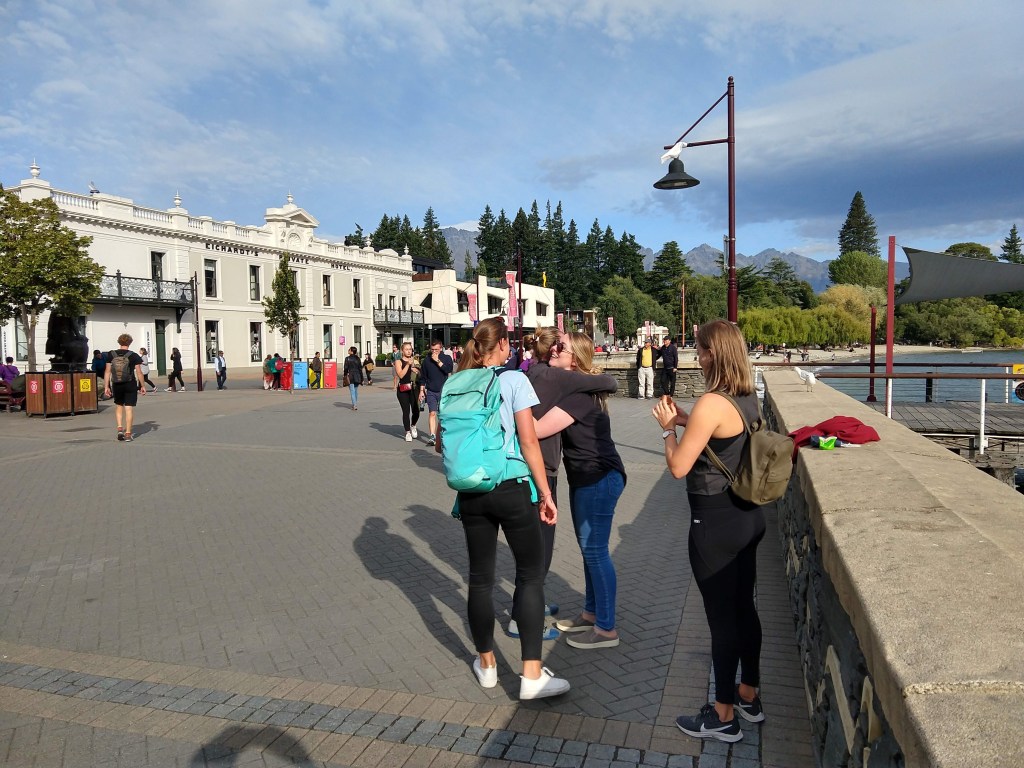
Queenstown’s backdrop: the Remarkable Mountains and Lake Wakatipu
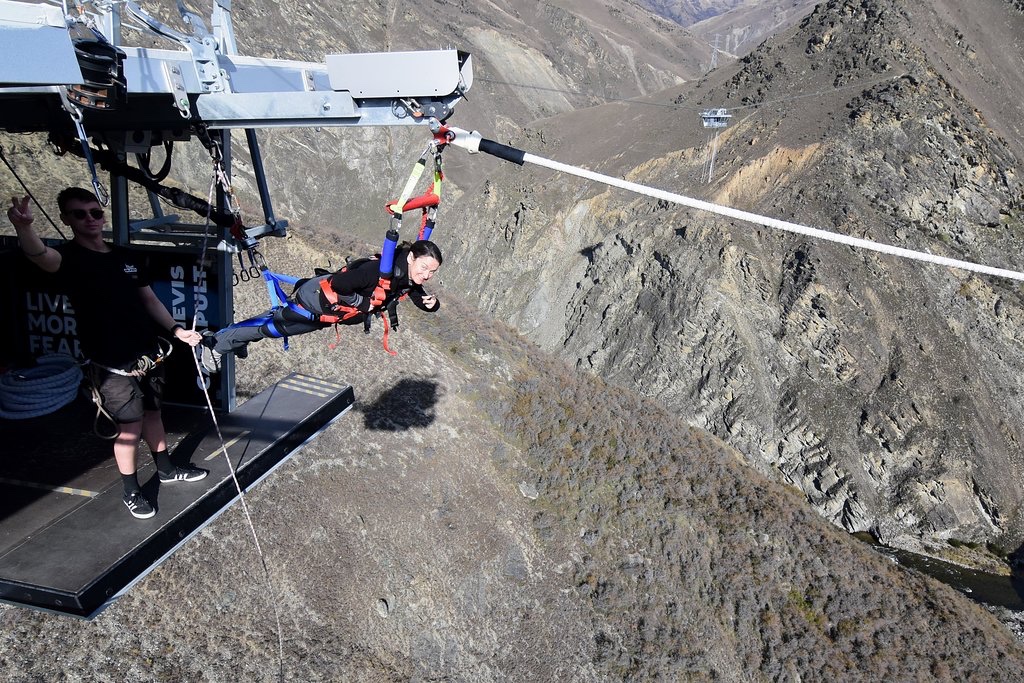
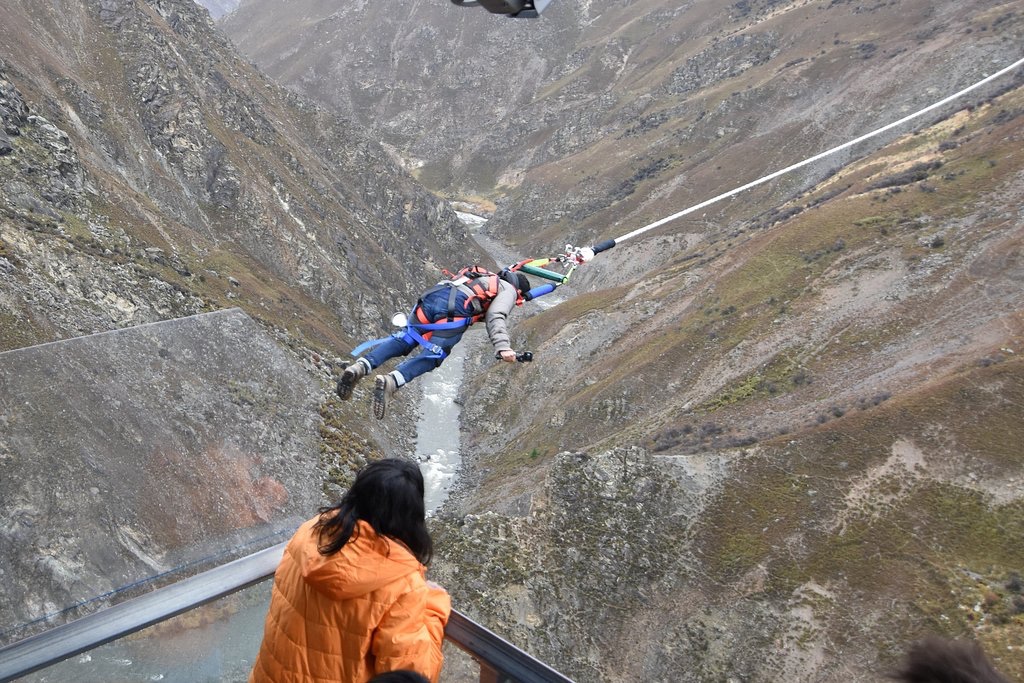
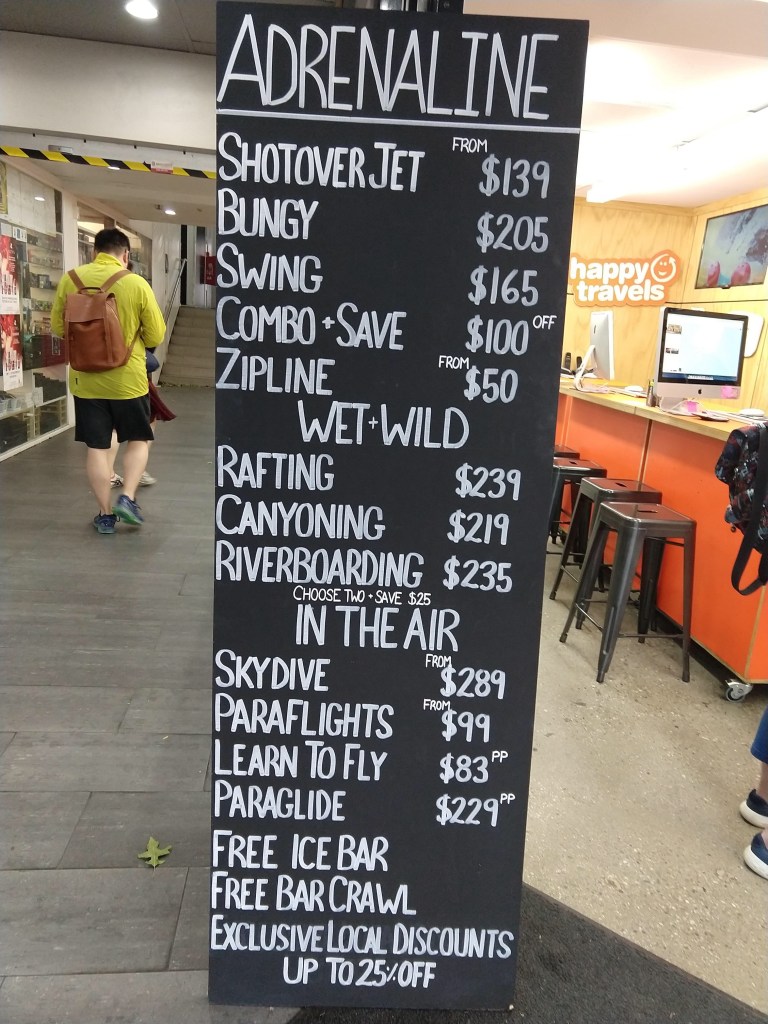
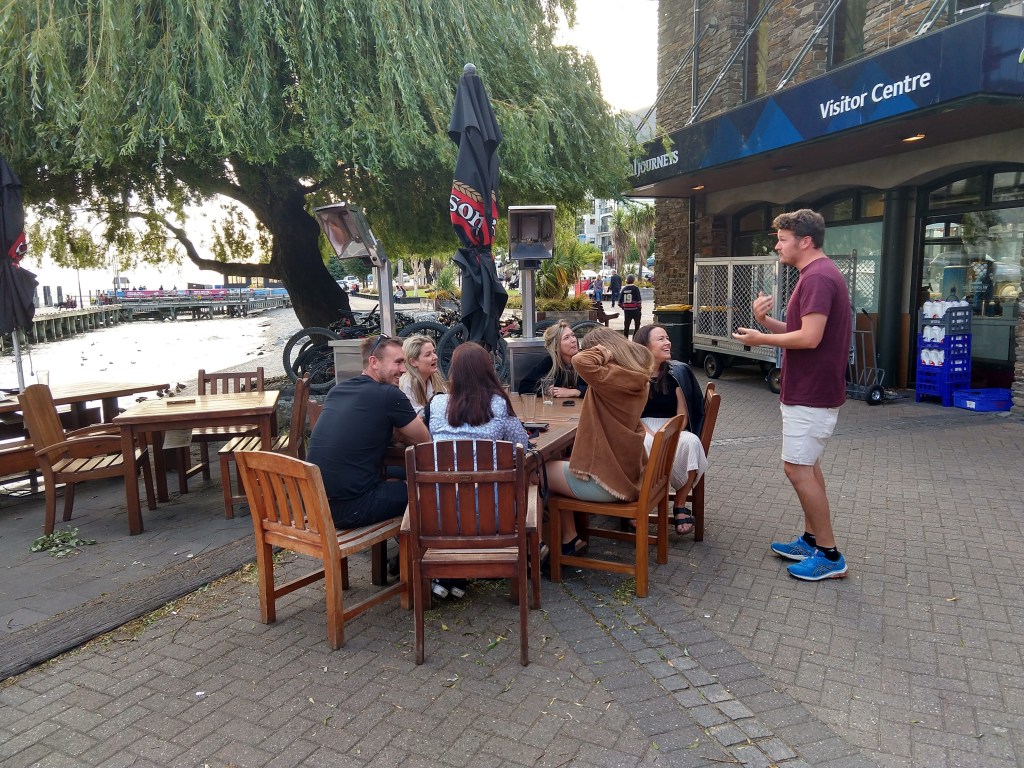
The exclamation point is part of the town. Queenstown is the adrenaline capital of the world. Some folks just fly in for a few days to get their hit of adrenaline, then fly right back out. People come here to bungy jump, skydive, paraglide, leap into space on the world’s largest swing, and/or be launched into space on the world’s largest catapult. The swing isn’t really a swing. You are harnessed and roped, then you are suspended 1300 feet over a river canyon, then the trap door opens and you just drop and swing out over the river. The catapult is recently opened, a year and a half ago. You are harnessed and roped over the Nevus Valley, then suspended horizontally. Five four three two one, a switch is flicked, and you are jet-launched at sixty miles per hour, five hundred feet in a straight line, then you drop 1500 feet and swing for a while before they reel you in. Afterwards, all these adrenaline-filled and pumped people come back to Queenstown and party all night.
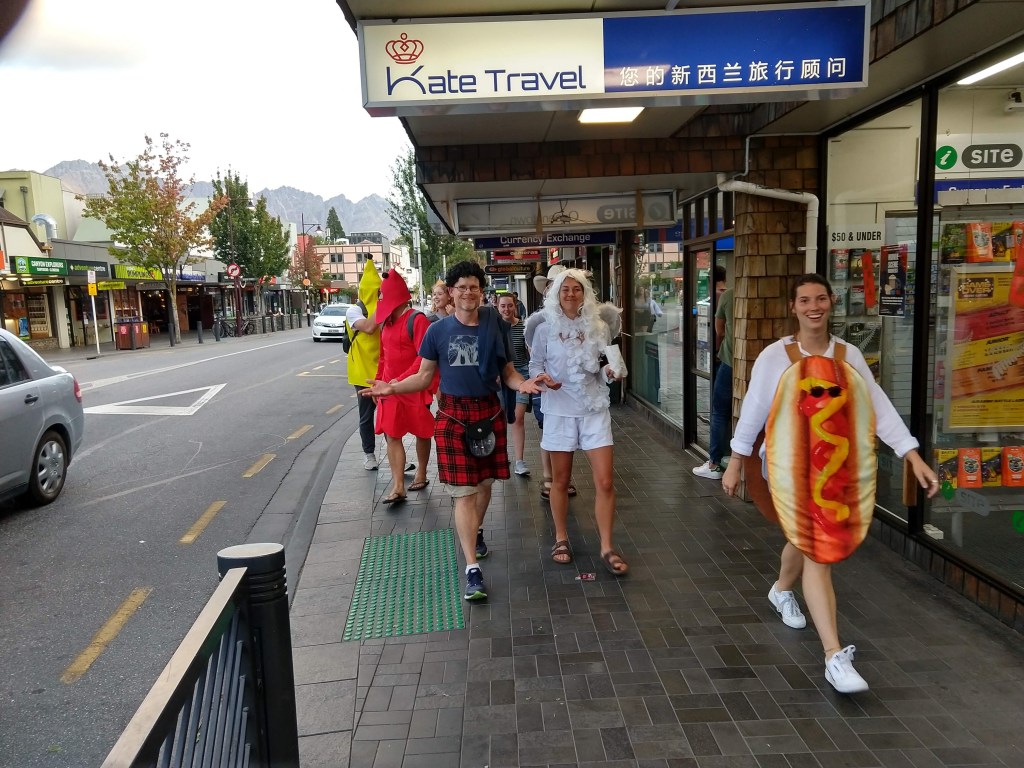
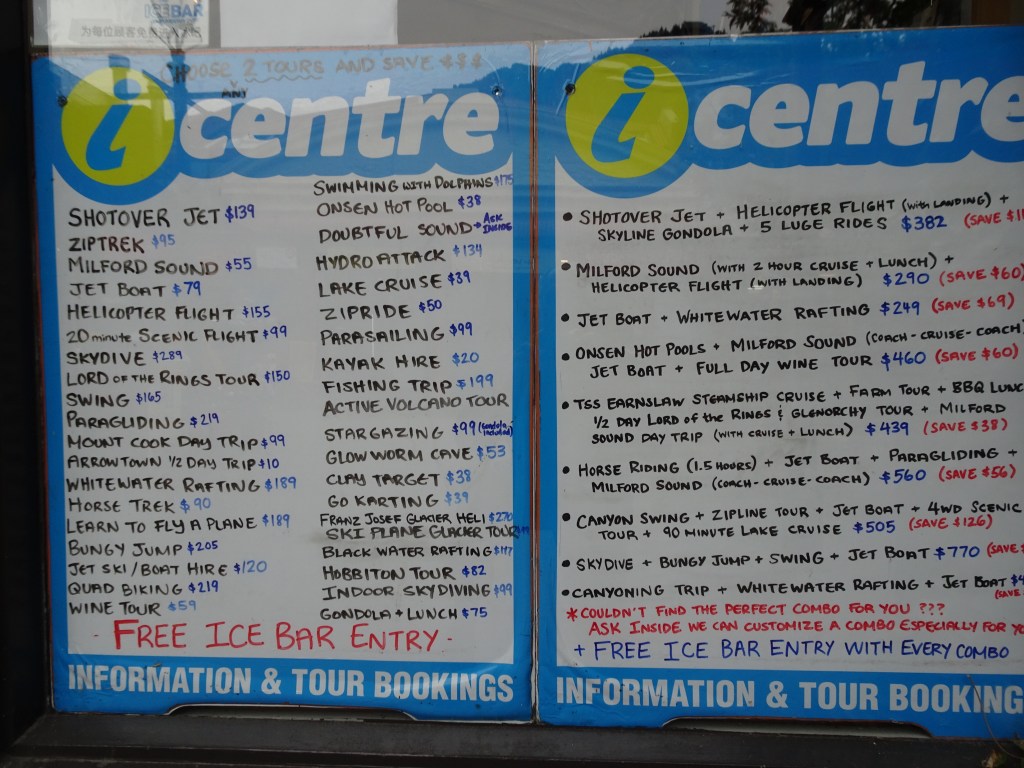
No, not Monica . . .Not Mike eitherLooking for something to do?
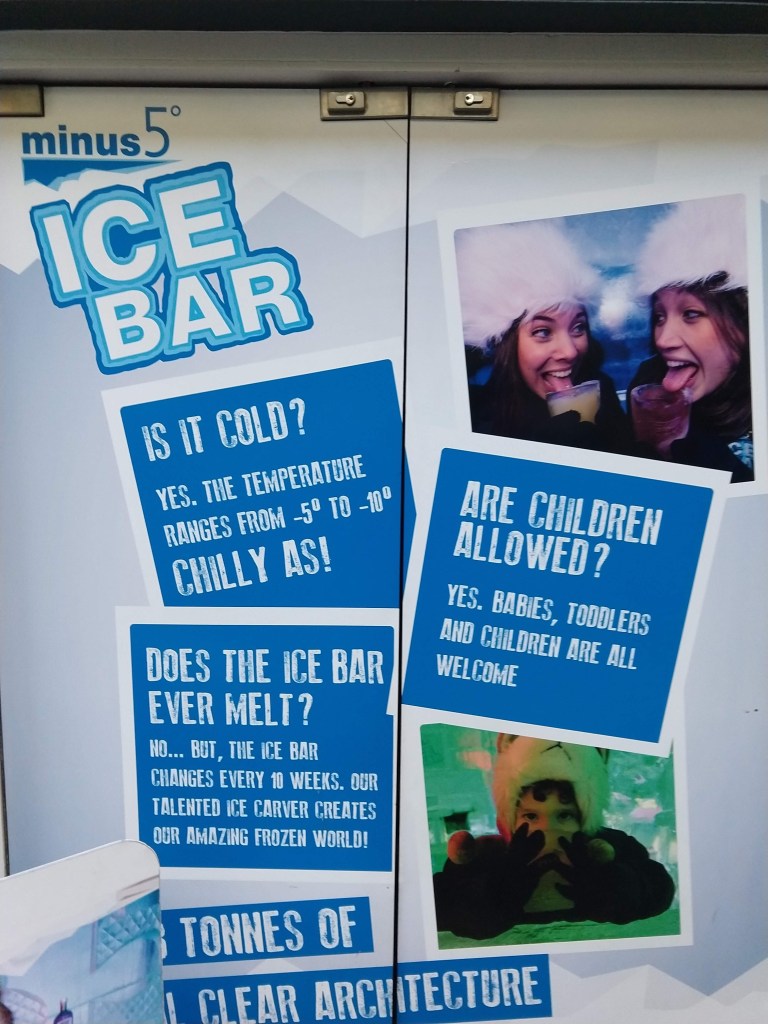
Later on, if you want to cool down a bit, you can have a drink or two in the Ice Bar. They give you warm jackets, then you can go in there and freeze. It’s a novel experience for people who come from places where it never gets cold. I don’t think our friends from Northern Minnesota (Hi Lawson, Hi Lynden) would get too excited about it.
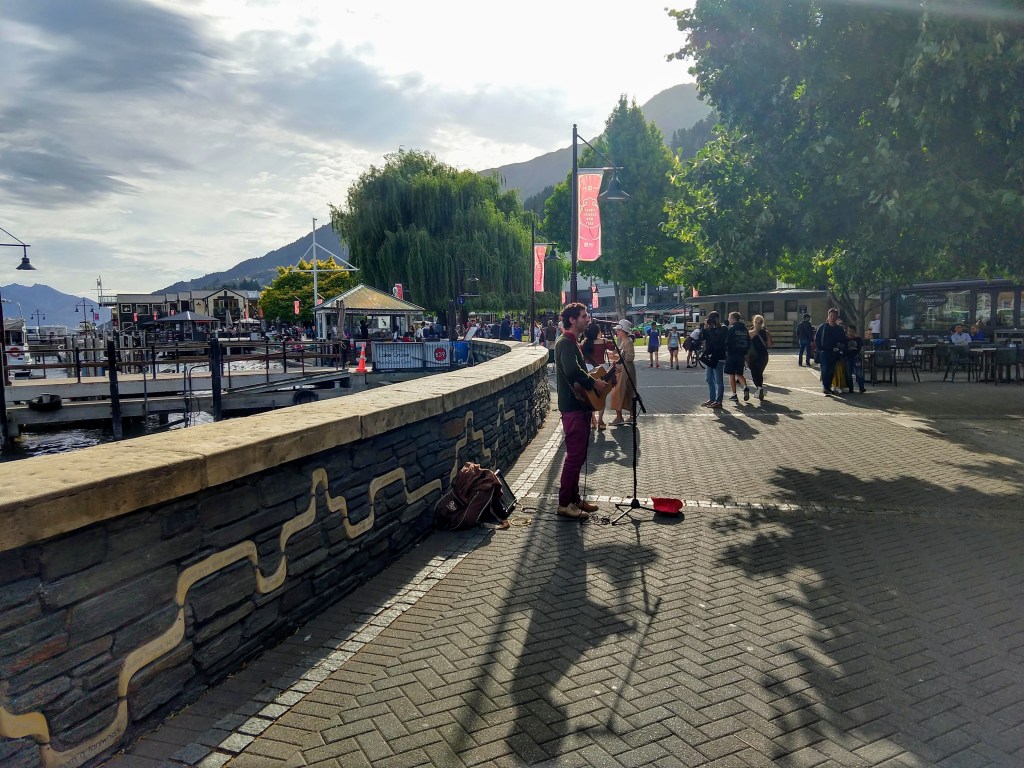
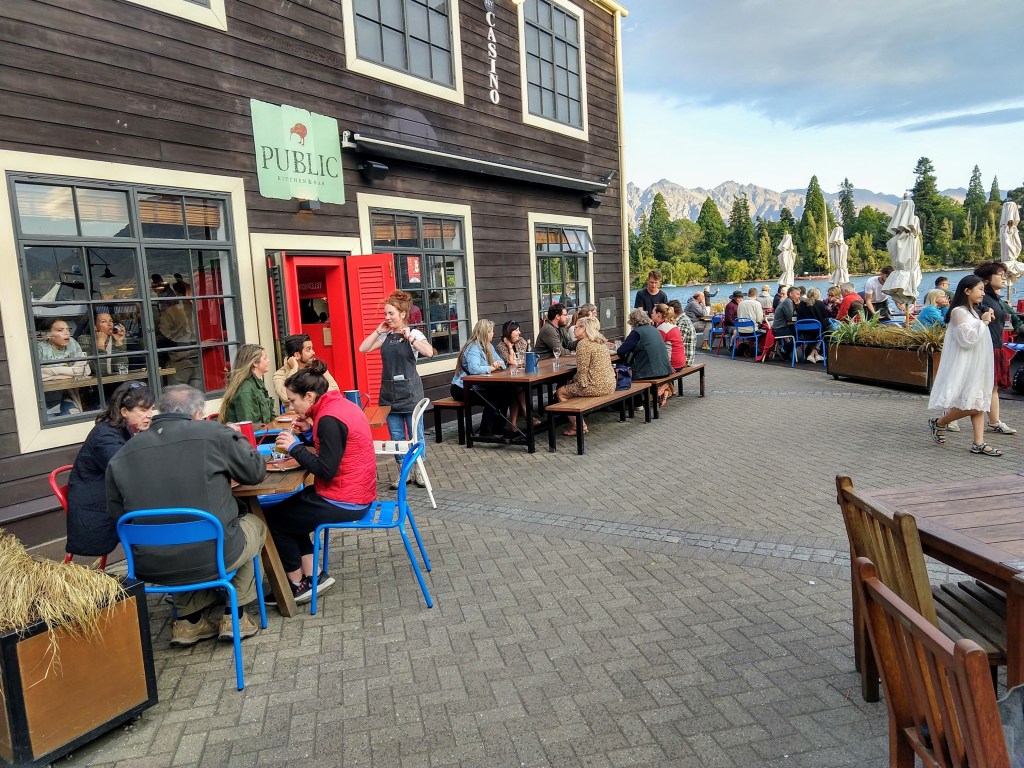
Throughout New Zealand there are young people from all over the world living and working. They are here on a work holiday visa, up to one year. You have to be between the ages of eighteen and thirty to get a visa, and it seems to be a good thing for all parties involved. New Zealand needs workers in the tourist and agriculture industries, and it is a wonderful place for somebody in their twenties to spend a year. We’ve met people mostly from the USA and Europe, but NZ issues the visas to most countries. Meanwhile, international tourists keep arriving. Queenstown is vibrant, stunning, breathless and beautiful, exhausting, and a wee bit artificial.
A Little Hike
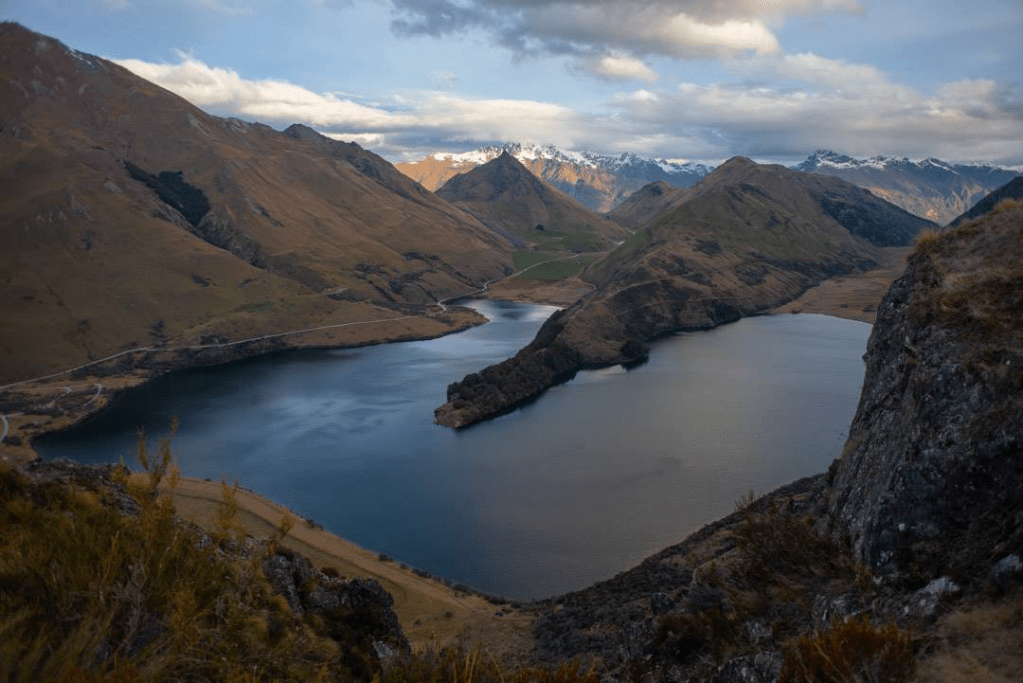
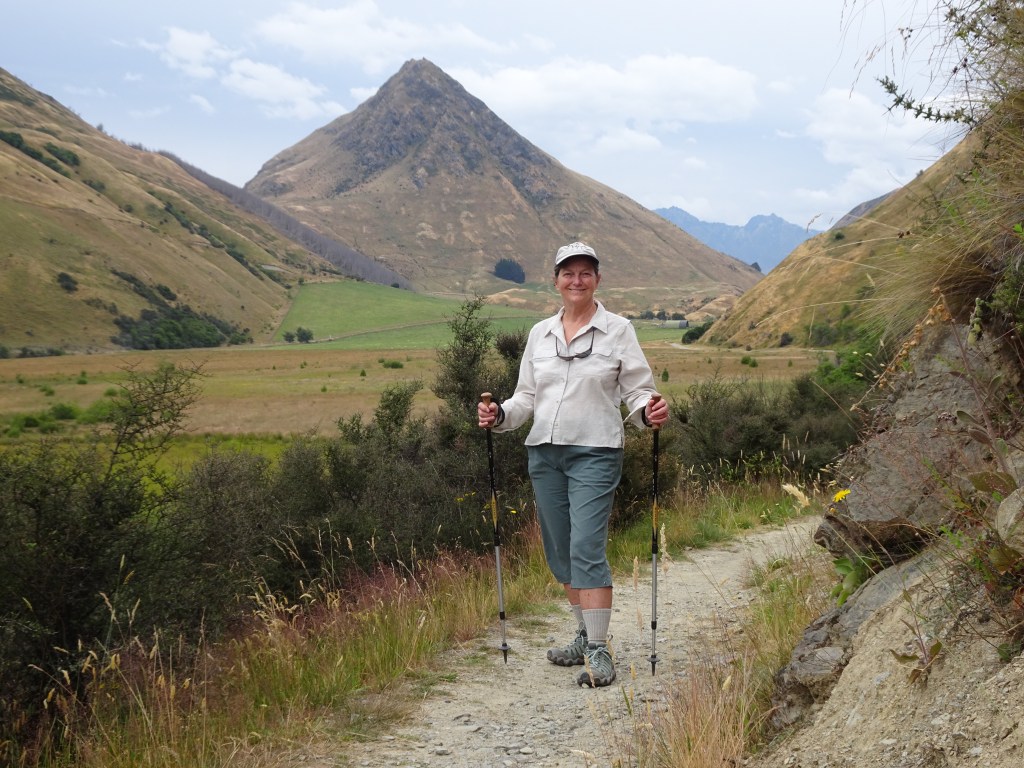
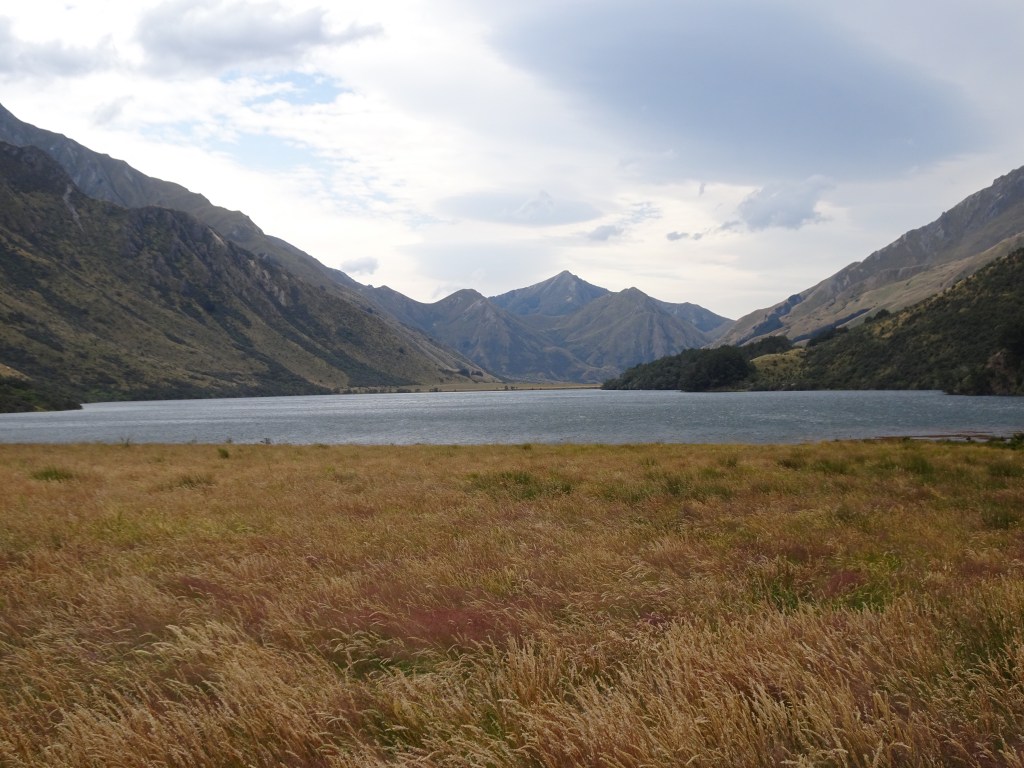
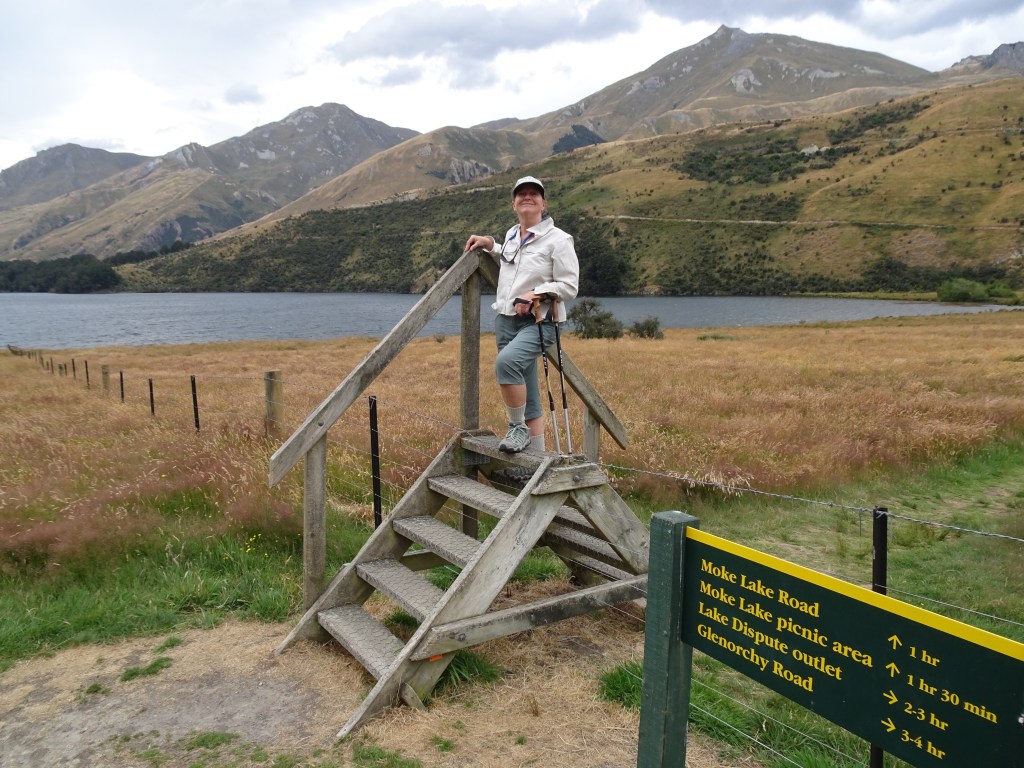
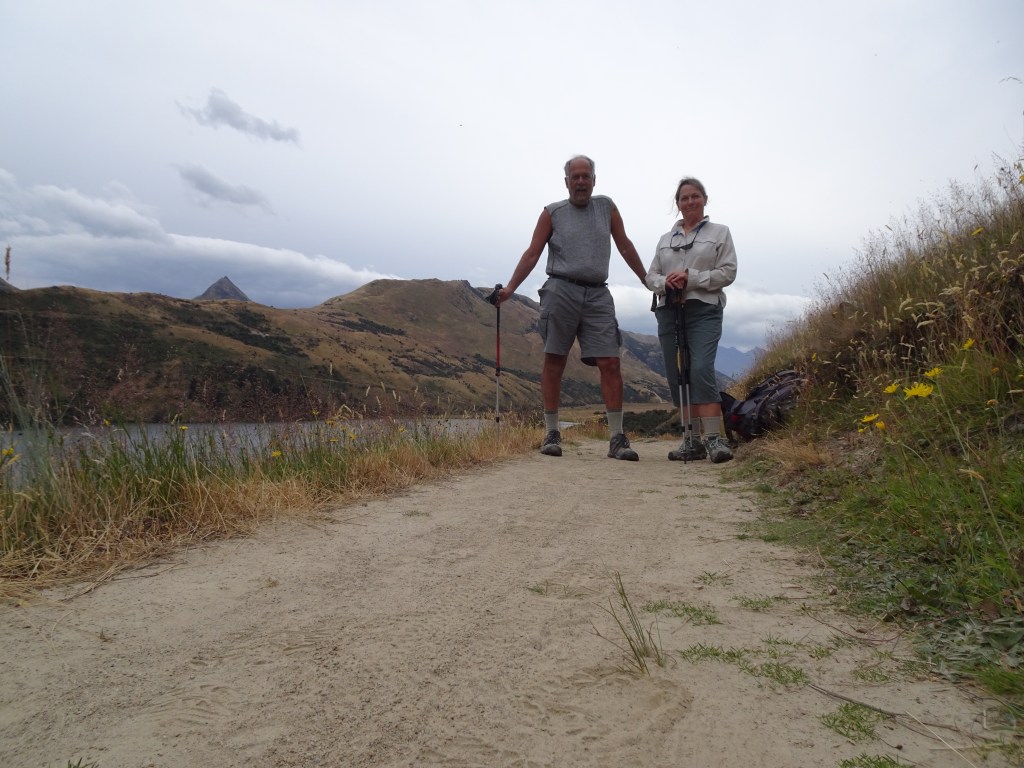
Moke Lake is a horseshoe-shaped lake, less than ten miles out of town, nestled in the mountains. There’s a trail around the lake. It took us about two and a half hours to walk around it. Far from the madding crowd.
After the hike
On to Glenorchy, and a Change of Plans
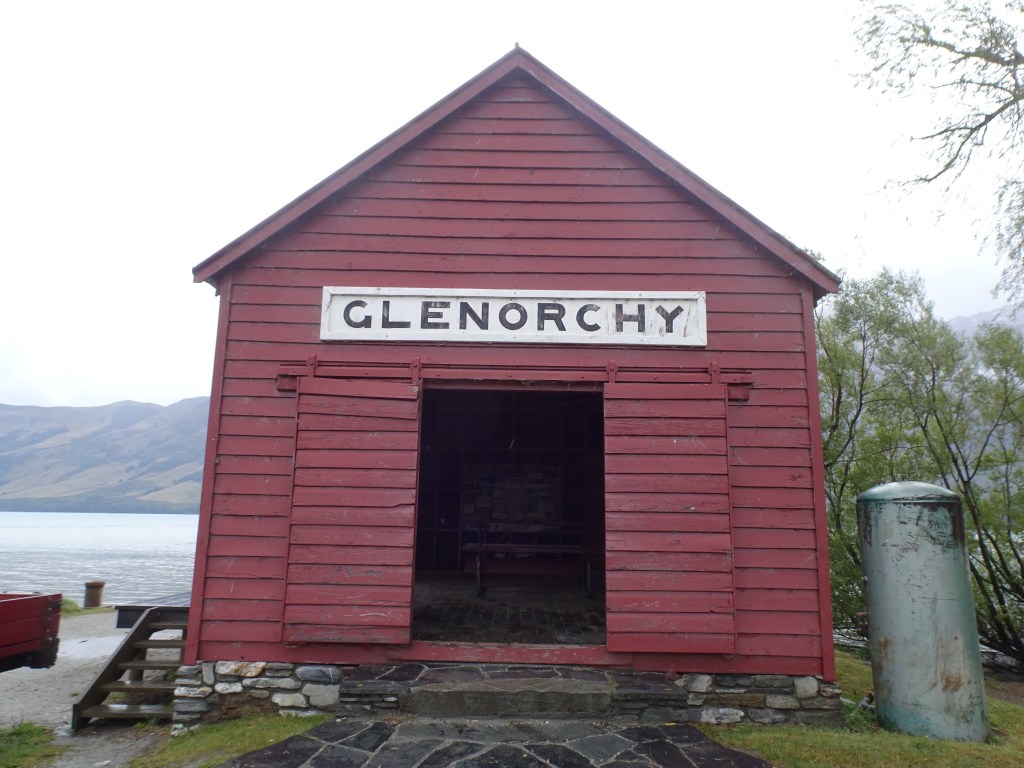
The old boat house. Glenorchy is at the “head of the lake,” on the northern tip of Lake Wakatipu, and steamships were the lifeblood of the community until the road was built in 1962.On the road back from Glenorchy. Lake Wakatipu.
We left Queenstown in the rain and drove fifty kilometers up the lake to Glenorchy. This is Southern Alp country, with mountains rising up everywhere. For us, however, the only thing we could see was thick grey clouds and lots of water coming down. We stayed in Glenorchy for two days, and we were grateful for our dry warm airbnb. The rains continued, the rivers rose over the roads and landslides slid down on them, and a state of emergency was declared through the south part of the South Island.
The mountains near Glenorchy are famous for being the backdrop for many scenes in Lord of the Rings. It’s also the jumping off spot for a few of New Zealand’s Great Walks, including the well-known Routeburn Track. There is a hiker’s hut on this track, not far from Glenorchy, and it was hit by a landslide one of the nights we were there. Thirty one people were helicoptered out, and the trail itself was washed out. The middle of summer, it took everyone by surprise.
The roads leading into Fjordland National Park were closed due to flooding and landslides. We were planning to go there, and we were looking forward to an overnight boat trip out on Doubtful Sound, a remote fjord deep in the park. We had to pull out our tablet and cancel and come up with a new itinerary. We left Glenorchy with plans to head back to Wanaka, then head to the west coast. A little disappointing not to get out to the fjords, but…..On to the next adventure.
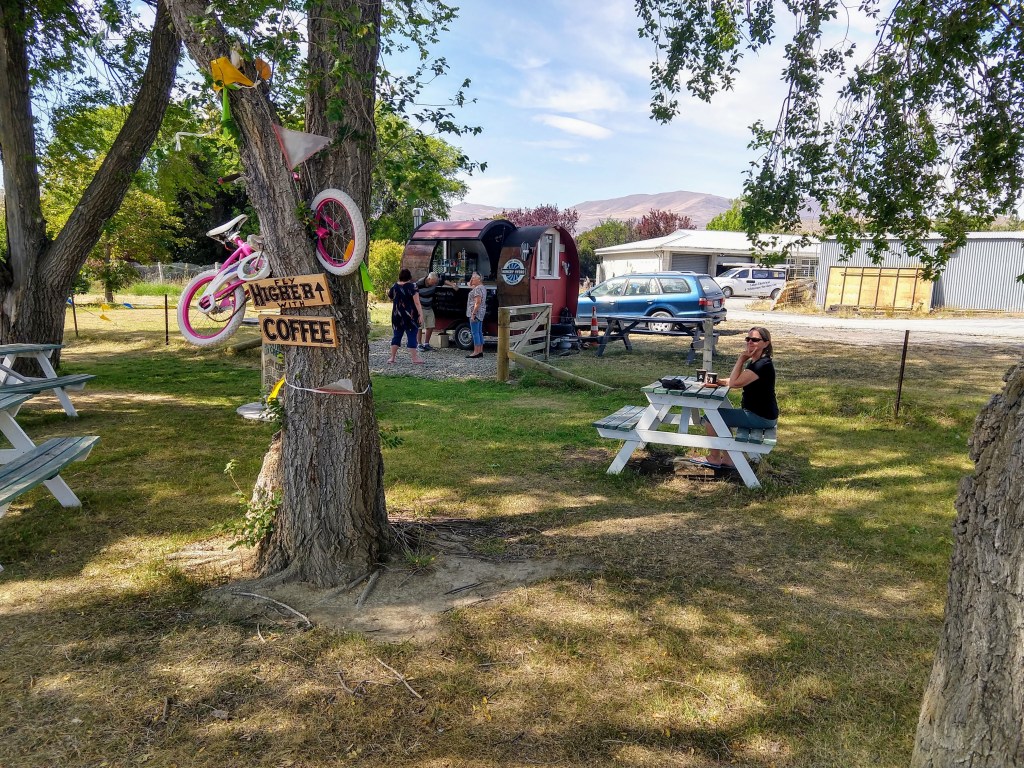
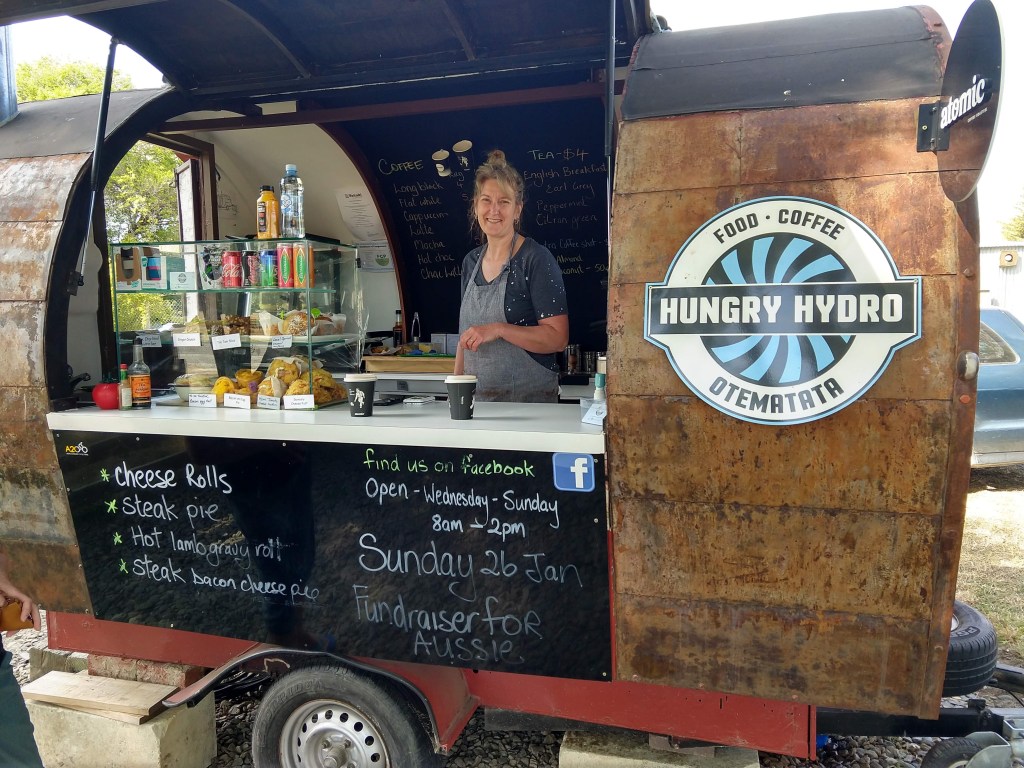
Driving along the A2O bike route (Alps to Ocean)Not your typical rest area. Serving muffins from apricots picked off the tree next to the cart.
Lake Tekapo
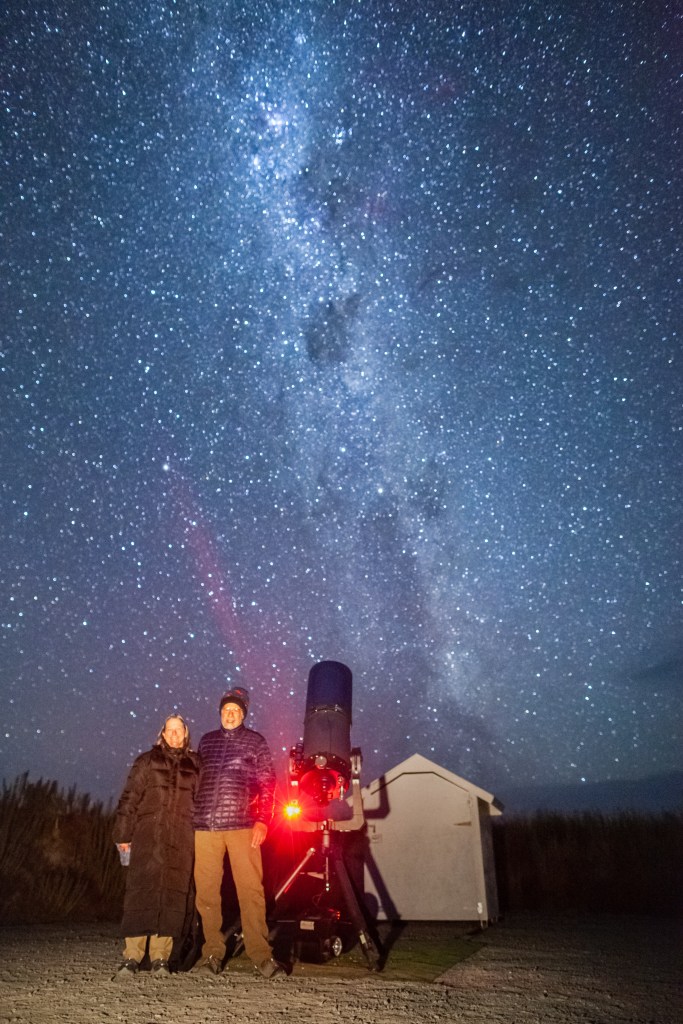
It is thrilling to be out at night and gaze at the Southern Cross. This constellation is one of the most recognized sights in all the world, and is easily visible from everywhere in the Southern Hemisphere. It has been used throughout the millennia as a navigation anchor, and it is filled with meaning and mythology. The area around Lake Tekapo is one of the finest places anywhere to appreciate the Southern Cross and the night sky.
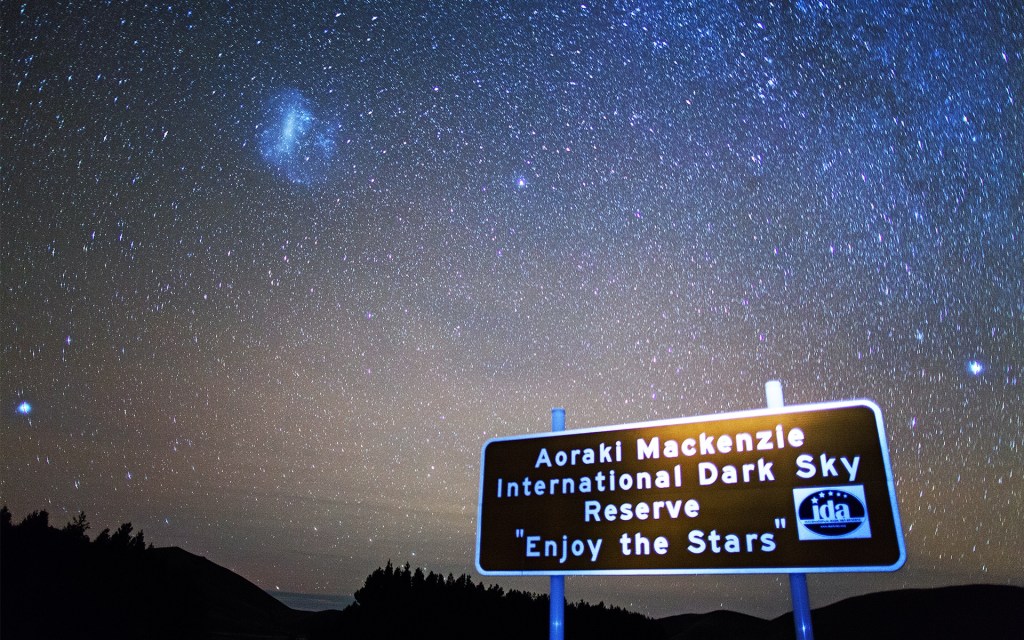
The International Dark Sky Association (IDA) is a non-profit organization, based in Tucson, that advocates for the protection of dark skies. It promotes an “international dark sky places program,” which recognizes communities around the world with exceptional dark sky treasures. Currently, there are sixteen Dark Sky Reserves in the world, and Lake Tekapo is one of them, in the Aoraki Mackenzie Region. There are also Dark Sky Sanctuaries, which is a step further than Reserves. These are remote places that are protected from light pollution. Great Barrier Island and Stewart Island, both in New Zealand, are two of the eleven sanctuaries worldwide.
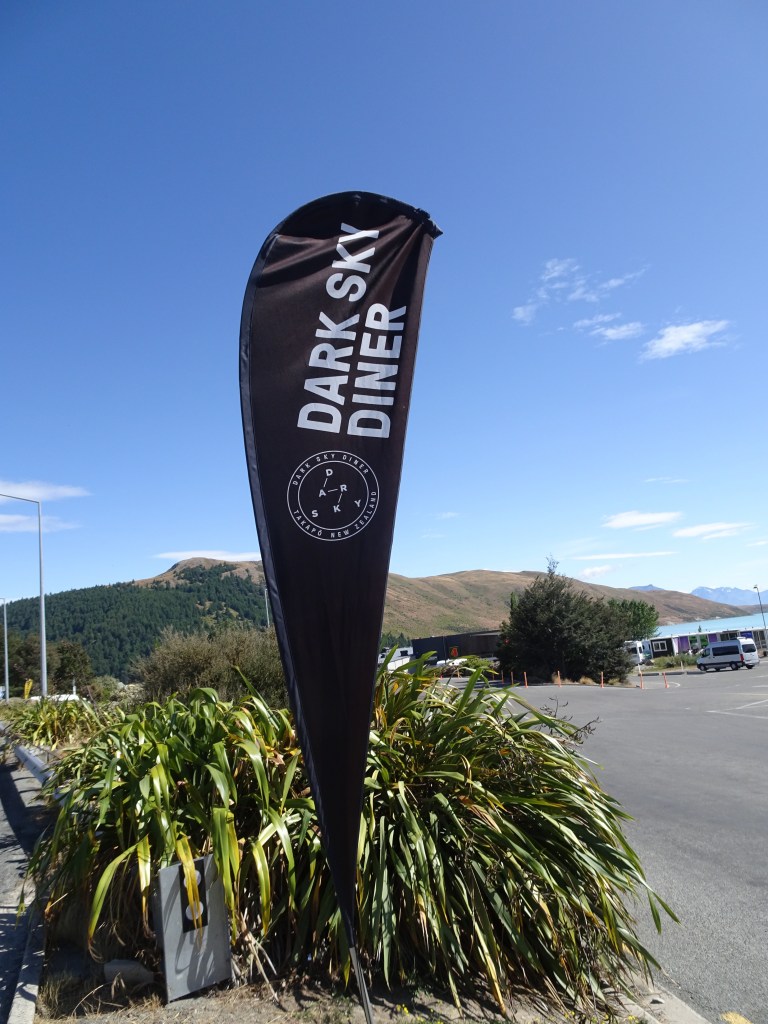
Lake Tekapo (pronounced similar to “Peek-a-boo”) is all about the dark skies. It’s a tiny town, only 350 residents, and there are three companies that take people from all over the world out on stargazing tours. The business is called “astro-tourism.” It’s a new type of tourism; these companies did not exist five years ago.
National Geographic says that 80% of Americans cannot see the Milky Way. The entire island-nation of Singapore is so lit up that the Milky Way is invisible there. People in Israel, the United Arab Emirates, and Western Europe can live their whole lives without seeing it.
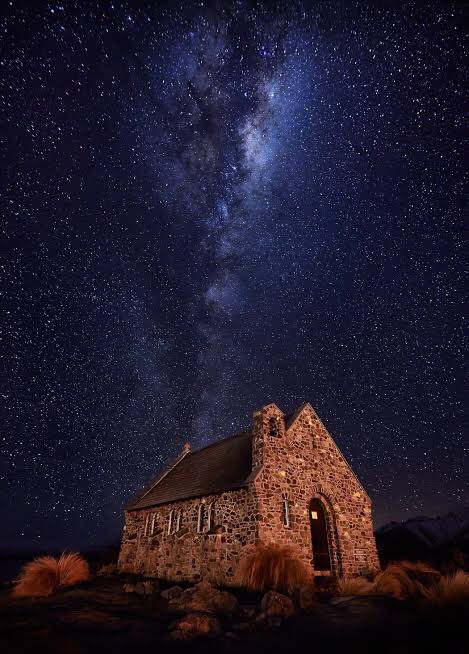
The Chapel of the Good Shepherd, on the banks of Lake Tekapo, with the Milky Way behind it. (Internet)
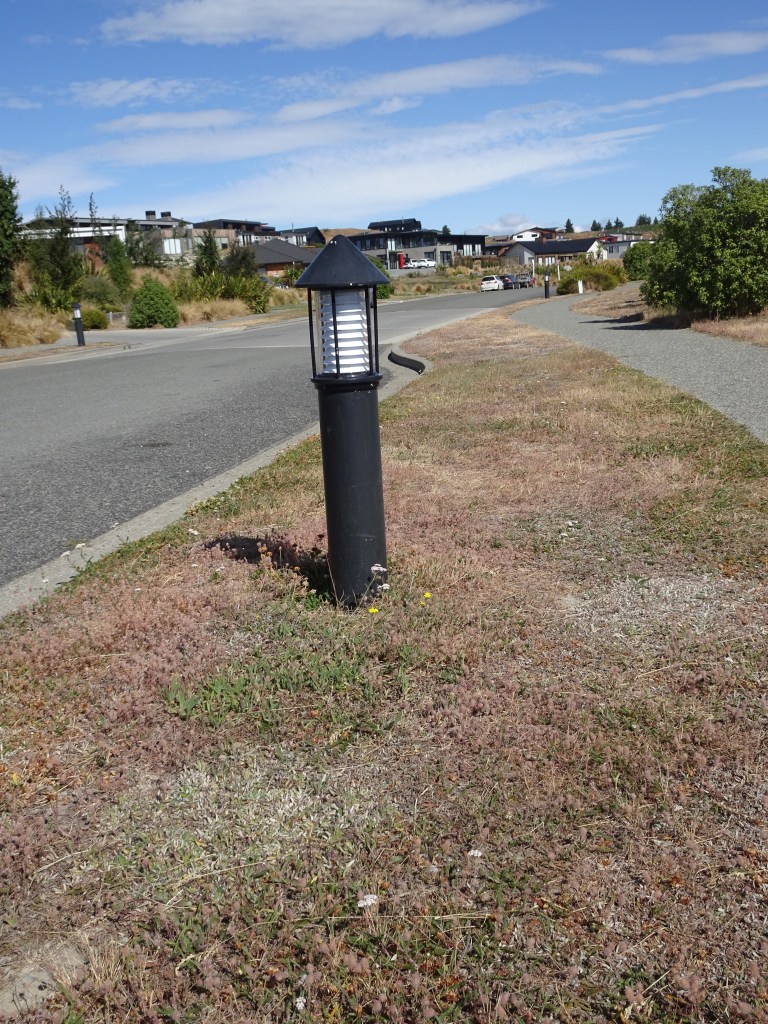
There are lots of places in the world with dark night skies. We’ve seen amazing, incredible stars in Oregon where we live, and in other remote areas. What makes this area special is the community-wide consciousness and effort to appreciate and maintain the darkness. Lake Tekapo does not send light up into the air. There are streetlights here, but they are low to the ground, and they are capped. The light stays on the ground. Driving through town at night, you can see your way, but the light is contained.
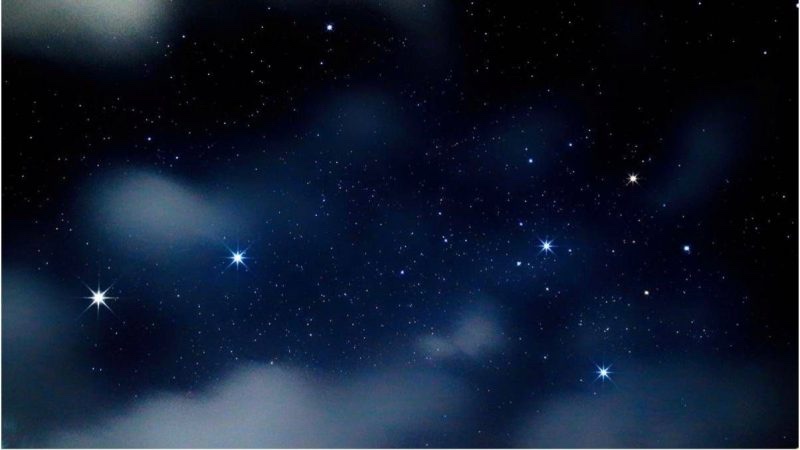
We went out on a stargazing tour because we wanted to learn a bit more about the Southern Sky. We met at 11:30 at night, and drove in a van about ten minutes outside of town, to an alpine reserve. It was dark, and the stars were out. I was interested especially in the Southern Cross and the stars around it. It is actually a very small constellation, but it is bright, and it is right in the Milky Way. There are two pointer stars that point to it, Alpha Centauri and Beta Centauri. Alpha Centauri is the closest star to earth, and both of the stars are very bright.
Alpha Centauri on the far left, Beta next to it. They point to The Southern Cross. It looks more like a kite than a cross. We go out and look for it whenever the night sky is clear. (This photo is from the Internet.)
We also saw quite a few other constellations, most of which we can also see sometimes in Oregon, but they look different here. Orion is upside down. Through a large telescope, we saw double stars and two nebulae.
There was absolutely no other light out there, and the sky was super black with thousands of stars. A real visual treat. When we came back to town, even though it was still a spectacular sky, it was not as spectacular as just out of town. Astro-tourism might seem to be just another ploy in the tourist trade, but I think it’s a good thing. It promotes less development, not more. It gives people who might otherwise not have the chance, an opportunity to glimpse something that we are losing. It lets people appreciate the natural world. It’s all good.
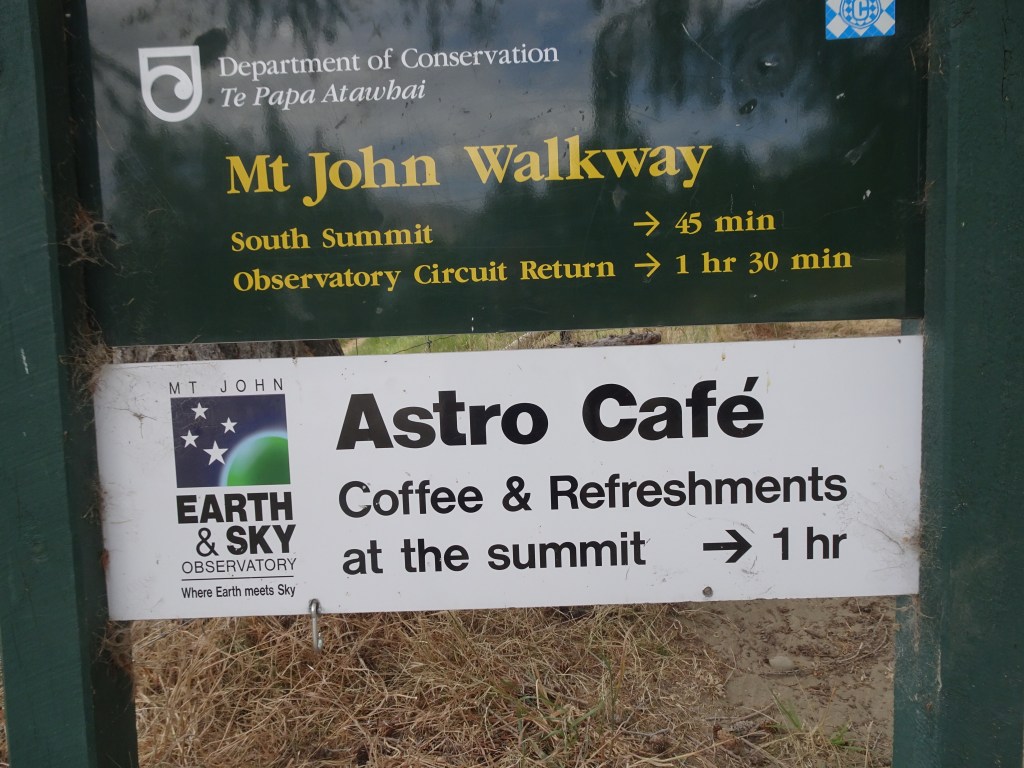
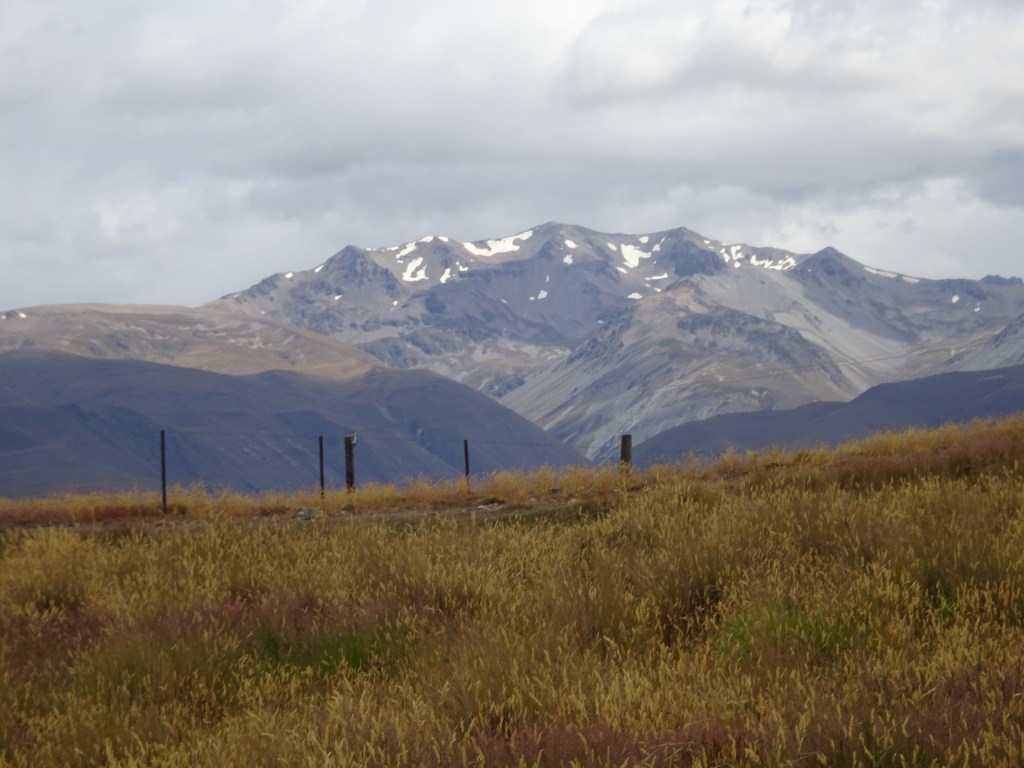
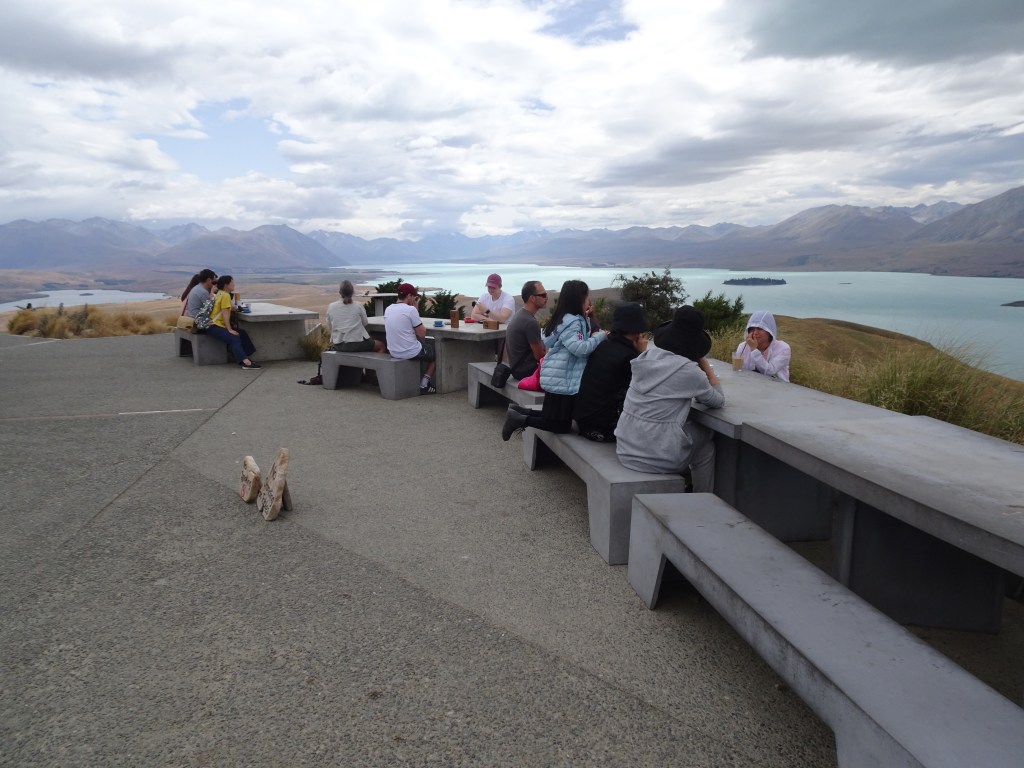
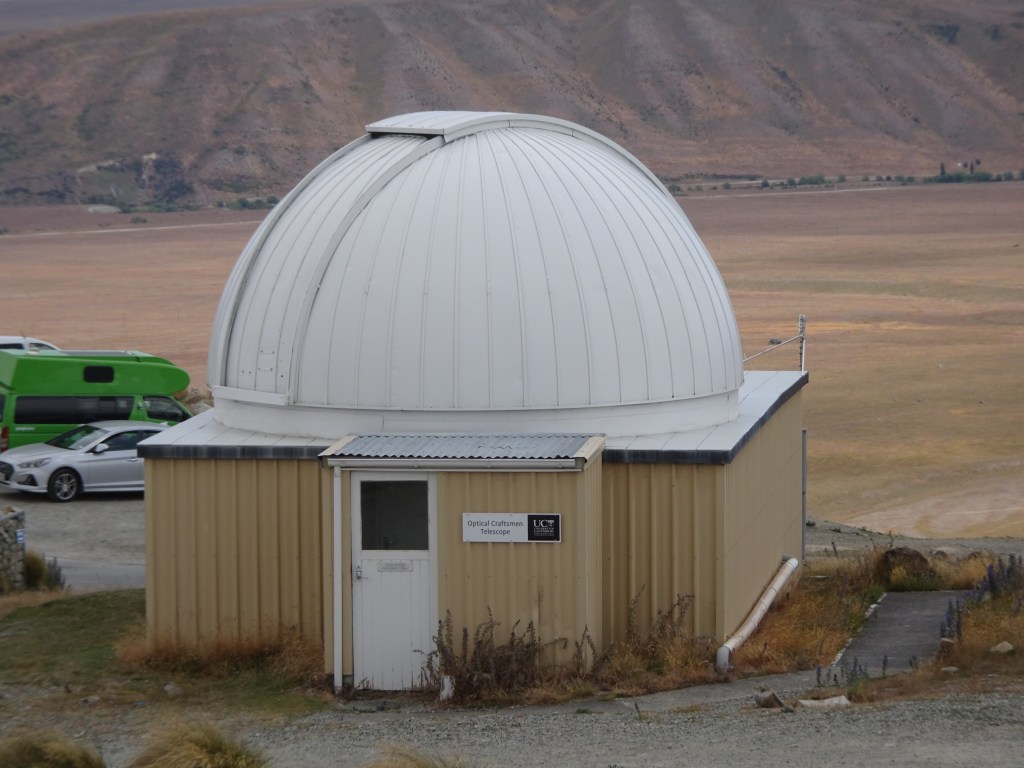
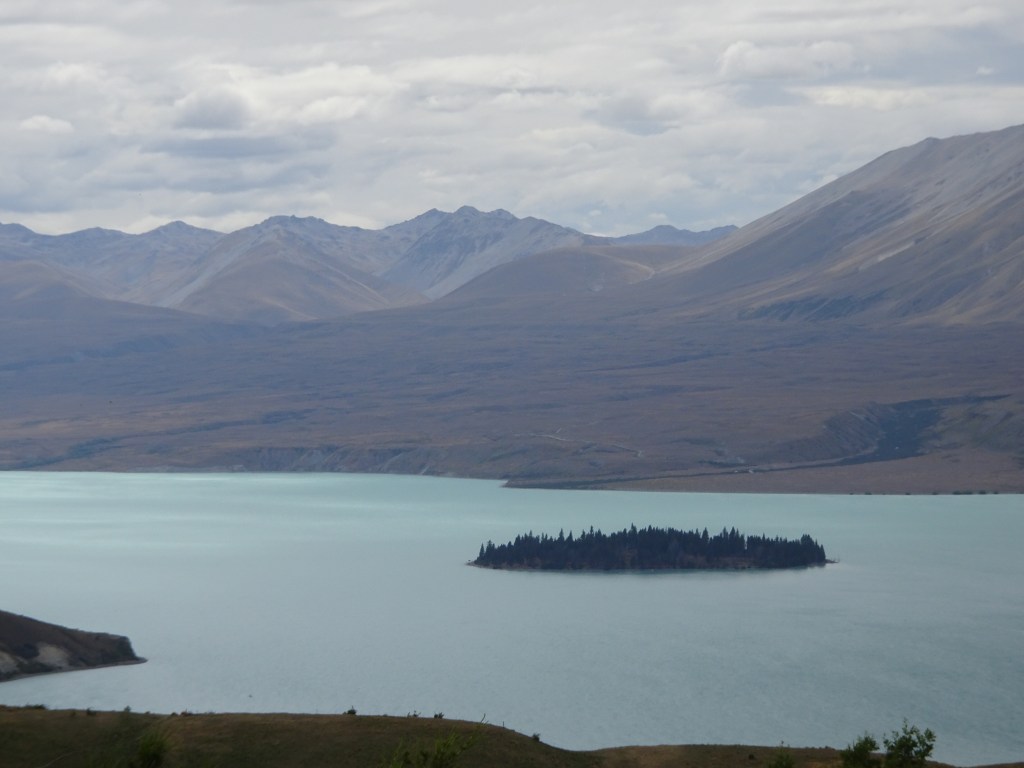
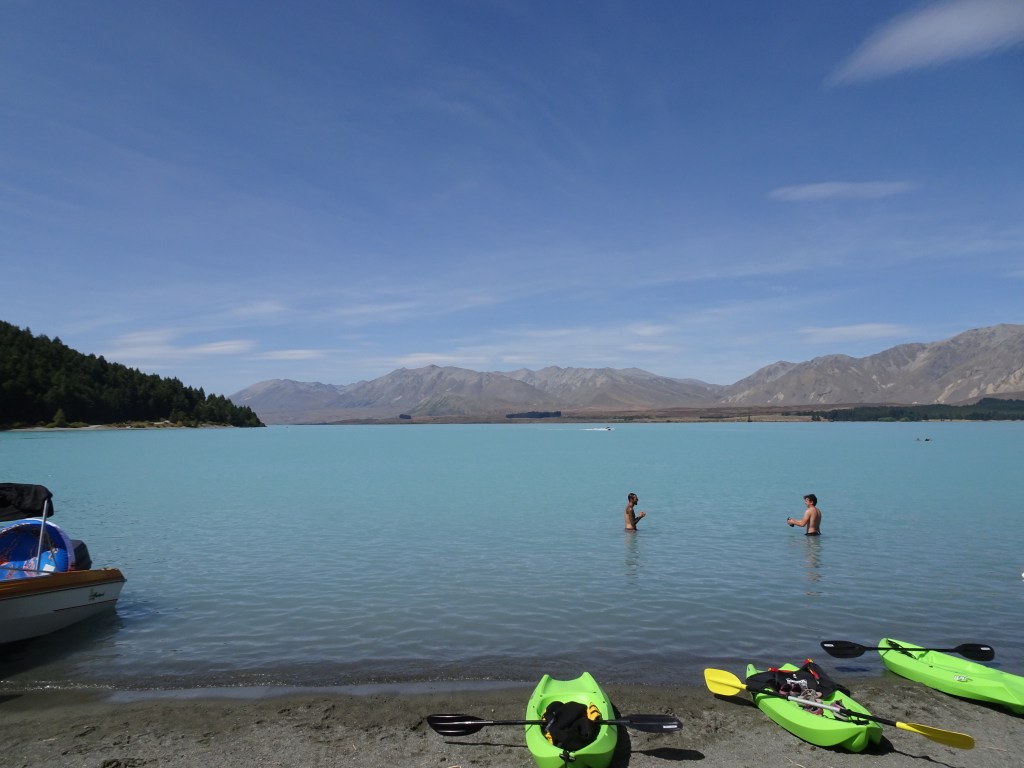
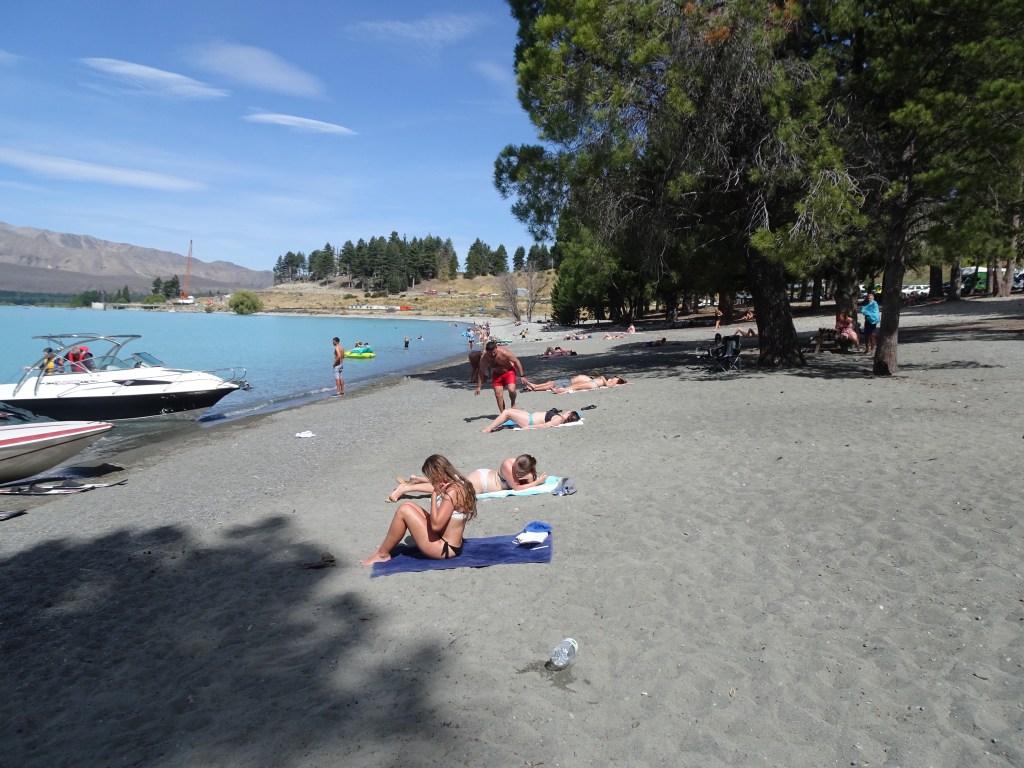
In addition to the night-time star outing, we hiked and swam while we were in town. The lake itself is beautiful turquoise. It is glacially fed, and the color is from the dissolved sediment. The elevation is only about 2400 feet, but it has a mountain feel. Mount John is just over 3000 feet, and it has an observatory on top, which is used by the University of Canterbury. They also offer programs to the public.
Heading up to Mt. JohnAn outdoor cafe at the top
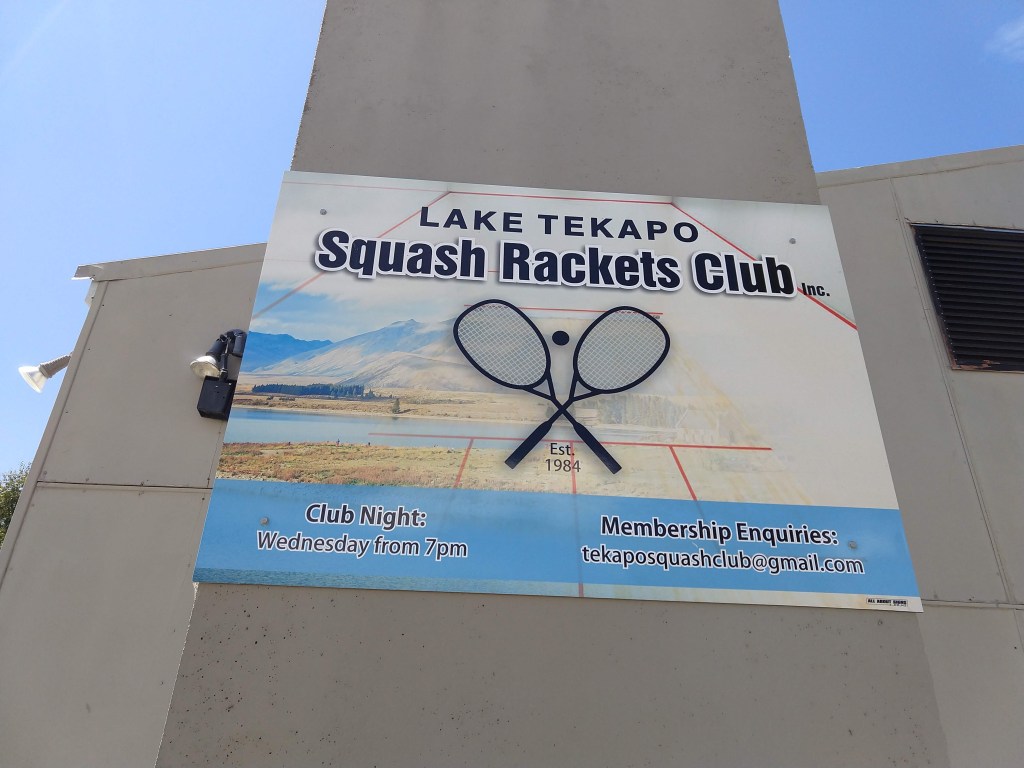
Lake Tekapo is a beautiful little place. And, just to sweeten things up a little bit, they have a squash court here, which anybody can use. I saw it, and it wasn’t hard to find who had the key. “Here you go,” she said. Just the words that a humble passing-through juggler loves to hear.
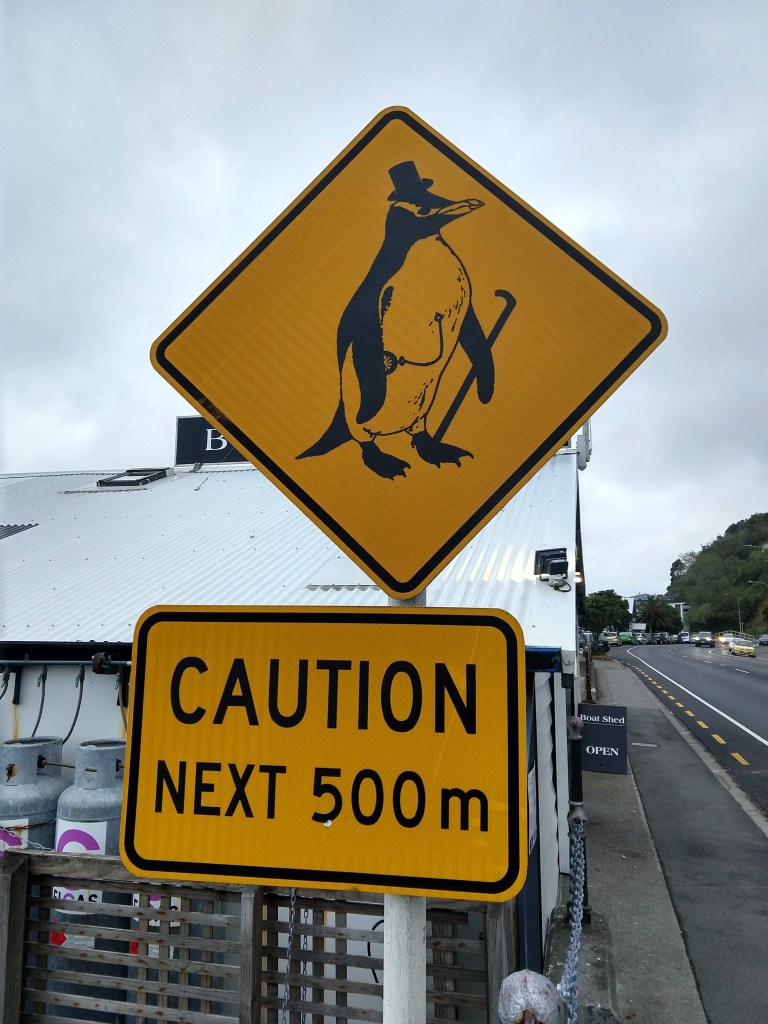
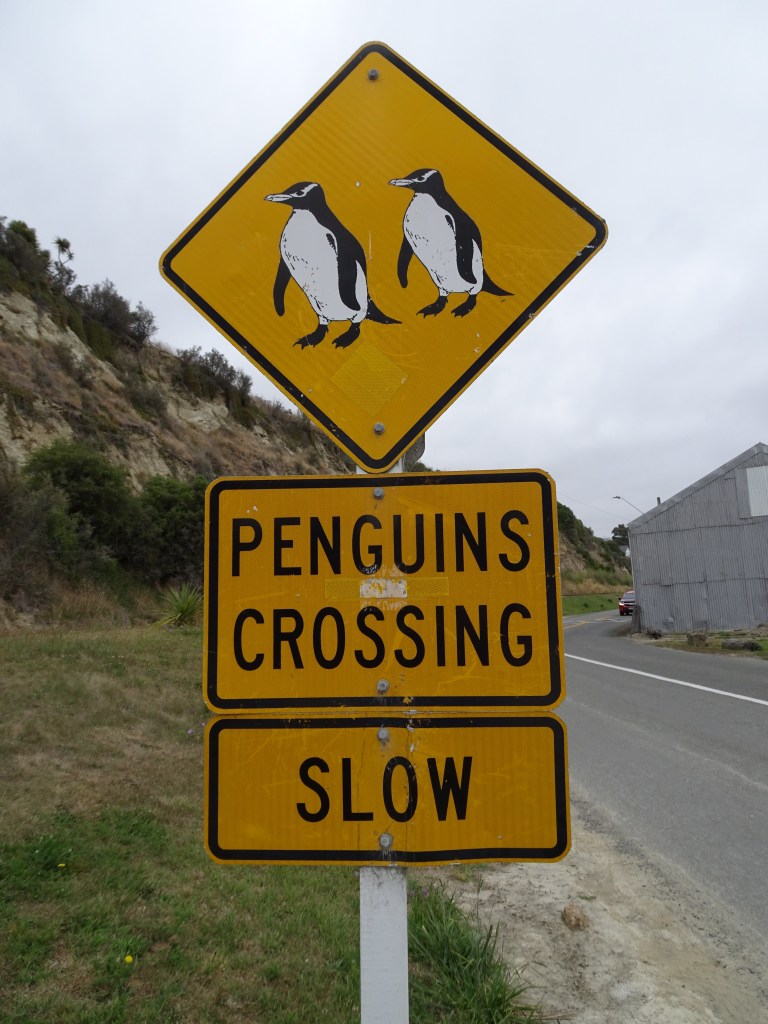
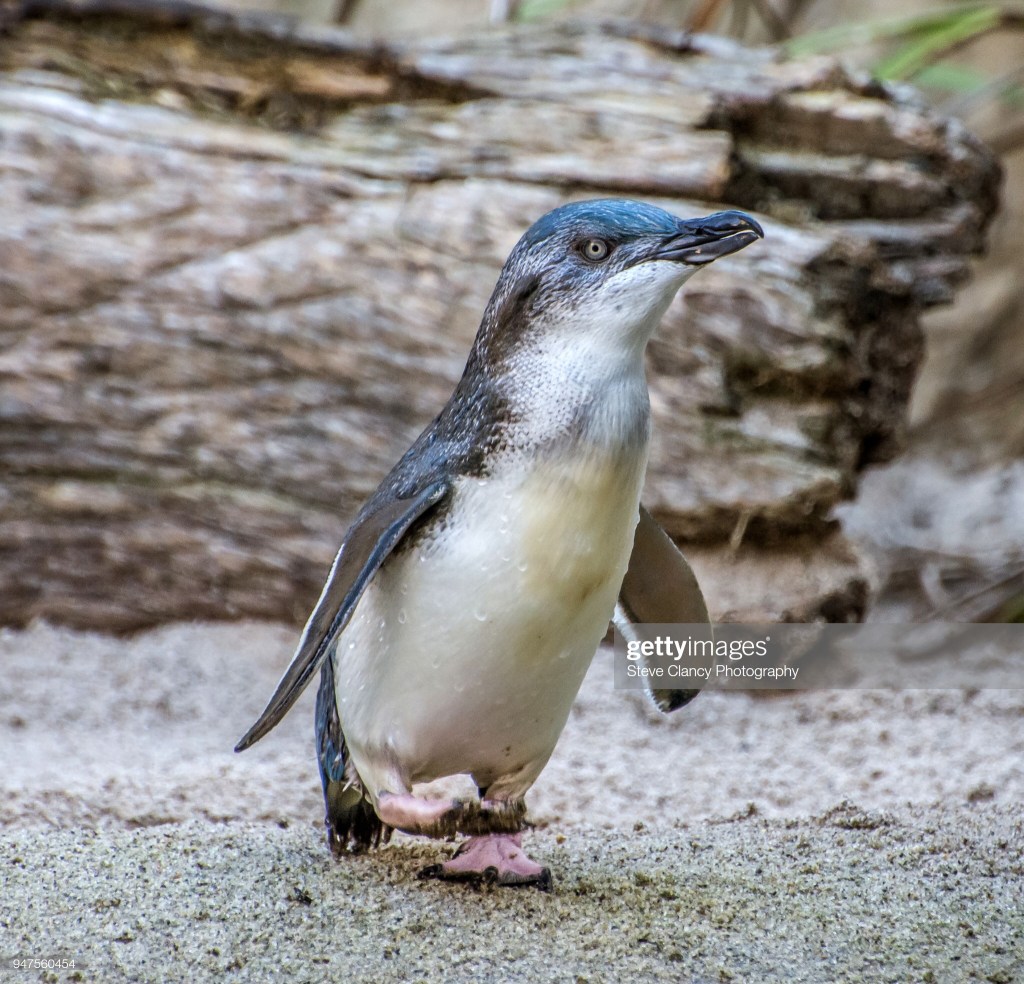
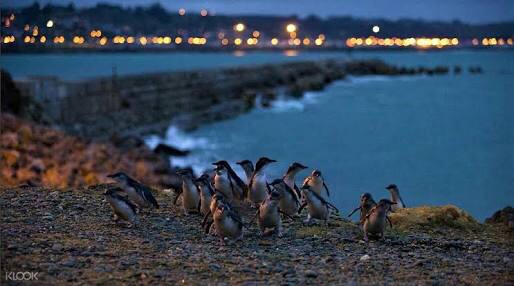
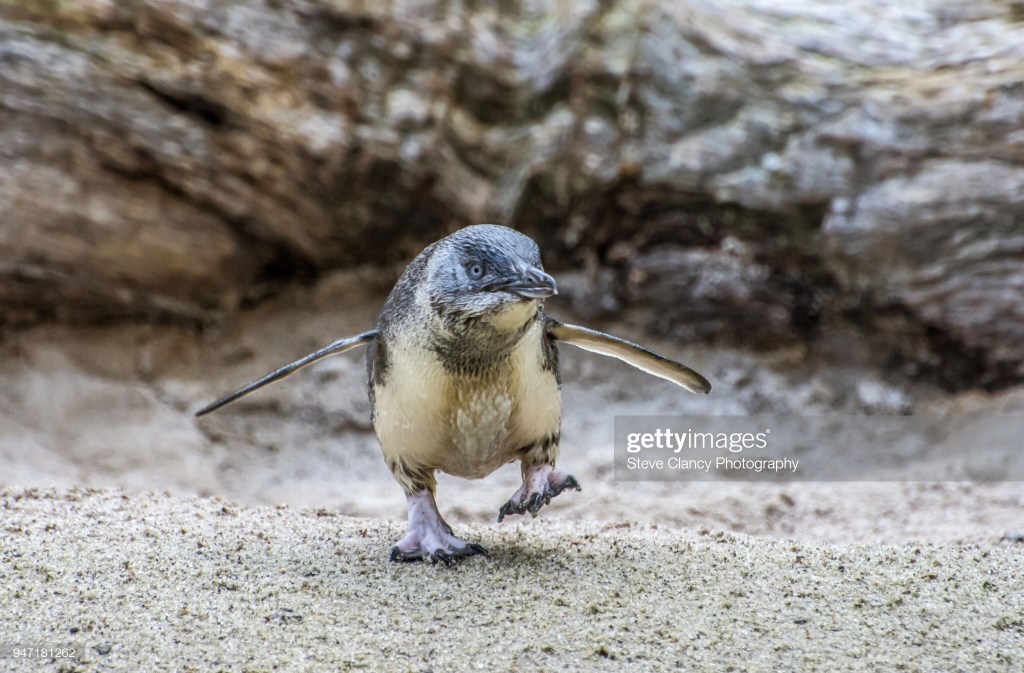
Oamaru is a tiny town on the coast, south of Christchurch, home to a colony of Little Blue Penguins. These penguins are endemic to New Zealand. (NZ is the only place in the world where they are.) Only about a foot tall standing, they are the smallest penguins in the world. There are several colonies around NZ, and Little Blues are the most common penguins here. What makes the Oamaru colony unique is the way that it is managed, and how successful it is.
The penguins were first noticed here in 1992, when this rocky beach was a rock quarry. People in the community, the Department of Conservation, and advocates for birds and wildlife pushed for the area to be set aside and put in the public trust. Now it is run by a private organization, Tourism Waitaki. (Waitaki is the region here.) The government has nothing to do with it. Protection of the penguin is its primary goal. Long-term viability of the colony is also a priority. The organization monitors and cares for wounded or ill penguins, traps predators, and generally keeps the birds safe on land so they can continue living and breeding here. The population is now growing about ten percent per year.
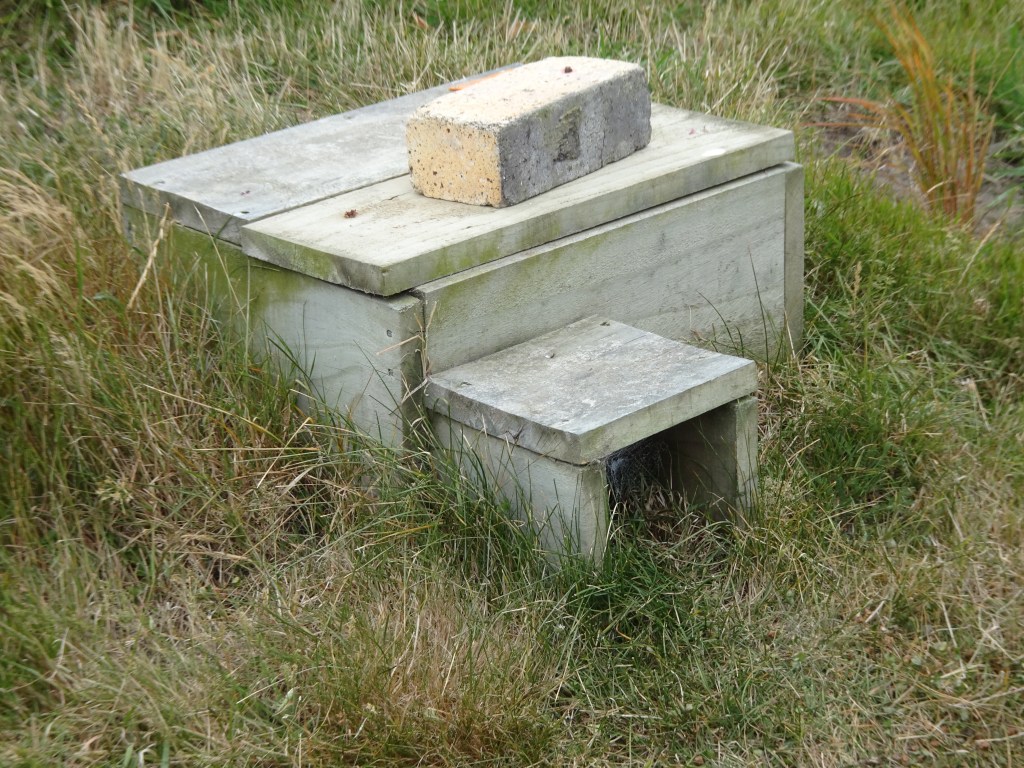
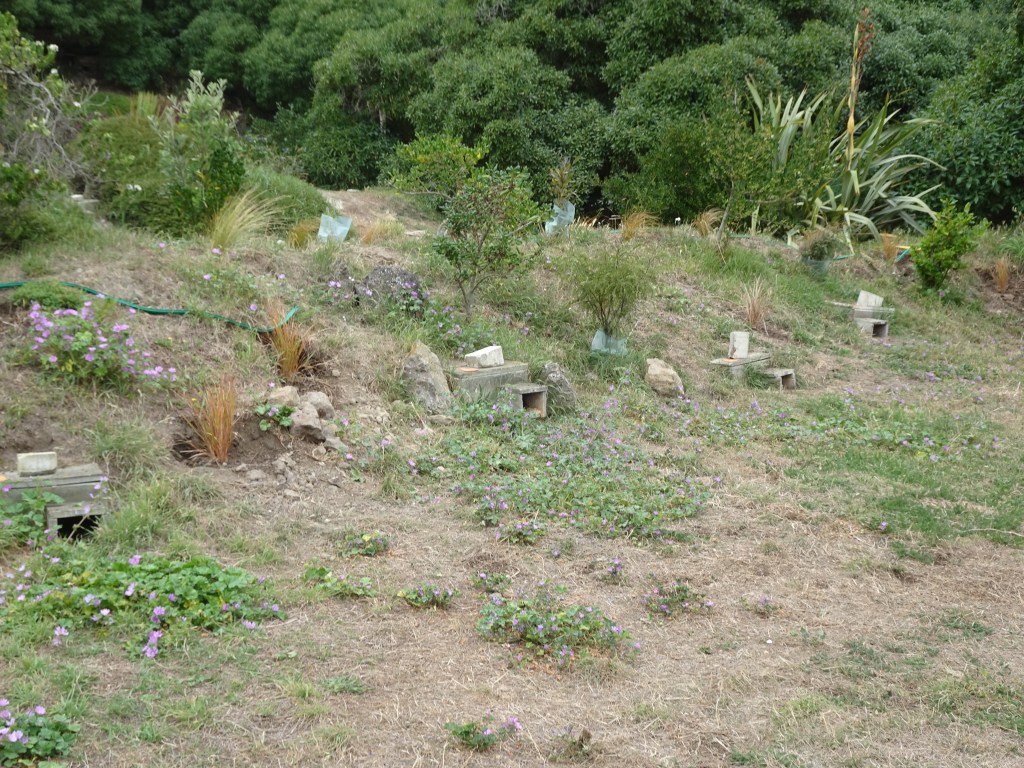
The organization has built nesting boxes above the beach in the hillside, and the penguins have eagerly adopted them. They stay in the boxes during the night. They lay their eggs in the boxes, and the chicks stay in the boxes until they are ready for the ocean. The boxes were built by volunteers, and the organization uses the money from the tourism to fund research and maintenance.
Every morning before sunrise, they leave their box and head to the ocean. They spend all day in the ocean, swimming and diving for food. The only times they don’t go to the ocean is when they are guarding the chicks, or when they are molting their feathers. Besides that, every single day of the year, year after year. It is a tough life. Every night they come back from the ocean, climb up the rocks, and crawl into their box. Each penguin goes back to the same box every night.
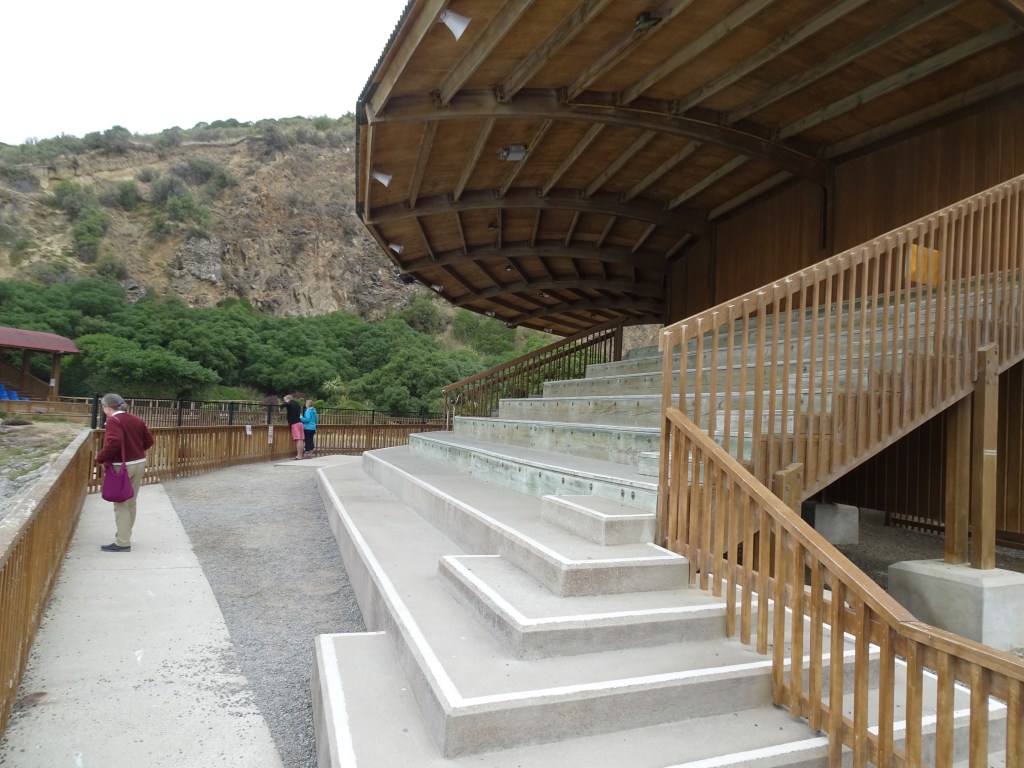
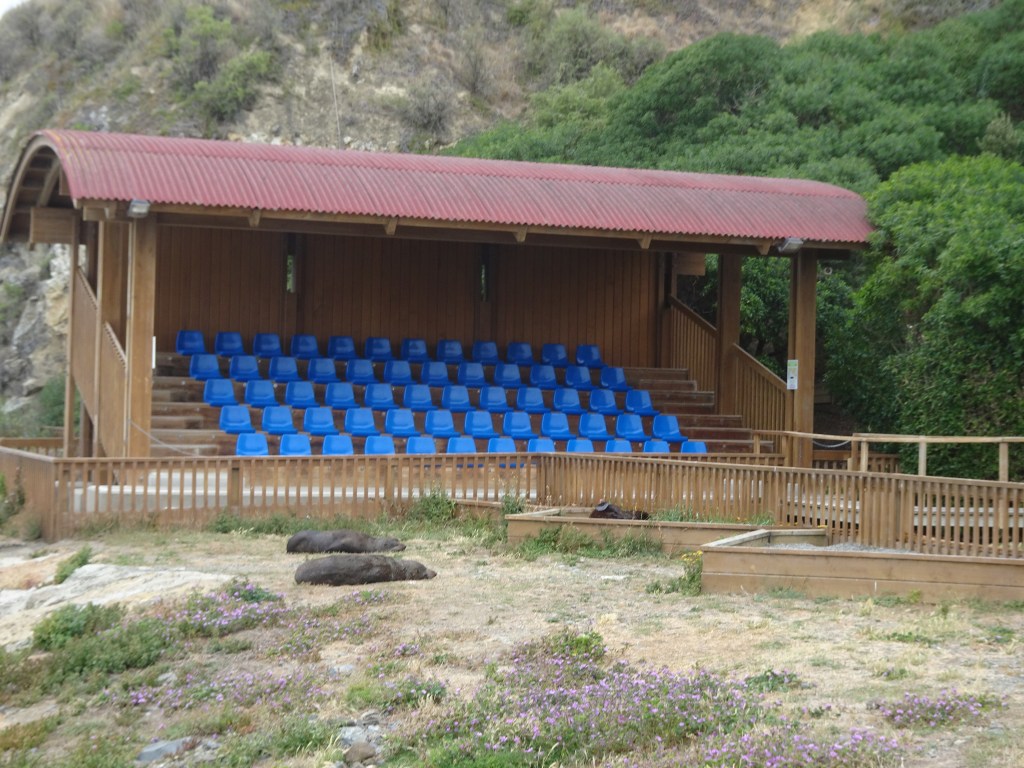
We bought tickets and went to the penguin show. The tickets were $25.00 each, and we showed up at dusk, took a seat and waited. Ninety percent of the people in the stands were Chinese, owing to the fact that we were there during Chinese New Year, and lots of people in China have a couple of weeks for travel. A curator gave a talk in English, and another curator gave a talk in Mandarin. They explained that the penguins come up every night, and they preen and oil their feathers, they cool off and dry out, and they make their way to their night-time homes. We waited and waited, and then they started arriving. This is the show.
The viewing stand.The penguins walk up just below where Monica is standing.The Premium Seats. They cost fifteen dollars more. The penguins are closer.
The area is lit with orange sodium lights, and the penguins cannot see this color in the spectrum. So, to us, they are in the light, but to them, everything is pitch black. The spectators are warned to be quiet, to stay seated, and above all, no photography. No phones, no cameras. The goal is to be as non-disruptive as possible. A little difficult, with 435 people there watching. And the penguins did seem like they knew something was there, the way that they furtively made a break across the open land. But they probably do that no matter what, because they know how vulnerable they are out in the open.
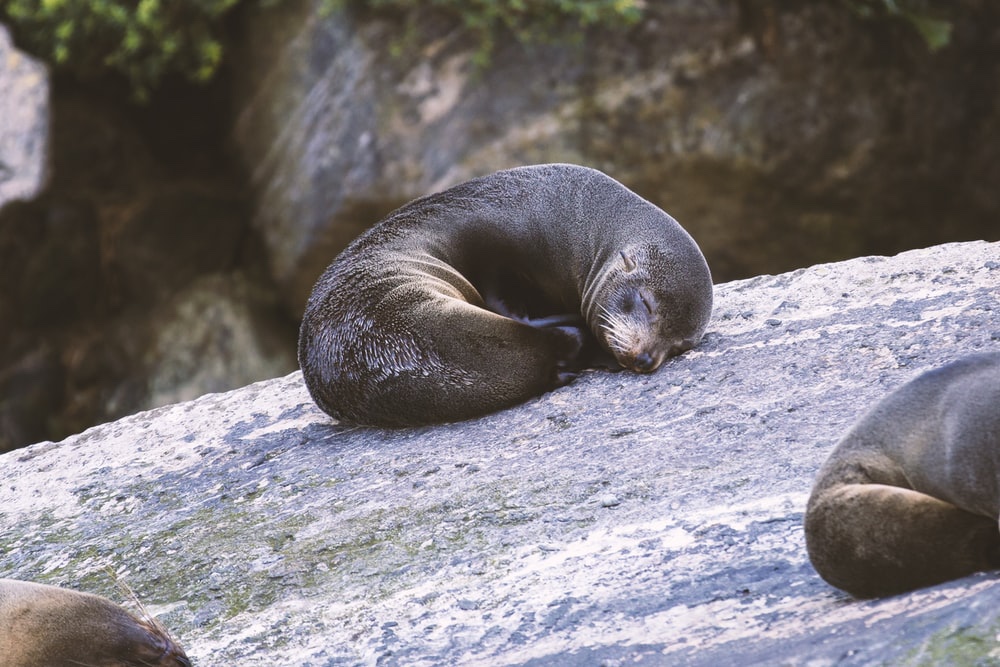
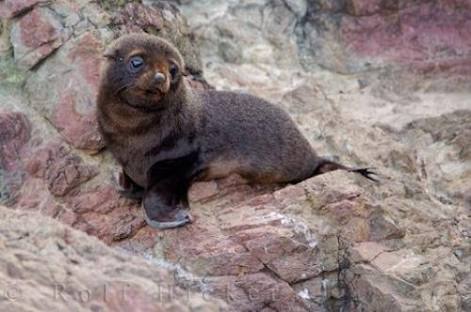
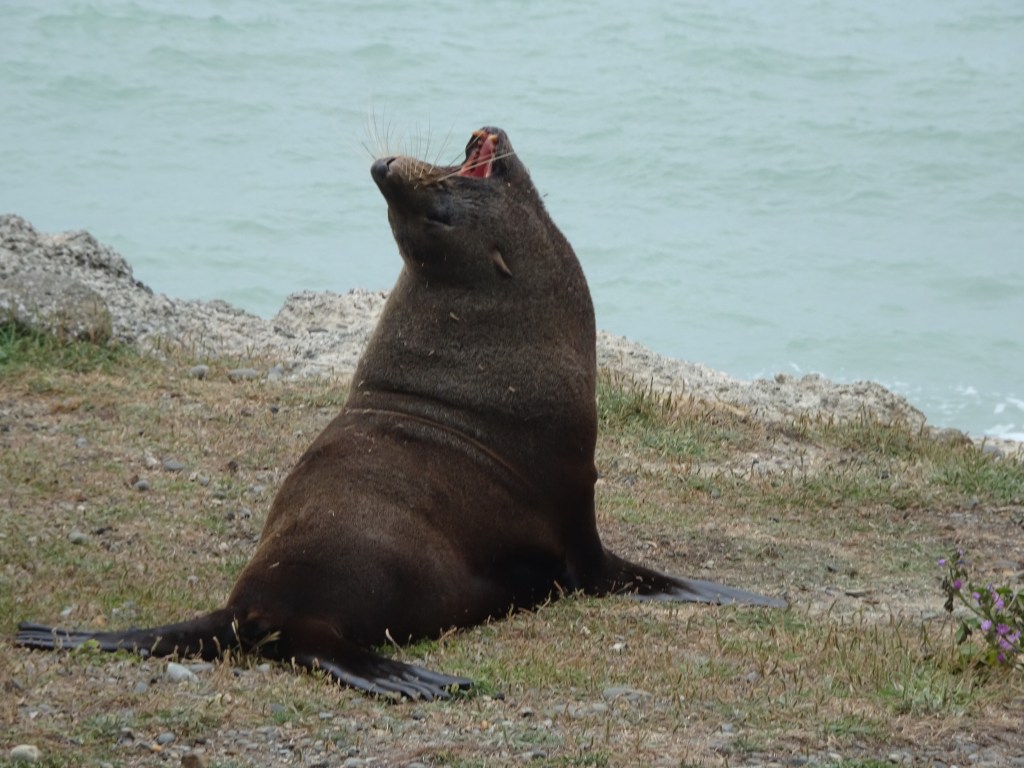
There are 350 nest boxes here. There were 61 chicks distributed in those boxes. Where there is a chick, one parent stays with it, and the other goes out and hopefully brings home dinner for the chick. Then the next day, they switch places, and the other parent goes out. The penguins in this colony have had microchips implanted in them, and a marine biologist and her team can keep track of who goes where. The penguins feed their chicks, but they do not feed their mates. This area is also used by Fur Seals. These animals are more like sea-lions than seals, because of their ear flaps and back flippers, but more the size of seals. The penguins sometimes have to walk right past the seals, but the seals don’t bother them. We saw the birds walking within six inches of the seals.
The whole evening was an amazing wildlife event to witness. At first, while we were waiting, it seemed quite strange. Nature is not supposed to be this predictable. It’s like going to Yellowstone and asking the ranger what time they turn on the geyser, because I have an appointment at 2:15, and I’m in a hurry. It was like waiting for the movie to start. But——they showed up, just like we were told they would. The waves were crashing, and the penguins surfed onto the rocky beach and then jumped, clambered, and waddled their way up the rocks, through the field, and then through the tunnel under the walkway to where their nests were. Everybody was captivated. The only other instance I can think of, of wildlife performing on a schedule, is waiting for the Vaux’s swifts to swirl like a tornado down the smokestack. We were told to check under our car before starting it up and heading out, because penguins sometimes like to take harbor under them. They also walk right through town at night. Penguins and people co-existing.
Yellow-eyed Penguin
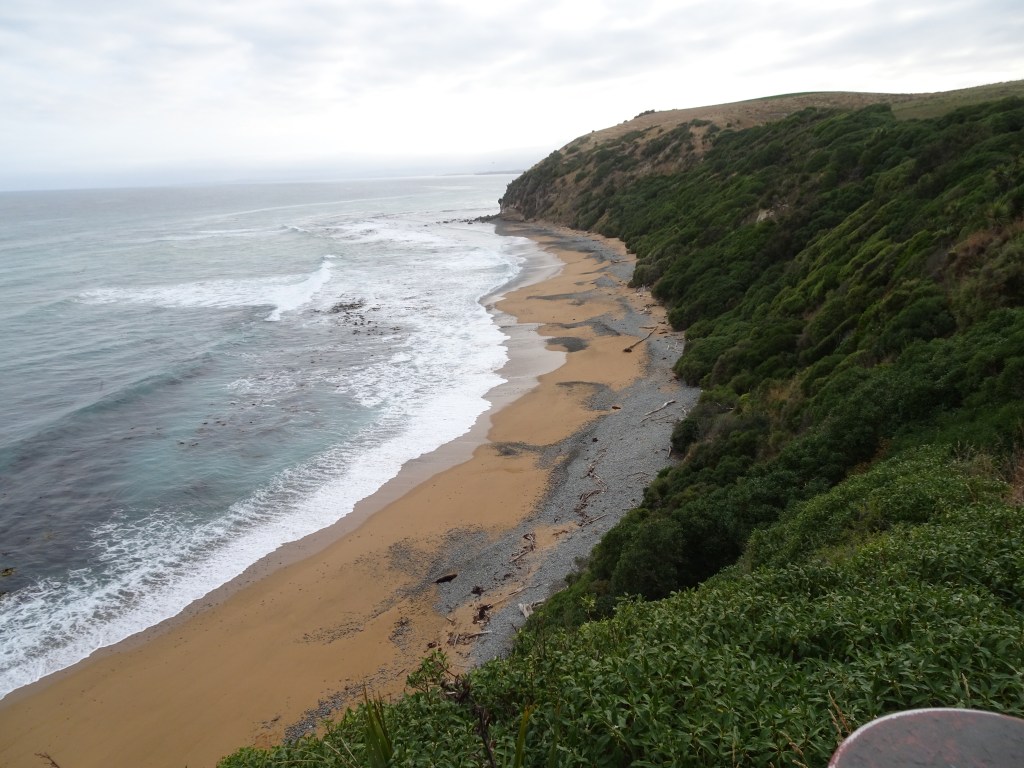
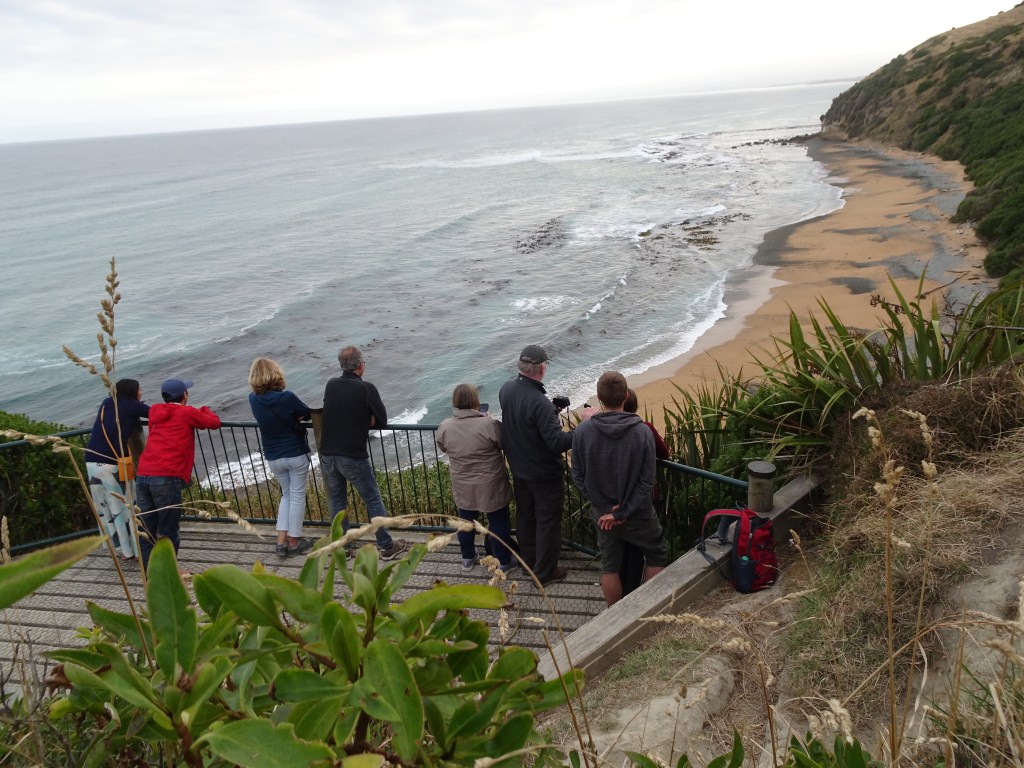
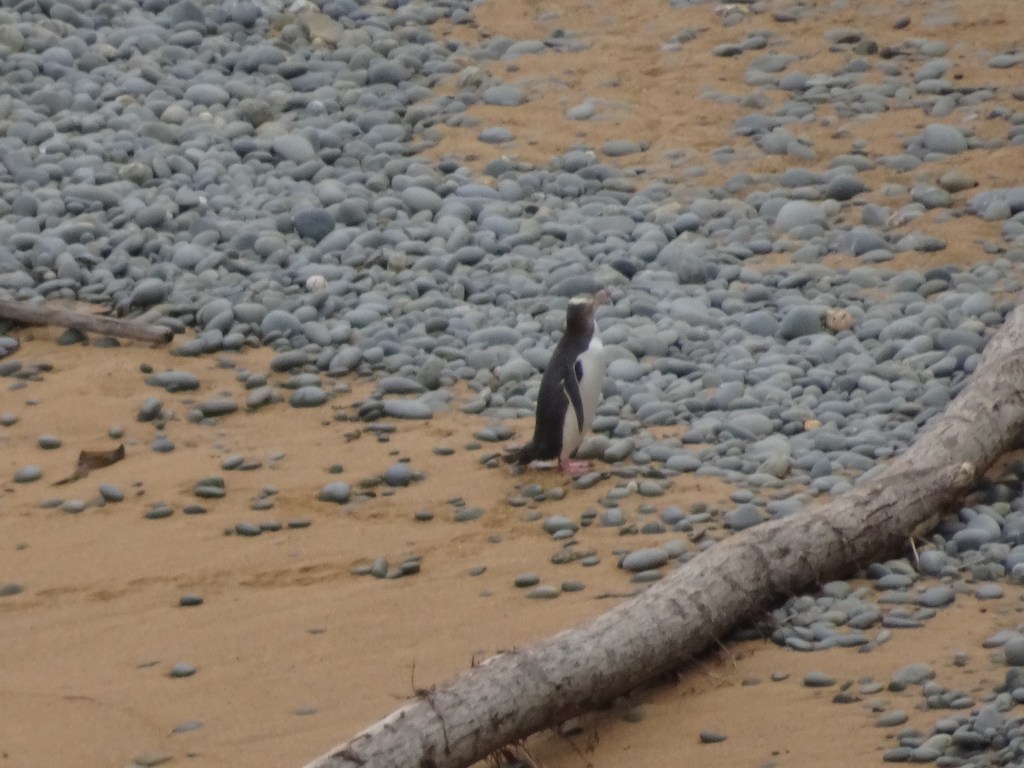
There is another species of penguin in Oamaru. The Yellow-eyed Penguin. This is a very shy and solitary penguin that comes ashore at a beach just south of town. The beach is closed to people at 3:00pm every day, to allow the penguins to have the place to themselves. Every evening, a few individuals come up to nest in the bush. There is a viewing station way up on the hill, and you can go there in hopes of spotting one or two. One afternoon, we saw two individuals saunter out of the ocean onto the beach.
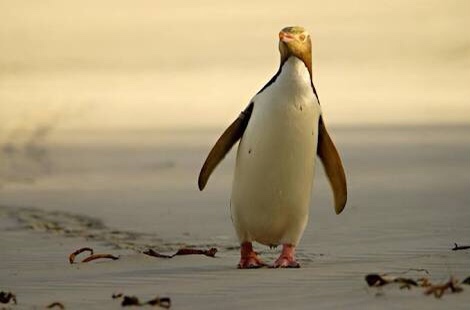
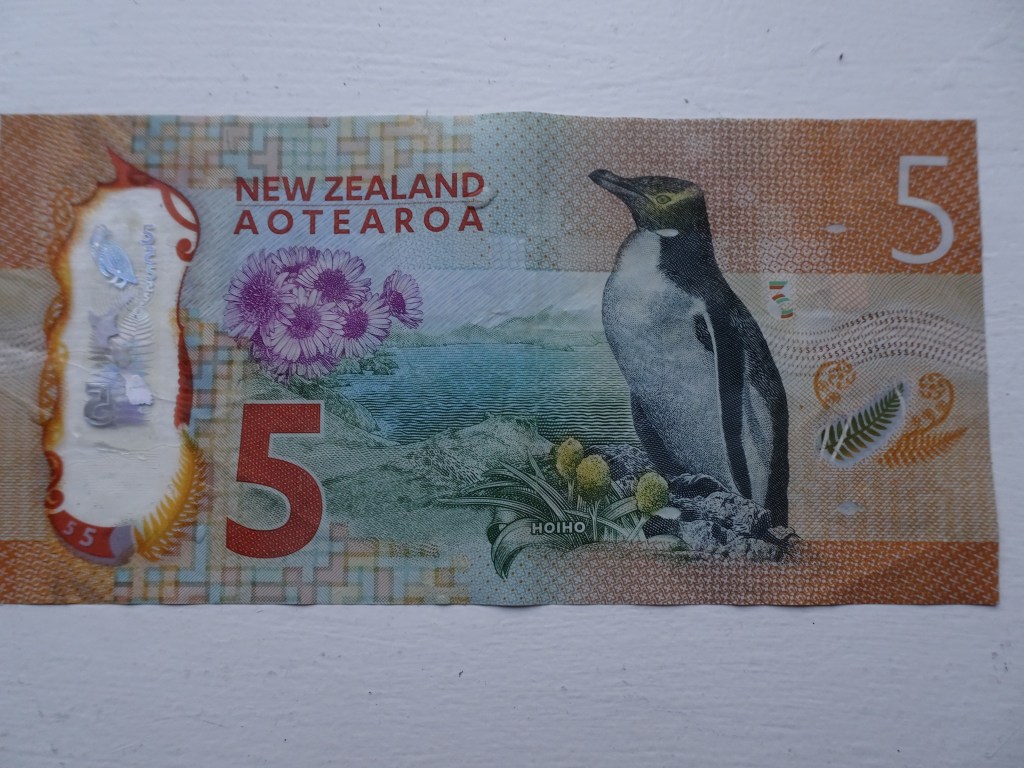
Bushy Beach from the viewing platformThe yellow-eye is on the five-dollar bill. Hoiho is the Maori word.
Steampunk
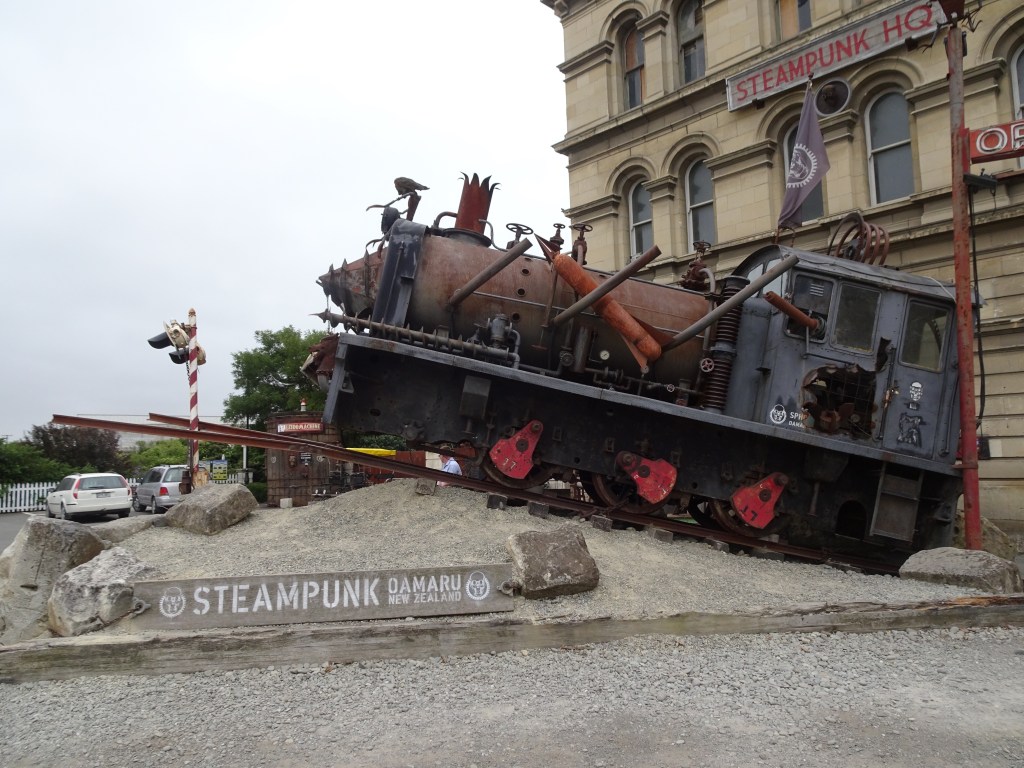
The other thing that Oamaru is known for is Steampunk. Steampunk?? Yes, Steampunk. It bills itself as the Steampunk Capital of the World. Steampunk is defined as “the retro-futuristic (I love that word) sub-genre of science fiction that incorporates aesthetic and technological designs of nineteenth-century steam-powered machinery.” It is definitely off-beat, and Oamaru is proud of it. The streets of massive Victorian limestone buildings from Oamaru’s heyday in the 1880s form the ideal backdrop for Steampunk. We have not learned the actual history of how setting and genre met in this perfect match!
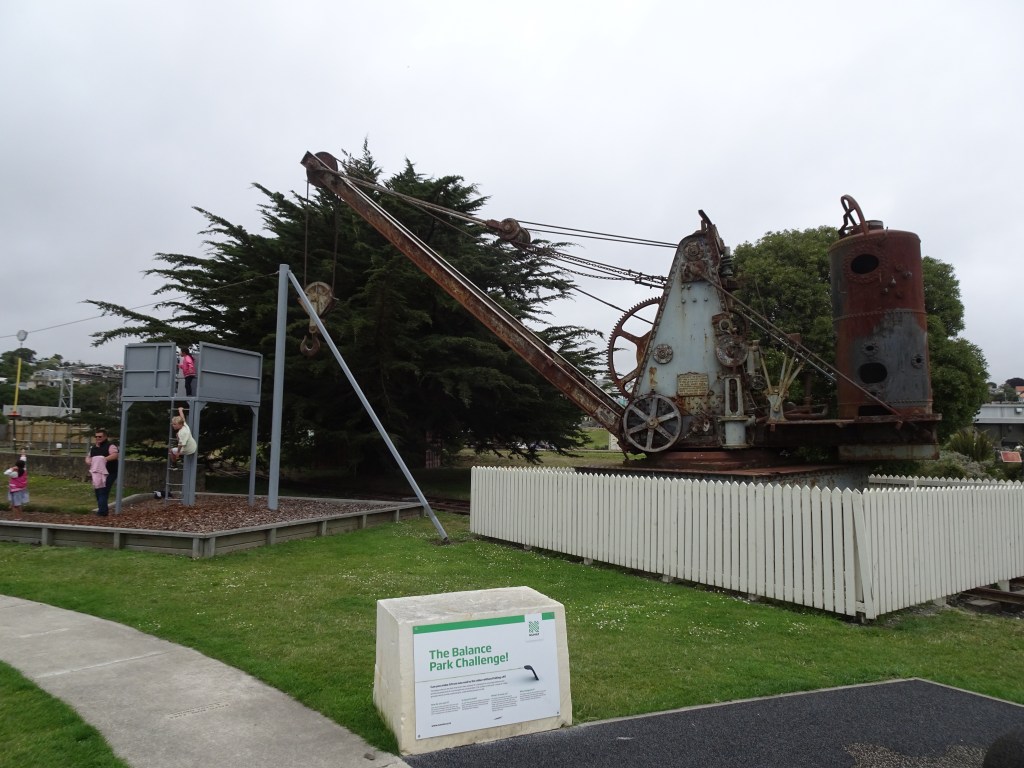
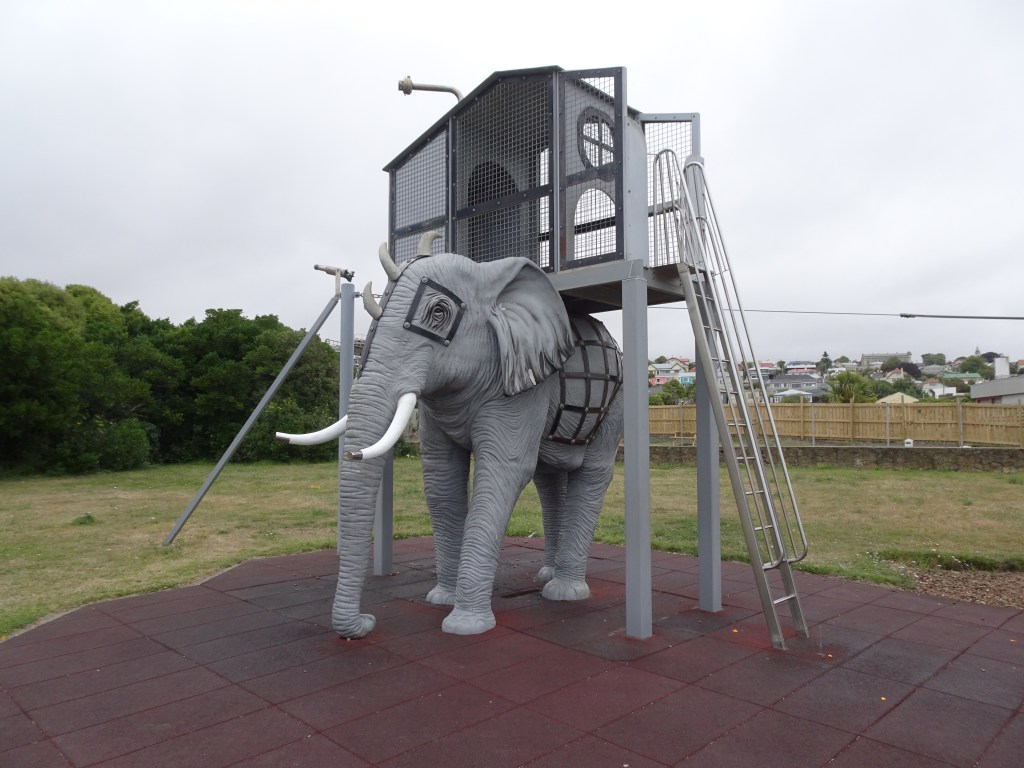
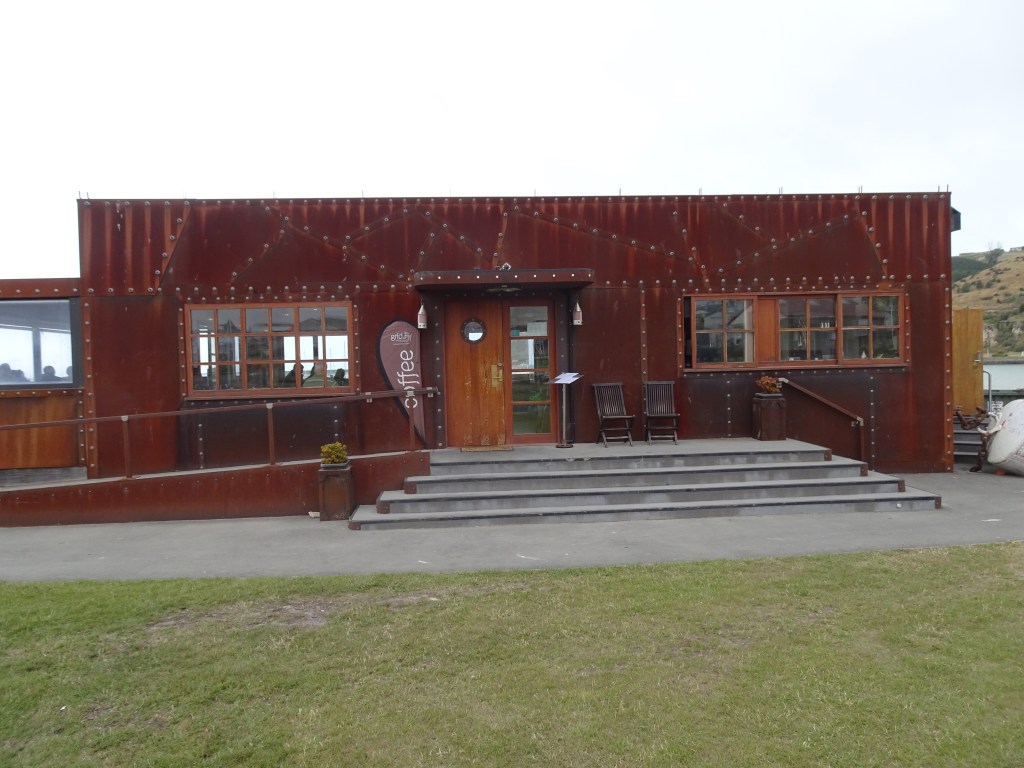
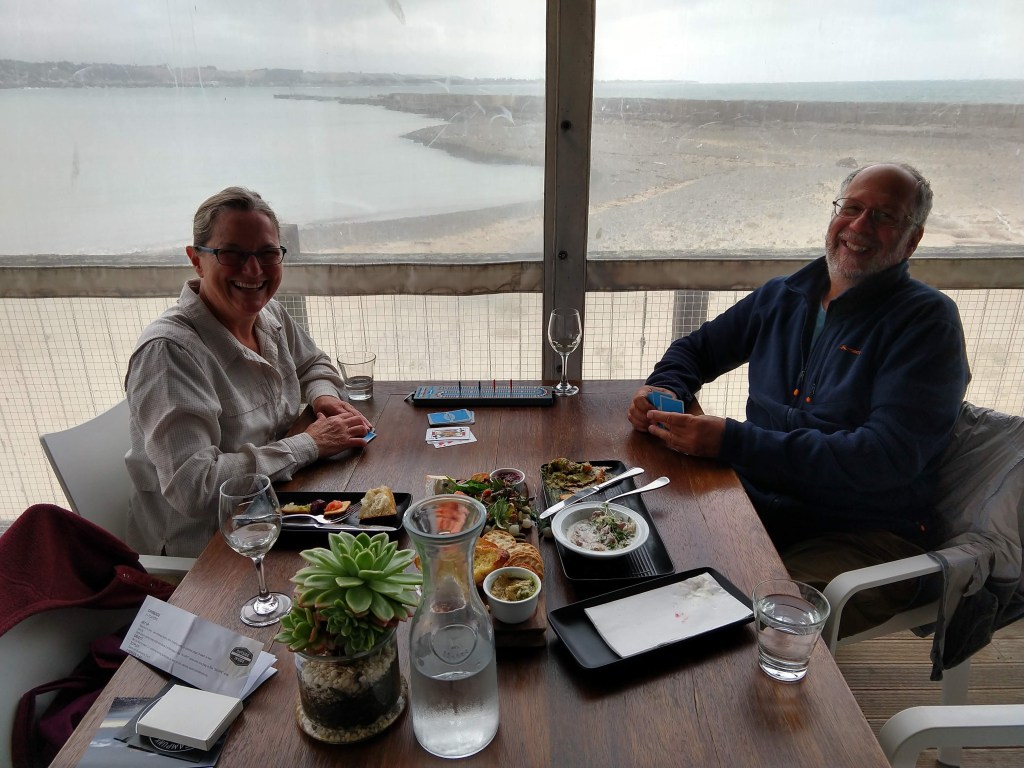
Steampunk HeadquartersSteampunk PlaygroundSteampunk ElephantSteampunk CafeCribbage by the ocean. Tomorrow we head into the mountains.
It’s hard to overstate how badly Christchurch was devastated by the earthquake in February 2011. There was an earlier quake the previous September which structurally damaged a lot of buildings, but all in all did not cause much harm. Then, at noon on February 22, the city was hit hard. The epicenter was five miles from the very center of downtown. 185 people died, 115 of them in one building that collapsed. Two years later, a full seventy percent of the buildings in the city had been demolished because they were unsafe. Liquification of the sediments underground had happened. Sludge (liquified sand) poured through fissures. All the water pipes broke. The city was leveled. Ten thousand people moved away.
The Canterbury Earthquake Recovery Act (CERA) was founded. Its purpose was to oversee the big picture, to create a vision, to plan how Christchurch wanted to regenerate itself. The directors of this project saw it as a once in a lifetime opportunity. How often does a major city get the chance to completely redesign itself? Where banks and apartments and hotels and churches once stood, now was razed earth. Much of the downtown was “red-zoned.” This meant that nobody was allowed inside the Zone. After all the damaged buildings were torn down, people could return. The community was going to decide what the future city would look like. CERA operated for five years, until 2016. Then it morphed into another organization called Greater Christchurch Regeneration. This organization is still making decisions.
Christchurch is the largest city on the South Island. It’s really the only “city” on the island. The population is 400,000. More people live in Auckland, on the North Island, than live on the entire South Island.
Safe new buildings, green open spaces, wide avenues, public gathering spots
So———Where do you start? What are your priorities? What kind of city do you want for your kids? Do you want a dense downtown population? Where do you want the parks? Restore or start over? These questions were talked about, debated, even voted on. The citizens of ChCh have decided that they want to make their city one of the safest, most efficient, most beautiful, most modern cities in the world.
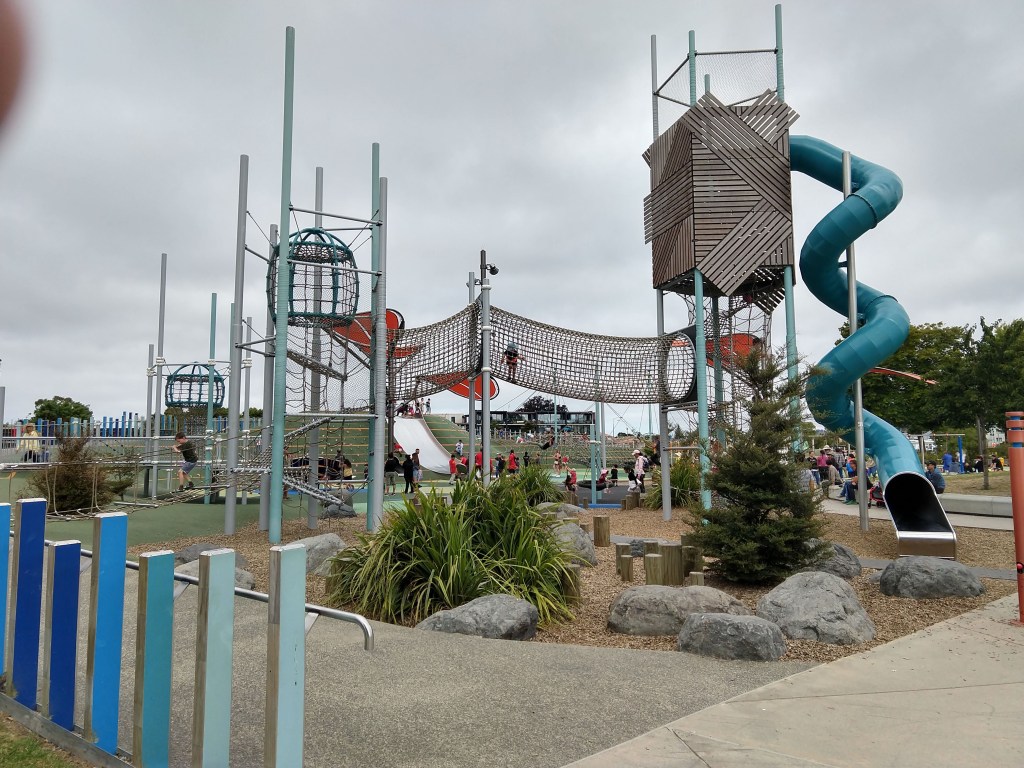
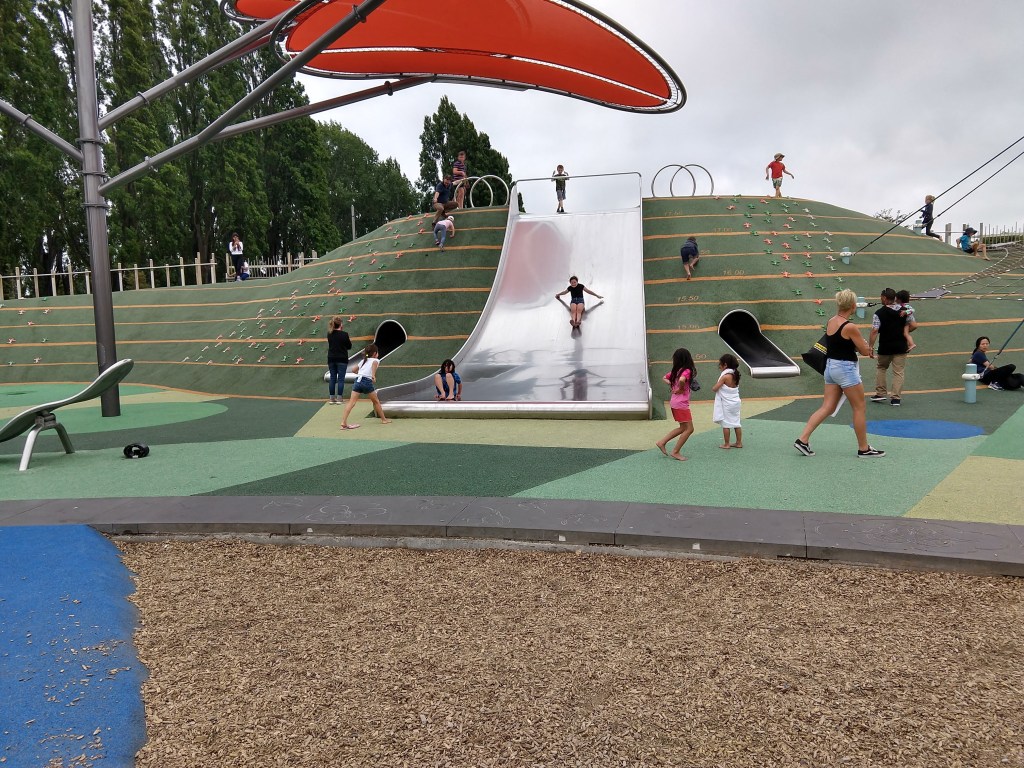
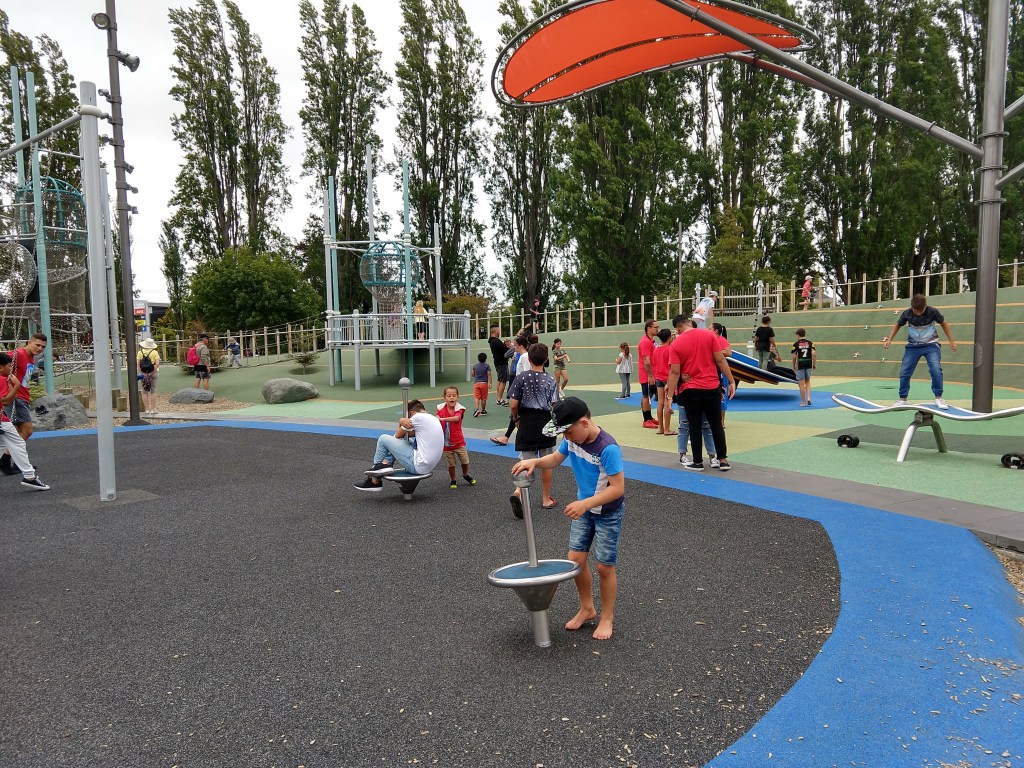
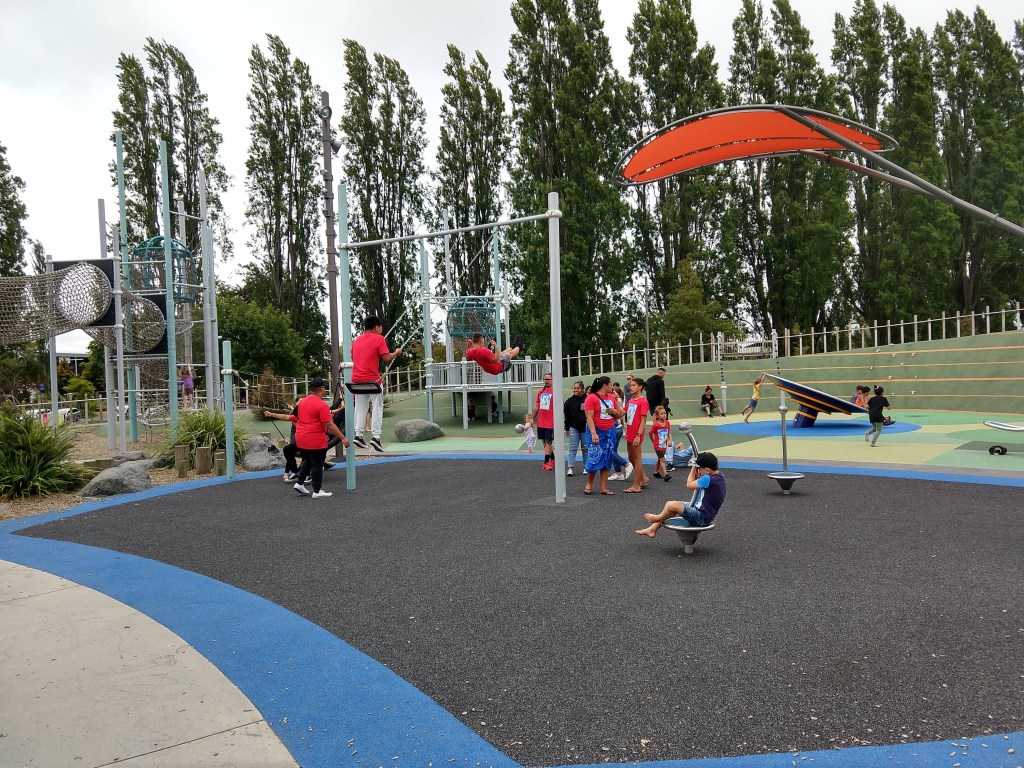
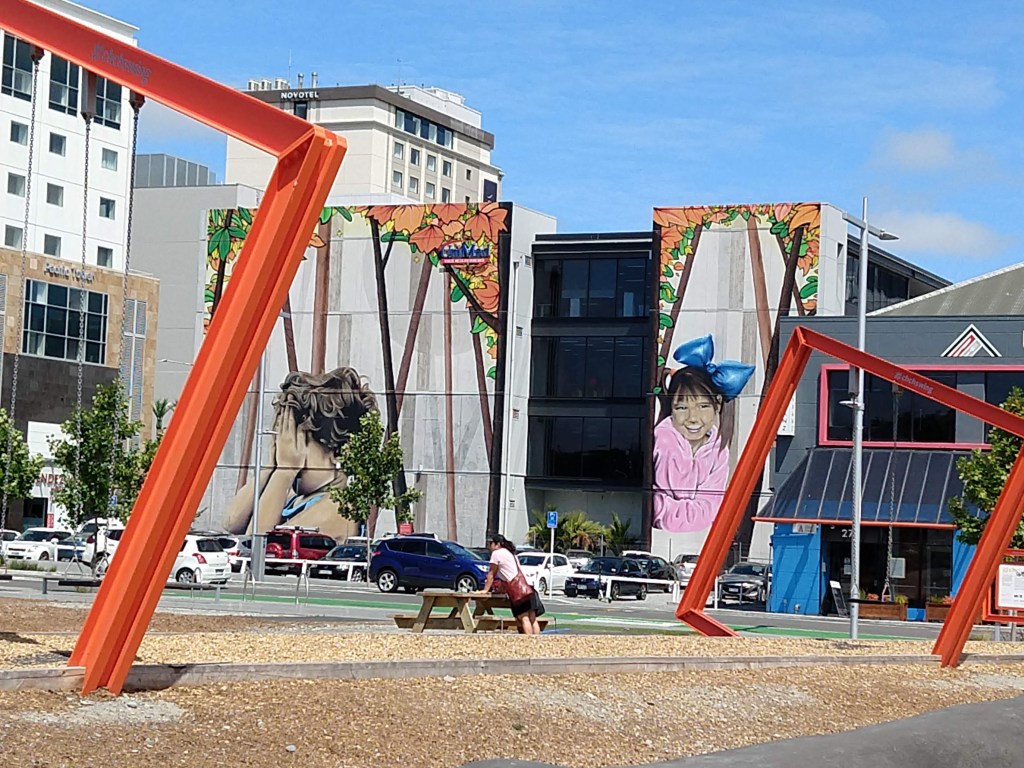
One of the first things they did was build the largest playground south of the equator. The Margaret Mahy Playground is named after a New Zealand author of childrens’ books. The playground is colorful and cheerful, designed not just for kids but for everyone. It brought, and brings, people back to downtown. It is good for families, for businesses, for hope and faith in the future.
Sturdy equipment—-even for the big kids.
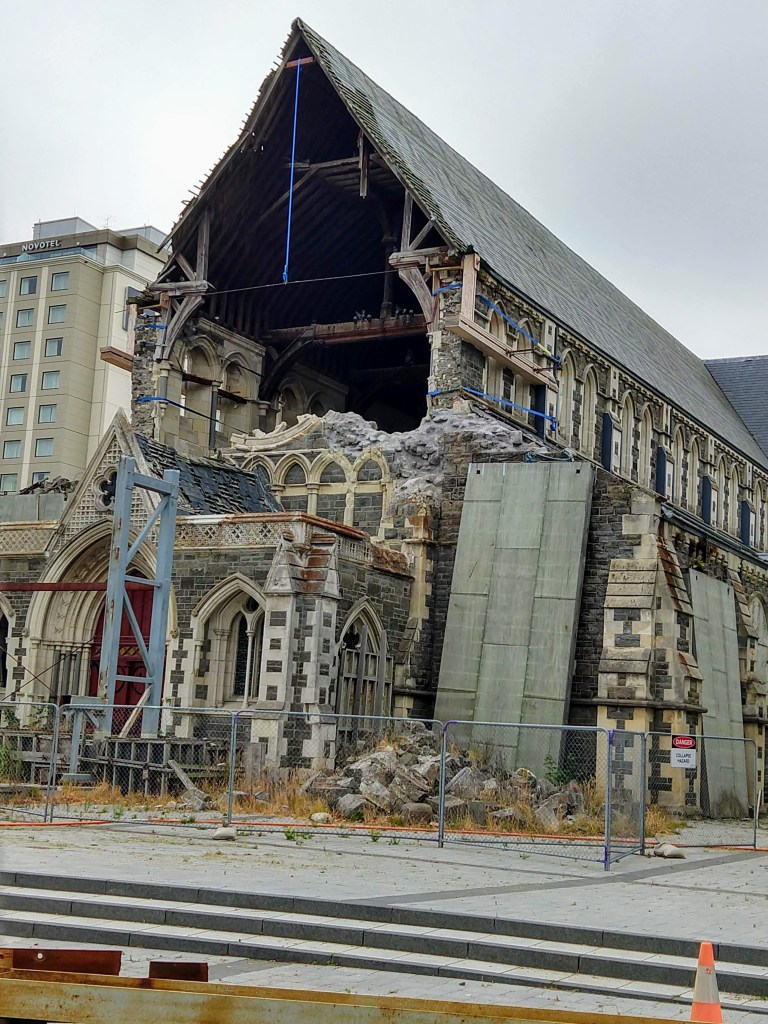
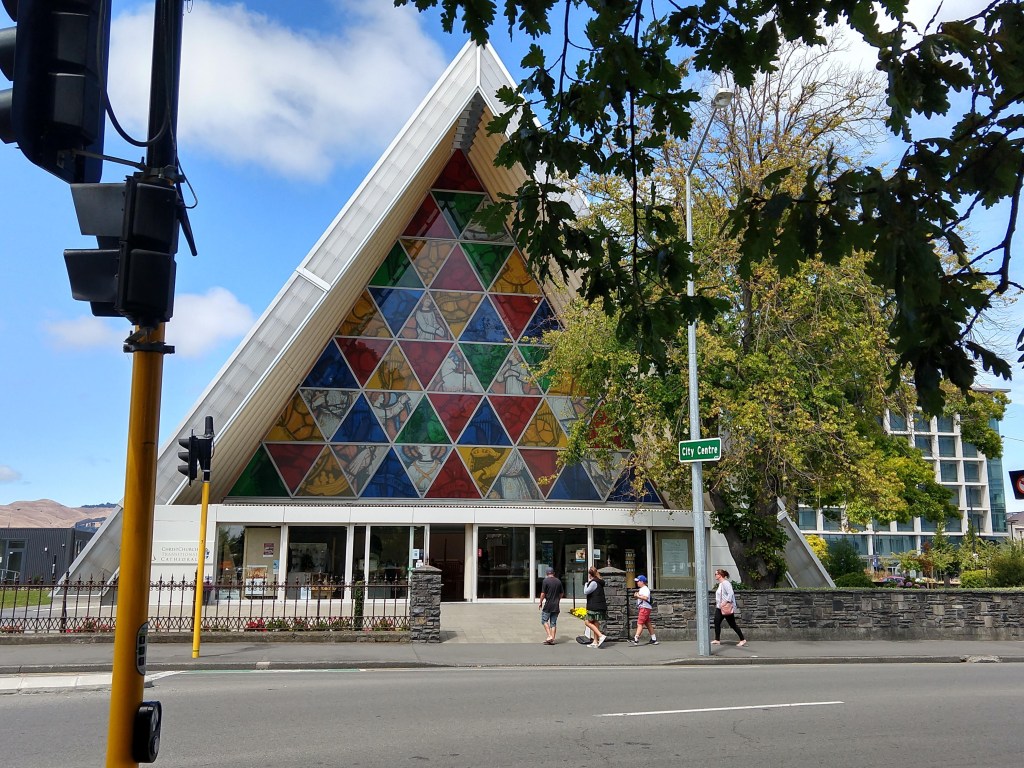
One of the difficult decisions was what to do about the Central Cathedral. It was a cultural heritage icon, right in the middle of the CBD, (Central Business District) and very important to the social fabric. It was an ongoing debate whether to knock it down and rebuild, or try to restore it. Finally there was a vote, and just last year it was decided that the community would restore it to as close as possible to how it used to be. In the meantime, they built a Transitional “Cardboard” Cathedral made of actual cardboard and shipping containers and reusable material, designed to be temporary.
The Cardboard Cathedral
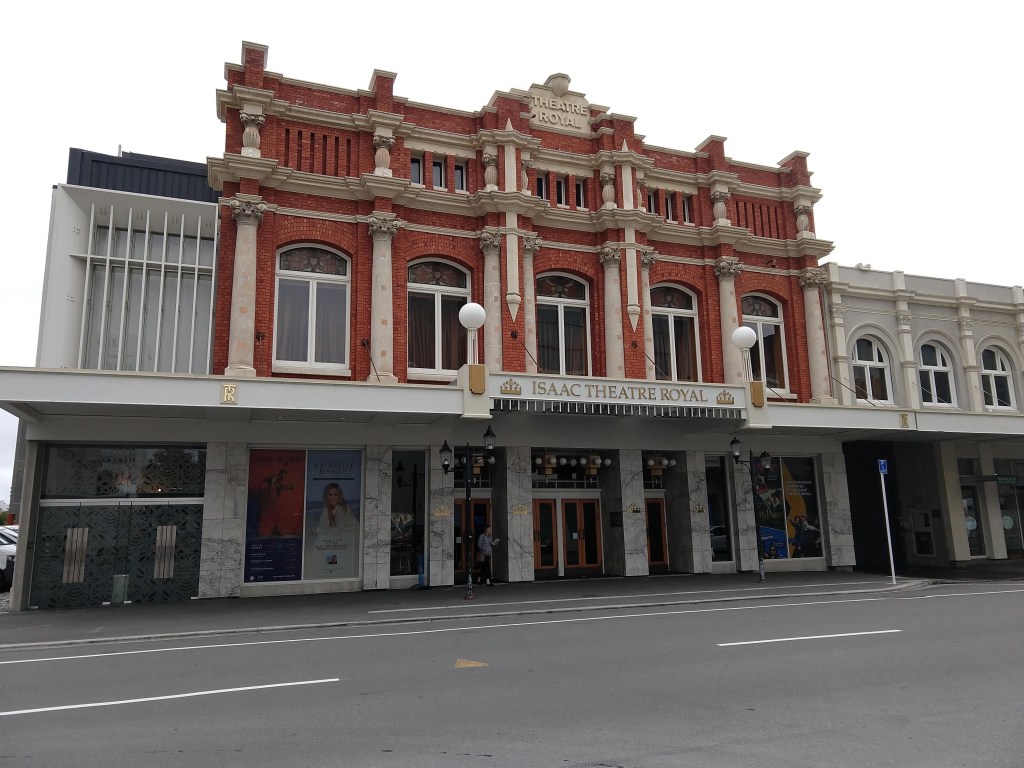
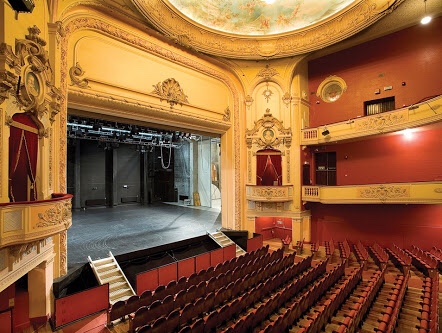
Another big restoration project was the Isaac Theatre Royal. The theater is also downtown, just a couple of blocks away from the Cathedral. It opened in 1905, and has been the main performing arts venue in the city ever since. It was a grand, majestic theater, and it was ruined, then painstakingly restored to its original grandeur.
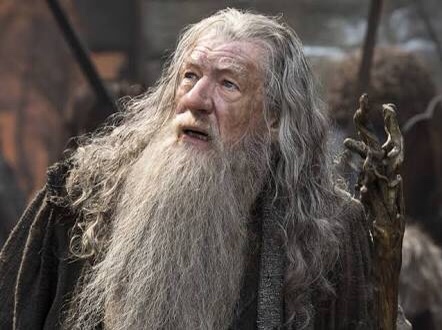
Gandalf Helps
The earthquake hit while The Hobbit was being filmed in New Zealand. Sir Ian Mckellan became one of the major donors who contributed to the restoration. He performed 31 one-man shows around the country, and donated all the money to the theater. After the stage was rebuilt, the high dome was lowered and completely re-done. Workers faithfully reproduced all of the ornamental moldings, replaced all the seats, and now the theatre is more magnificent than ever. The restoration took three years.
We learned these details by stopping in the theatre box office to ask if we could look inside. Just by chance, the technical manager was in the house. Jack took us on a tour of the empty theatre, even into the royal box now named for Sir Ian, and explained the whole history of its restoration. What a highlight of our time here and yet another instance of the generous kindness of Kiwis.
From the Ground Up
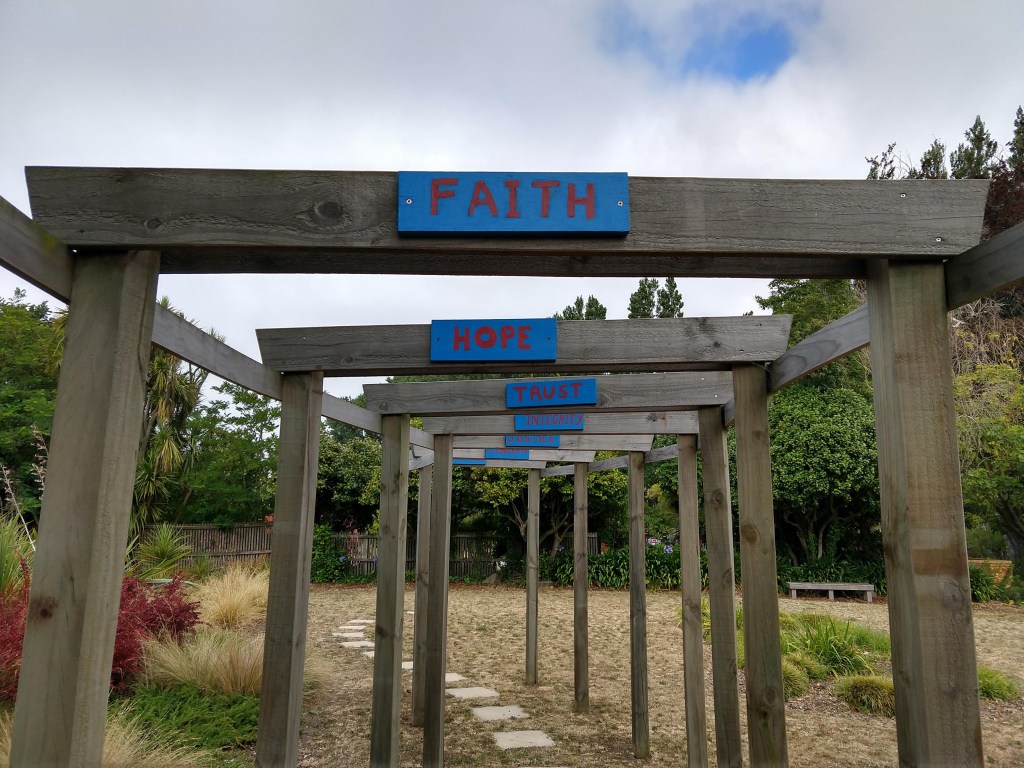
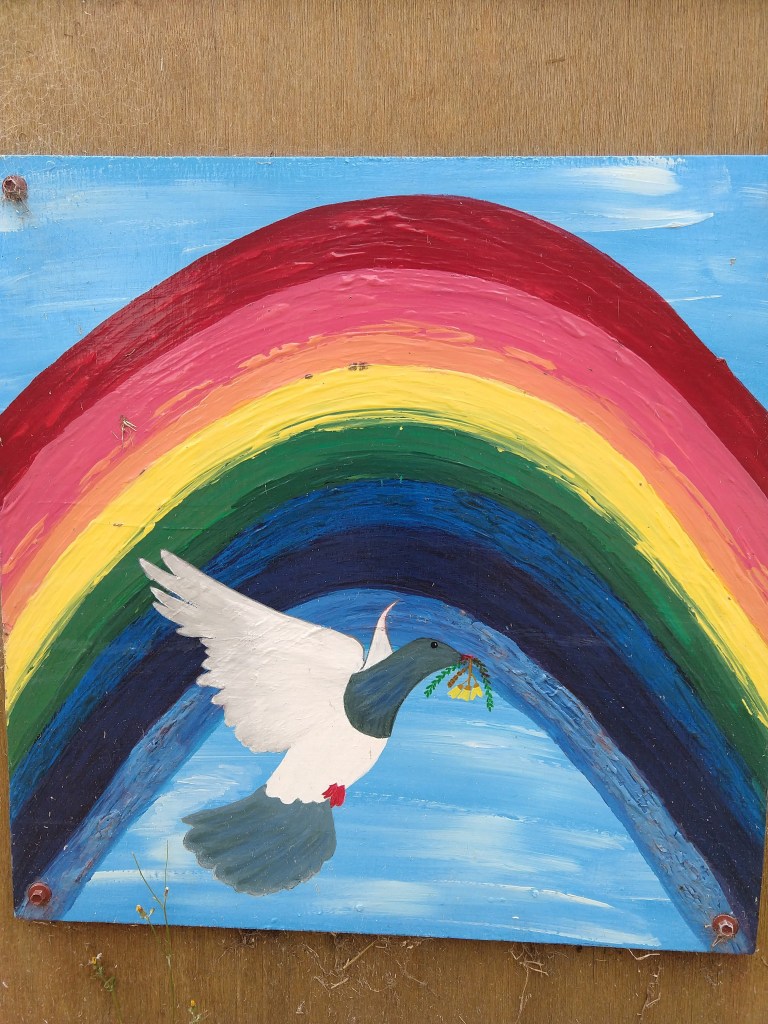
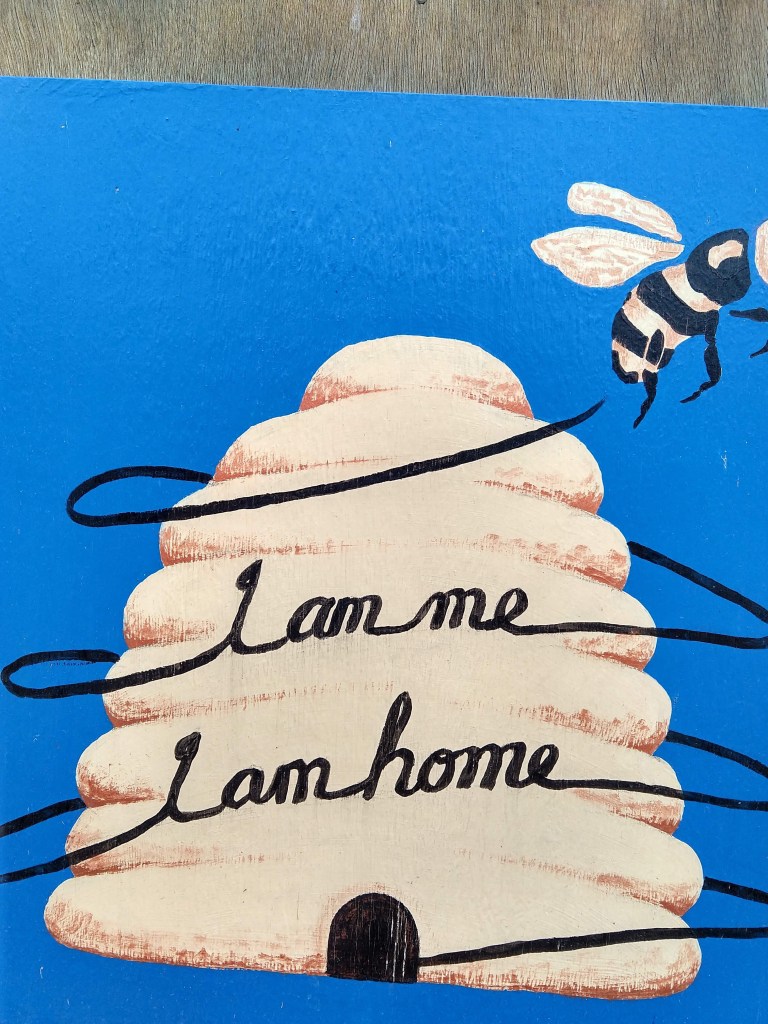
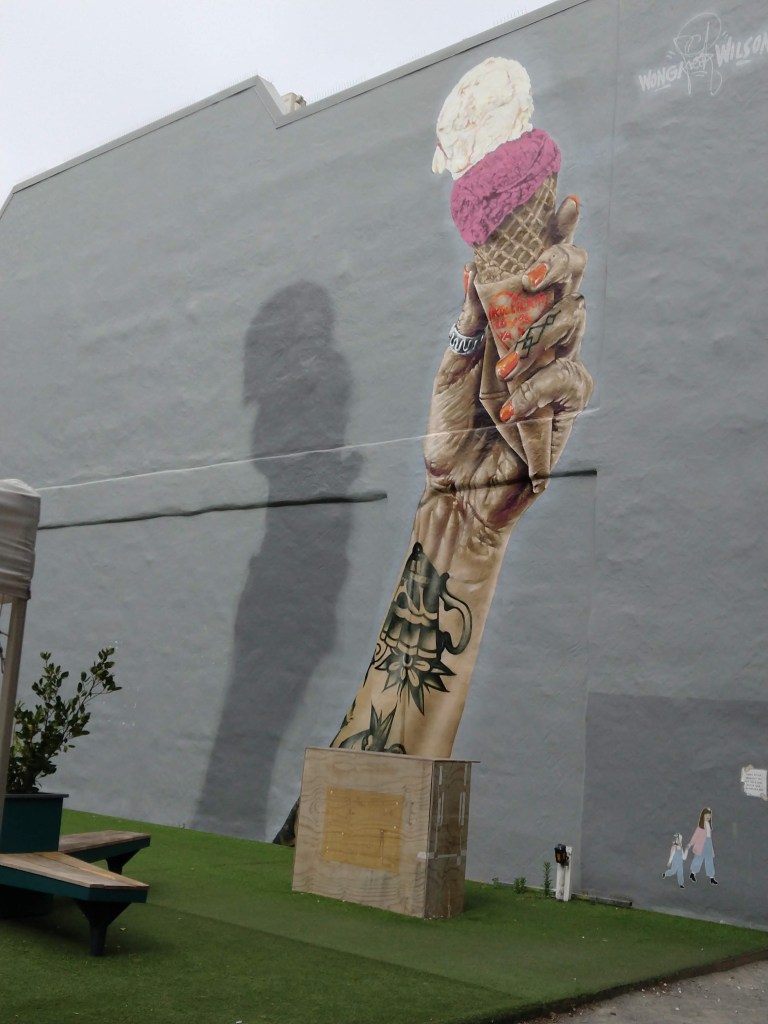
As the city was cleared out, all of a sudden there were large empty areas referred to as “Gaps.” There were also little gaps, little pockets of emptiness. An organization called “Greening the Rubble” started up, and it continues to use the small empty areas for pocket parks and public art.
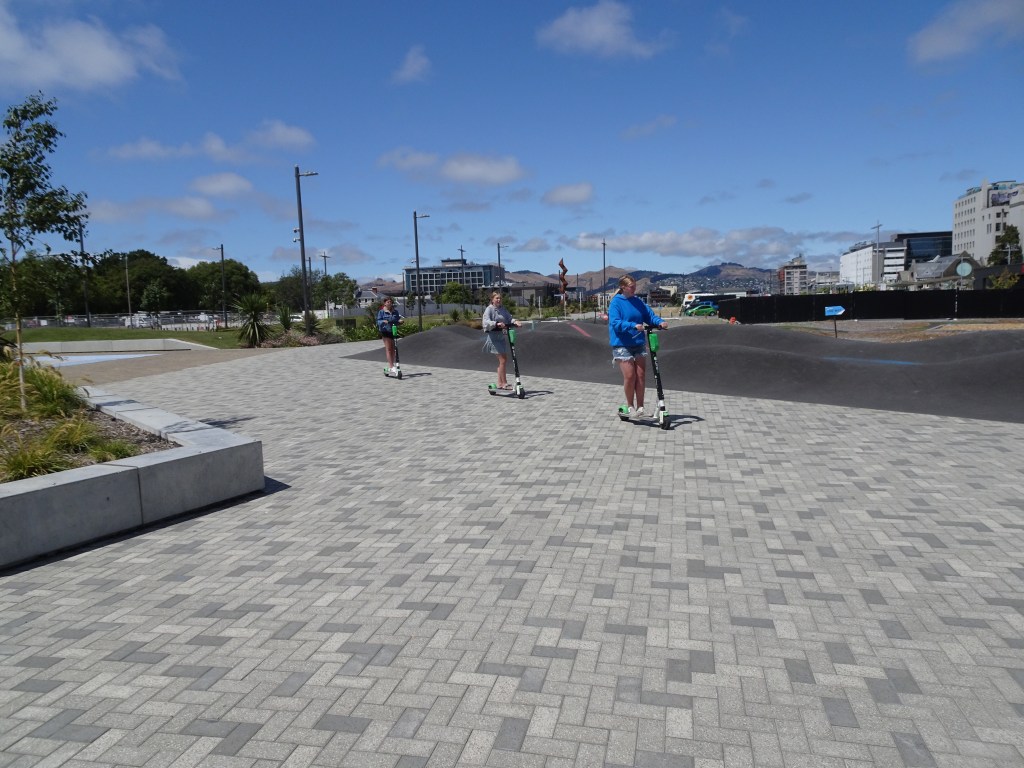
One large gap has started to be filled in. The first priority is for wide pedestrian walkways, public spaces, and trees. A public fruit orchard is in the works. Scooters are everywhere, and the wide walkways are designed with them in mind.
The wide walkways are the first part of the development.
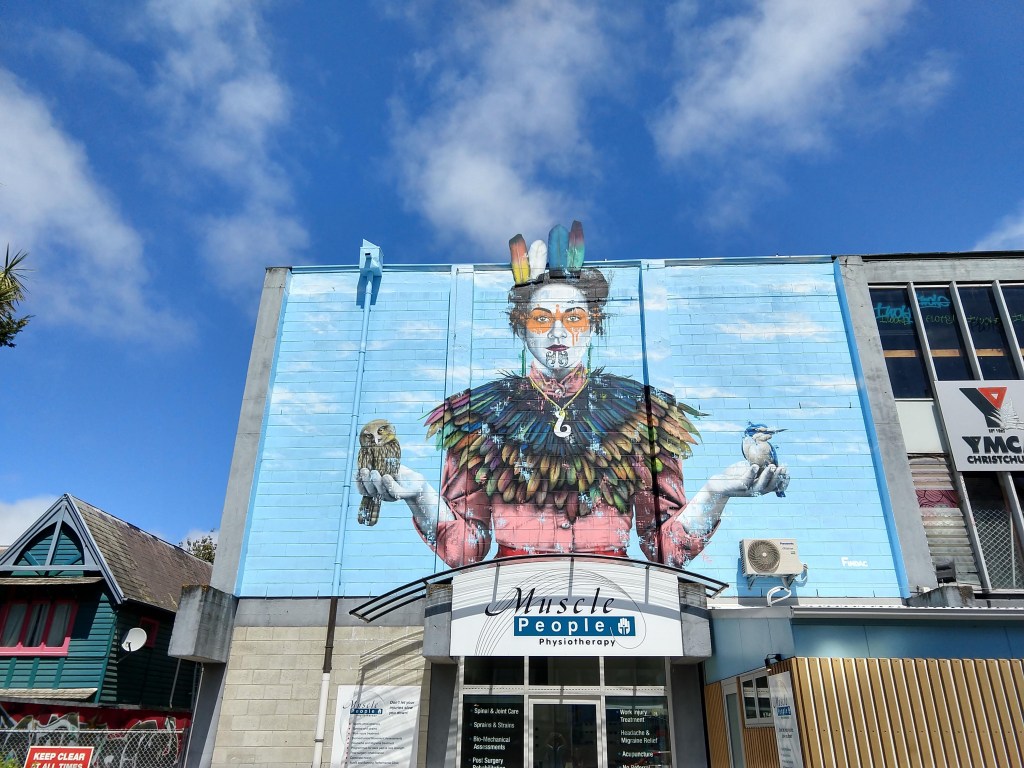
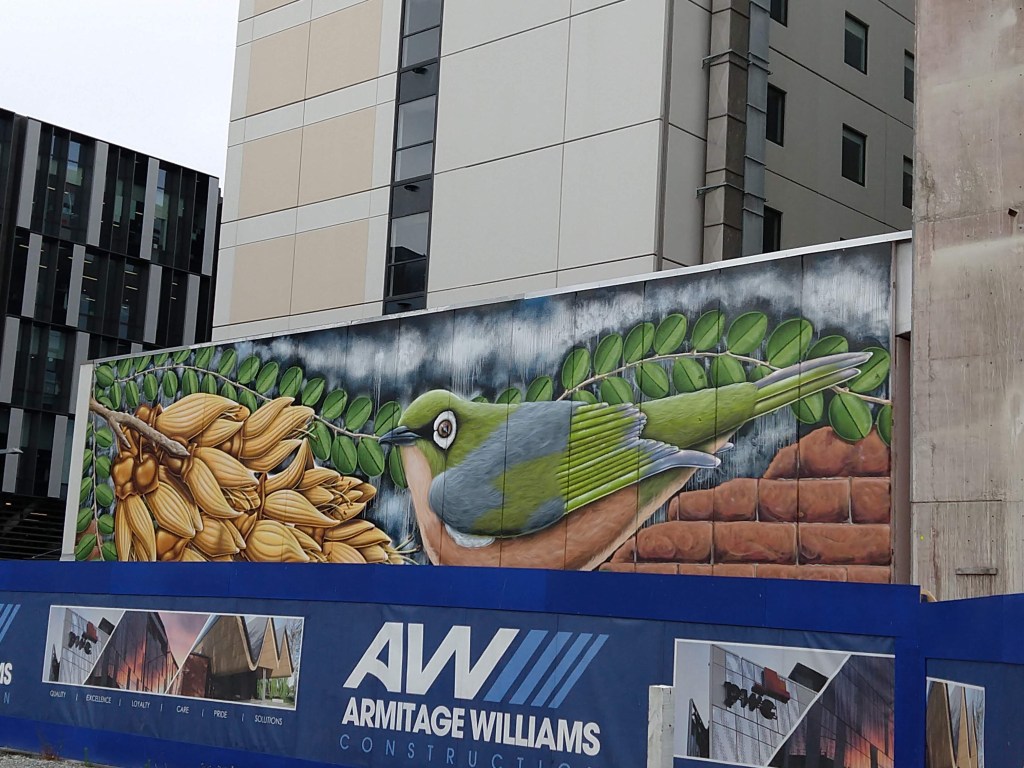
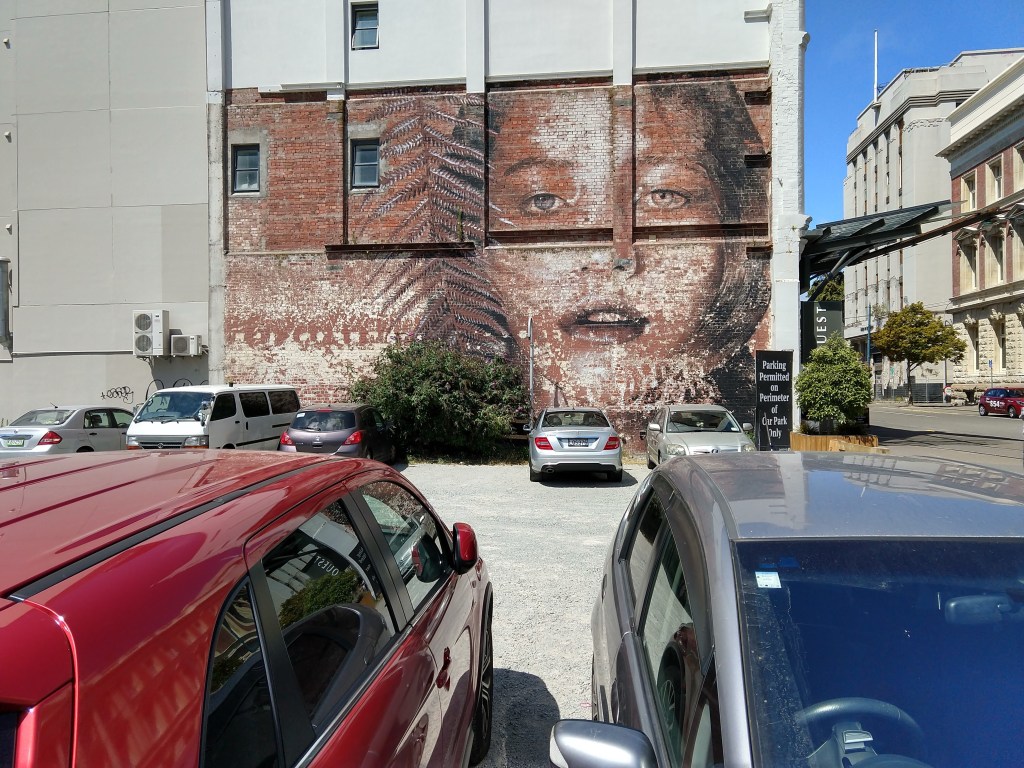
There will be no building taller than seven stories. One thing that that means is that there will be great views from the roofs of every building. There are lots of rooftop bars being planned. And public art is also an essential part of the new city.
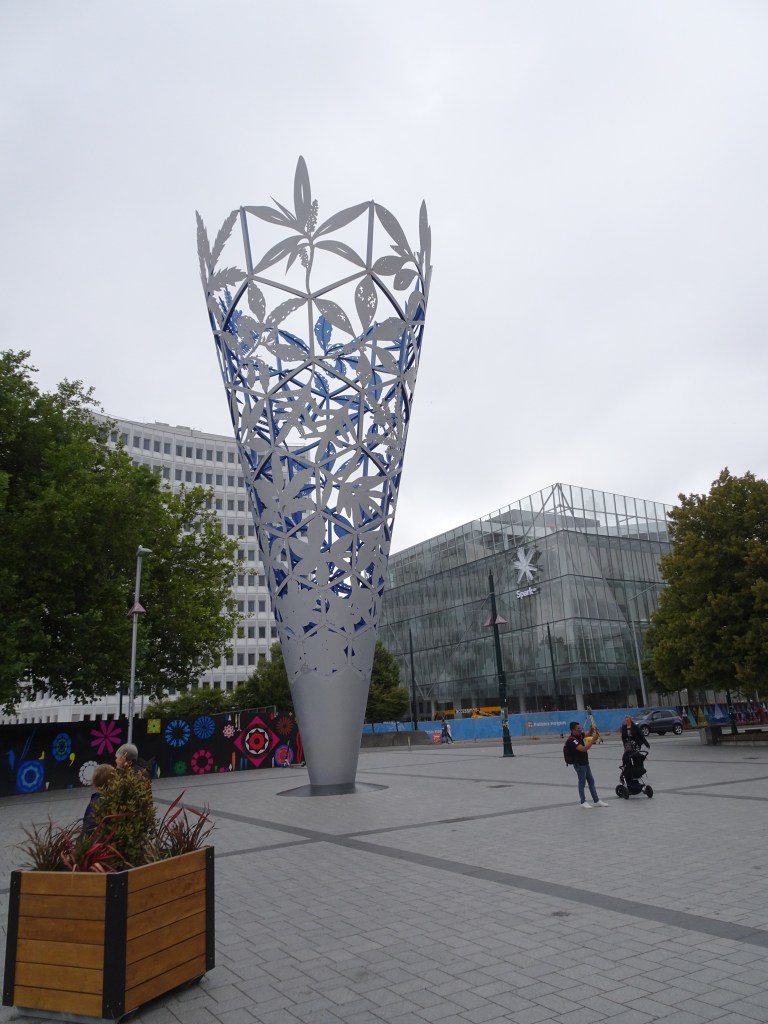
The Chalice, an icon of the city. This was installed in 2001, before the quake. It symbolizes abundance and hope.
Remembering
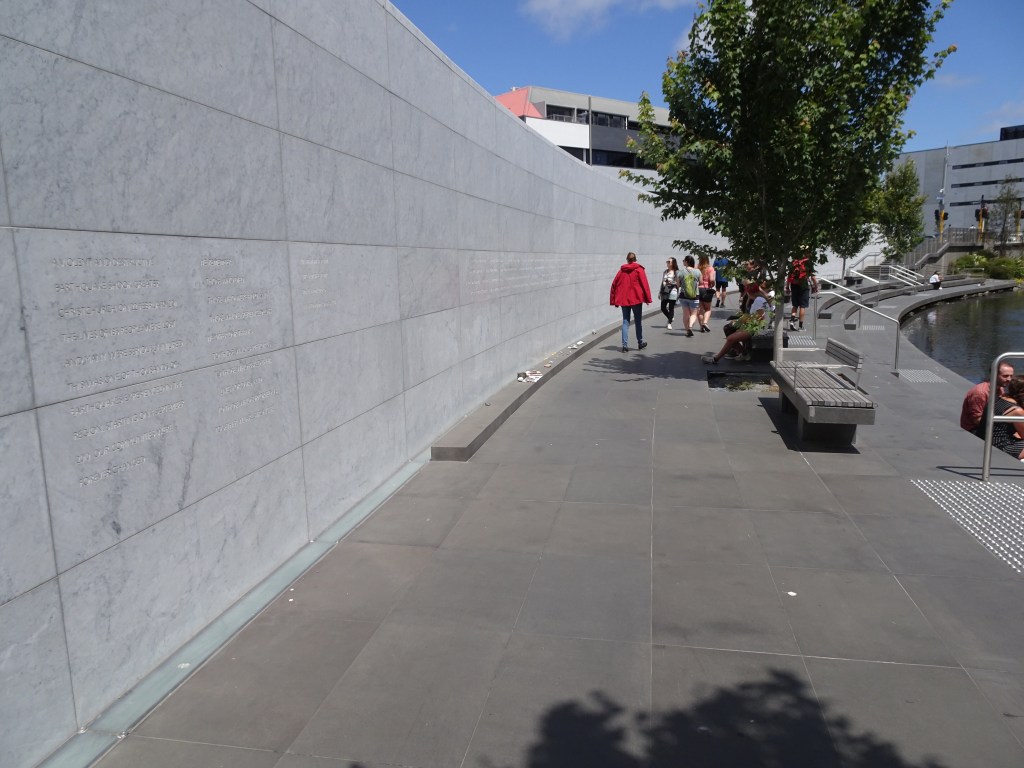
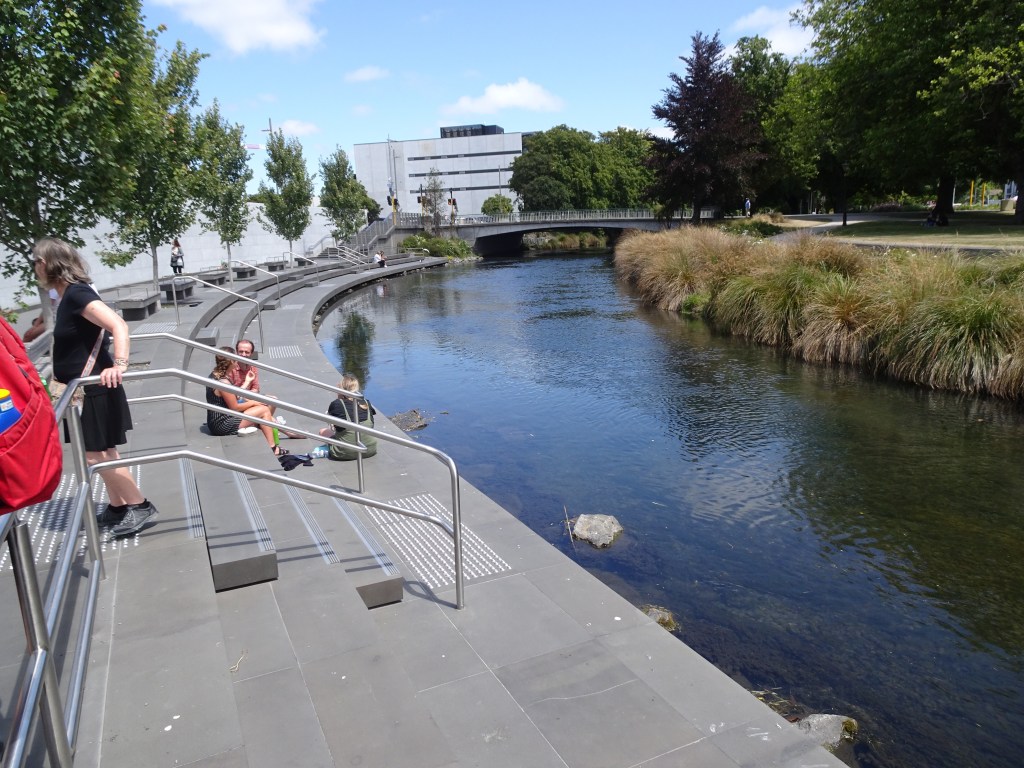
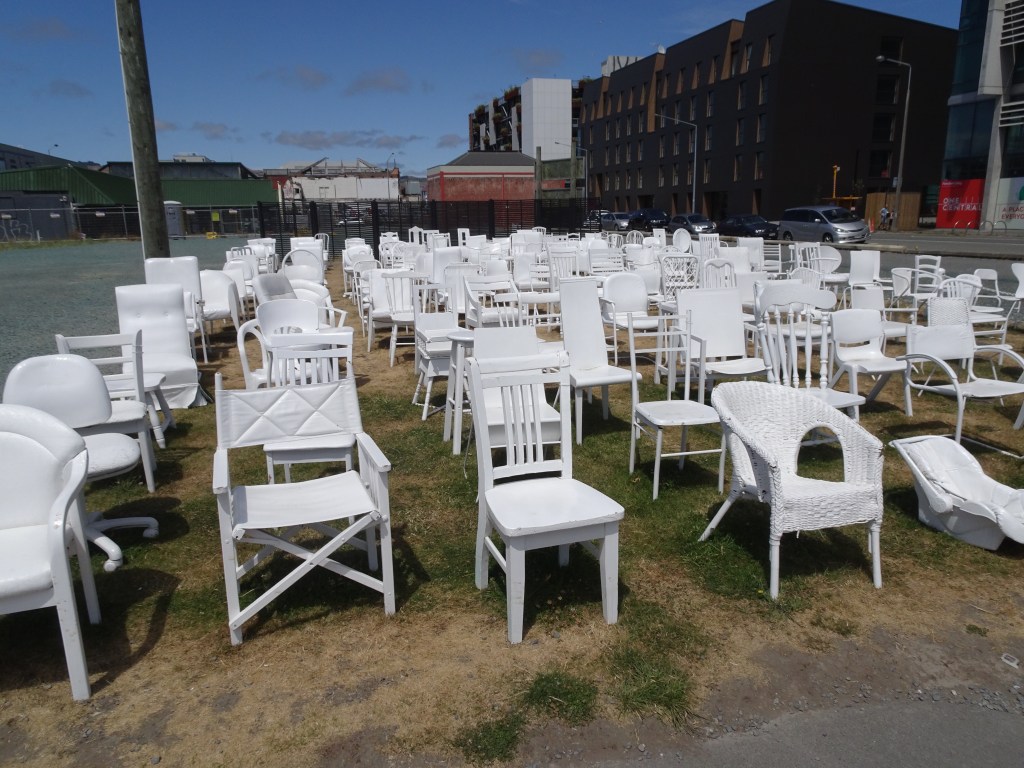
There are two memorials to the people who died in the quake. One of them is along the Avon River, which winds right through the middle of town. 115 people died when the CTV Building collapsed. A lot of the people were students studying English as a Second Language. All the people’s names (all 185) are inscribed on a wall along a walkway on the river. The river itself was widened and deepened right there to make it calmer, and seats and steps were installed so people could meet and gather. Lots of office people go there to eat lunch.
185 Empty Chairs. This is a permanent memorial. Each chair is different, to represent the different people and personalities.
A Vibrant Downtown
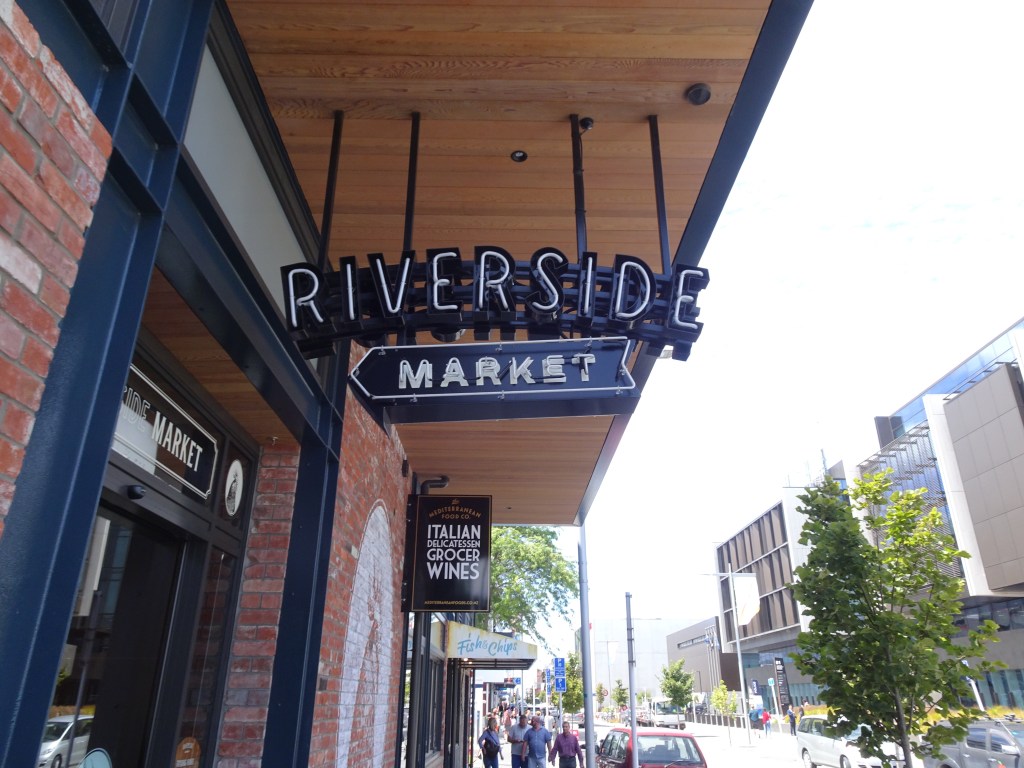
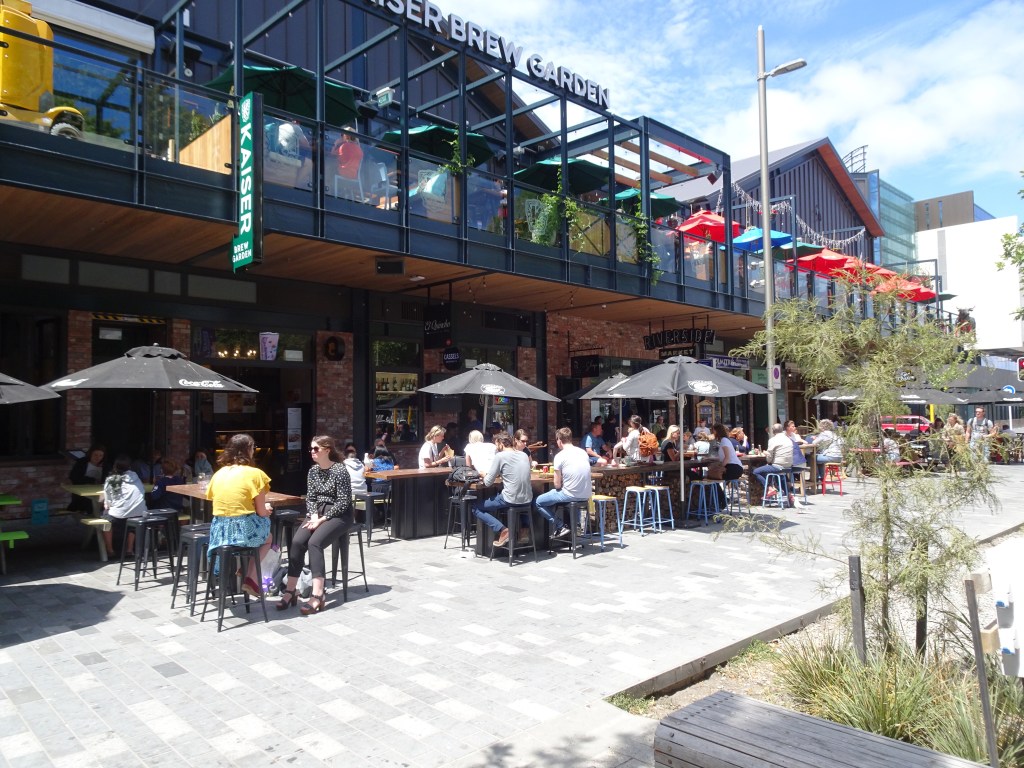
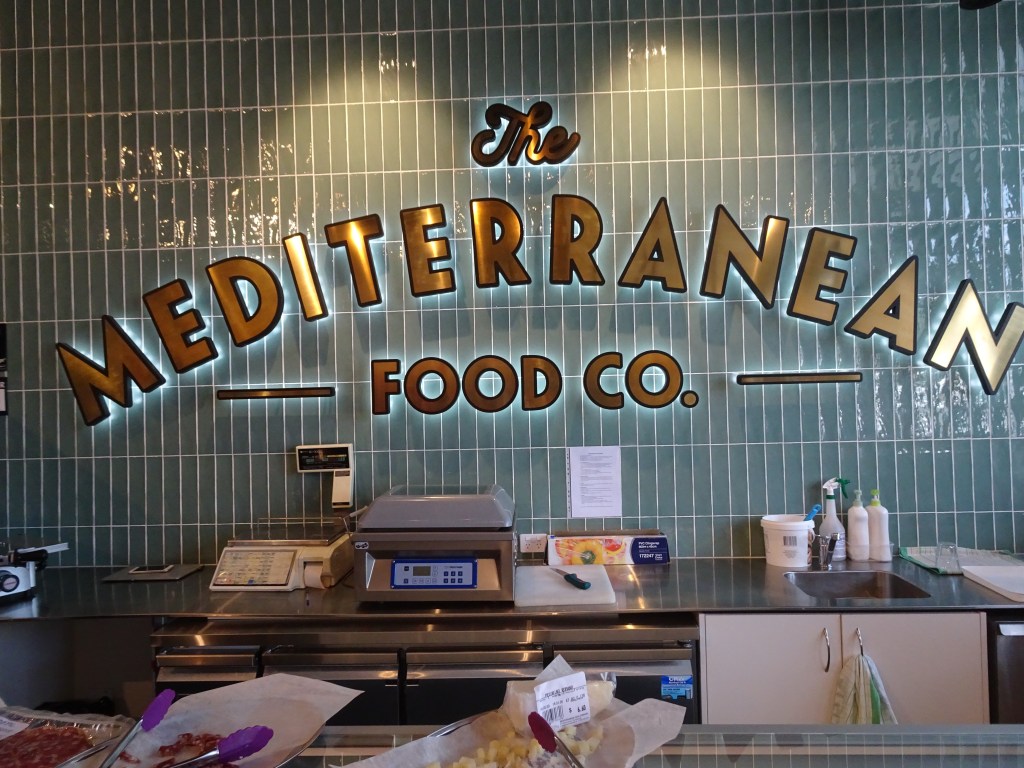
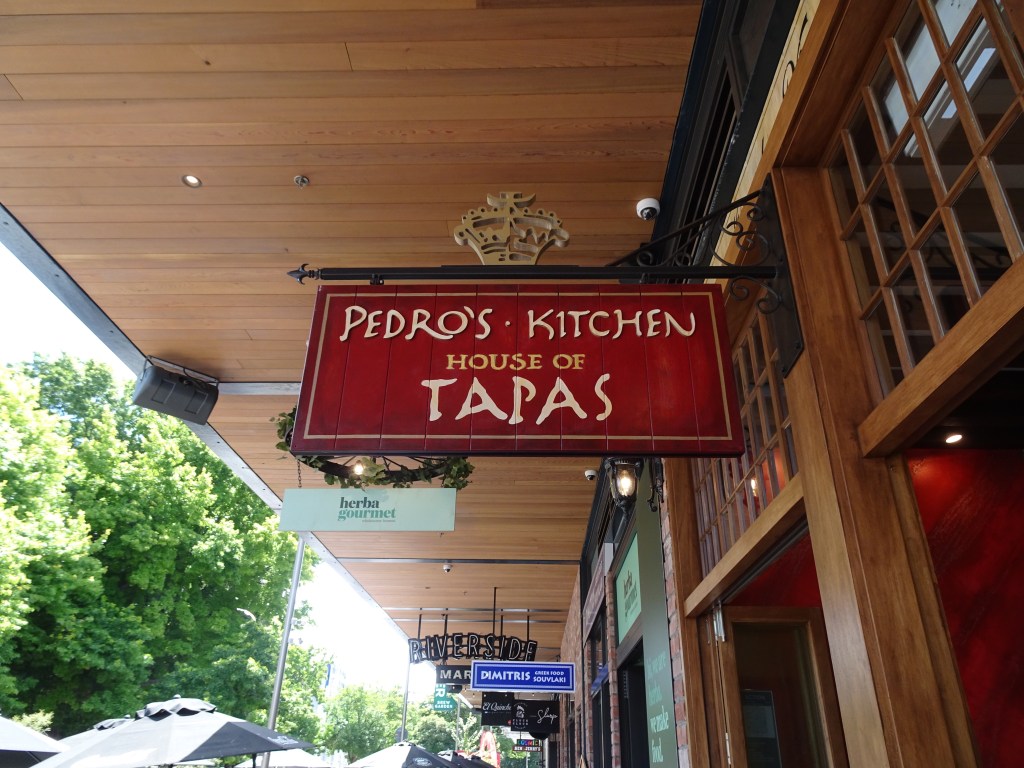
The Avon River is a sweet little river, just about knee-deep in downtown, and a lot of the new development is happening here. The Riverside Market opened just four months ago, in September 2019. Eight and a half years after the quake. It has taken a while, but this is a beautiful, sensational marketplace, full of food stands offering delicious foods and coffees and drinks, lots of places to sit, inside and outside, great views of the river, and lots of cheer and optimism.
You can choose which eggs and how many you want. $5.50 is equal to about $3.20 American dollars.
This marketplace is brand-new. It was rubble not that long ago. Christchurch now is cheerful and optimistic. Ever mindful that tragedies are an ever-present danger, and knowing that they have a long way to go to fully recover, the people here are proud of what they’ve accomplished so far. We loved our time here, and we appreciate each twist and turn just a little bit more.








 Rolling Through Kiwiland